
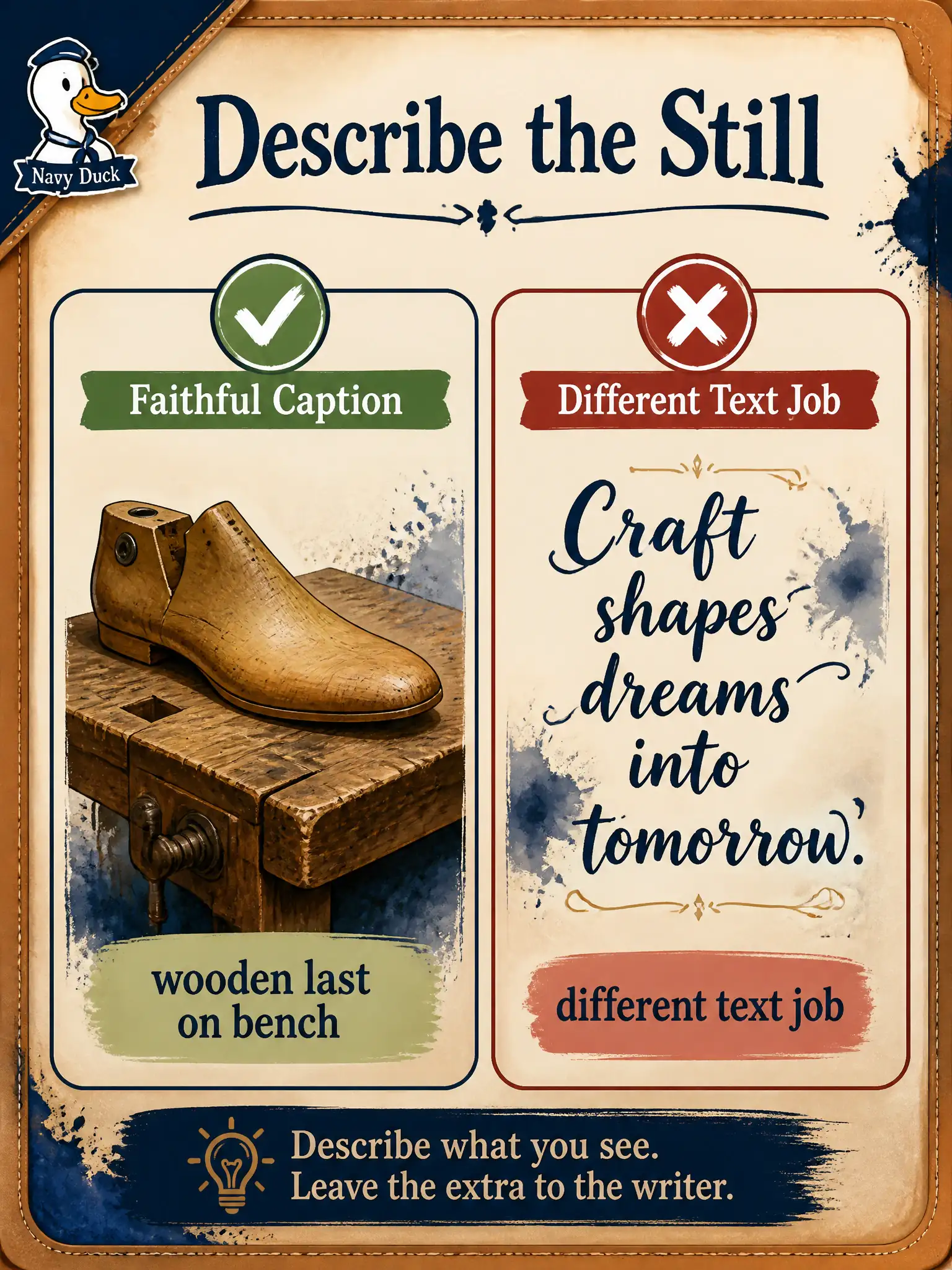
A last-maker can write what is actually on the bench or invent a poetic shop motto beside the still. Which English annotation belongs on a CLIP pair?
Select an answer to reveal the explanation.
Short Explanation
Describe the shoe on the bench, don’t paste a catchy motto that could fit any shop. CLIP wants a true caption for this picture, not a slogan contest.
Full Explanation
CLIP English annotation for a pair must faithfully describe what the still shows. Choosing a faithful English description of what is actually on the last-maker’s bench is correct because the text arm is a scene description for that image, not a decorative motto. Civic catalogs—tool crib photos, evidence stills, facility inventories—depend on captions that would let another worker recognize the same object without seeing a marketing line that could fit any shop.
An unrelated marketing motto that does not describe the attached still fails alignment. A blank caption so the image can stand alone fails because a CLIP pair requires the text arm. A CUDA occupancy note instead of natural-language caption fails by substituting systems trivia for the English description the skill path uses. Faithful captions also support accessibility and audit when civic images are reused outside the original shop floor.
Exam caveat: poetic or brand copy is not automatically a valid CLIP caption. Operational check: write or review civic captions against the pixels; reject mottos that could attach to any still without describing this one. Re-verify join keys and modality completeness on every promotion from lab shelf to civic production corpus.