
A wainwright loft is only preserving axle talk for later reading and will not speak replies. How far should the speech data plan go?
Select an answer to reveal the explanation.
Short Explanation
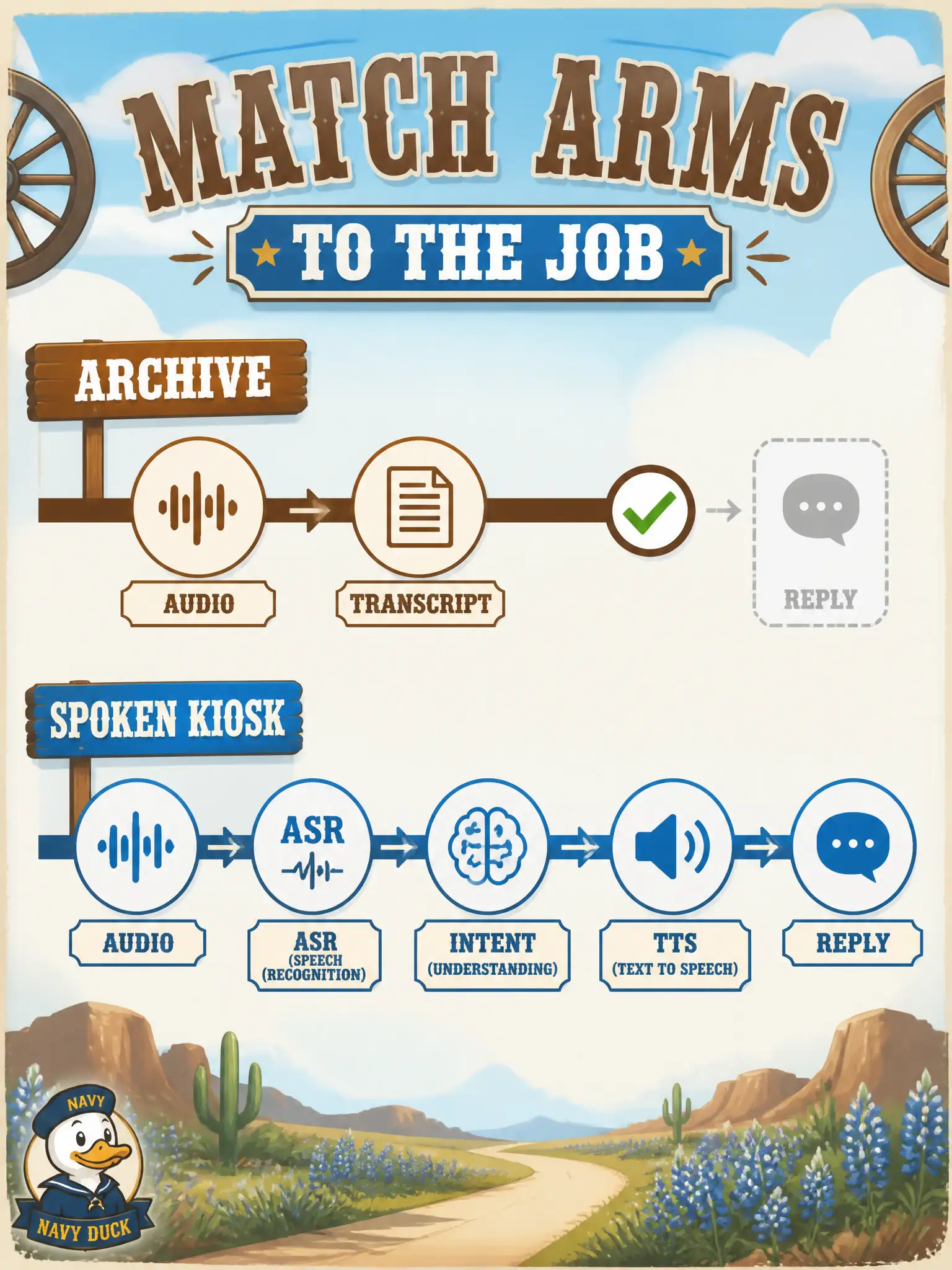
Collect only the arms the job will use. An archive that is read later needs paired audio and transcripts—not a fake reply script nobody will speak.
Full Explanation
Pipeline arms for a civic archive or public records loft should match the job the agency will actually run. Stopping at paired audio-plus-transcript—and refusing to invent a TTS reply set the loft will never speak—is correct because an archive that only preserves axle talk for later reading needs aligned speech and text for search, audit, and accessibility, not a synthetic spoken-reply arm. Collecting unused modalities wastes labeling budget and creates false confidence that a conversational stack exists when the operational path is read-only.
Always collecting full ASR, intent, and TTS arms even when no spoken reply is planned fails by over-scoping the corpus beyond the service contract. Skipping transcripts because archive jobs only need unlabeled audio fails by removing the text arm that later reading and civic search depend on. Replacing the archive with a CLIP slogan list fails by swapping modalities entirely: vision–language slogans do not preserve speech for later reading.
Exam caveat: NCA-GENM associates must size multimodal data to the deployed path, not to a maximal textbook stack. Operational check: write a modality inventory against the civic use case, collect only required paired arms, and document explicitly that unused reply/TTS collection is out of scope.