
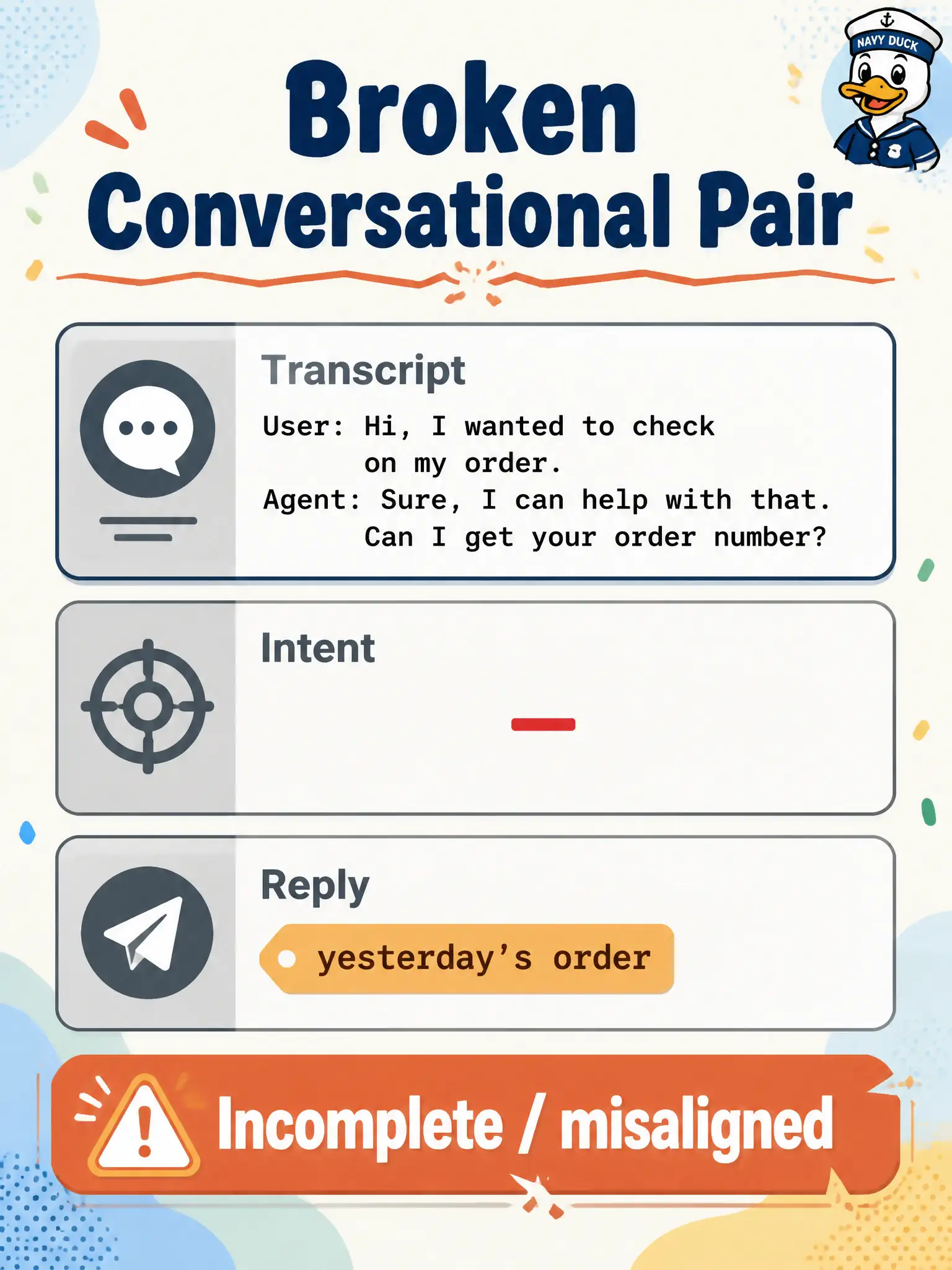
A tinsmith row has a clean transcript, a blank intent field, and a spoken reply line left over from yesterday’s order. How should that example be diagnosed?
Select an answer to reveal the explanation.
Short Explanation
A neat transcript with an empty intent and someone else’s reply is a mismatched recipe card. Fix the missing and misplaced arms before calling it a training example.
Full Explanation
A usable civic conversational example for a public counter or municipal workshop kiosk needs aligned, complete arms for the same turn: transcript, intent, and reply that belong together. Diagnosing the tinsmith row as a broken pair with incomplete and misaligned arms is correct because a clean transcript with a blank intent field and a spoken reply left over from yesterday’s order fails both completeness and alignment. Feeding that row into end-to-end training would teach the service to ignore missing intents and to answer with stale replies—exactly the failure mode residents notice when a civic assistant responds to the wrong request.
Calling it a finished conversational pair ready for end-to-end training fails by mistaking surface neatness of one arm for a complete labeled turn. Treating it as a Domain 2 late-fusion design that no longer needs intent labels fails by confusing architecture vocabulary with data hygiene; fusion type does not excuse blank intents. Claiming leftover TTS lines can replace missing intents fails conceptually: a reply generated for another order is not a substitute for the intent of this turn.
Exam caveat: associate items often hide misalignment behind one clean-looking modality; check every arm against the same example id. Operational check: before training, enforce required fields, join keys, and same-turn ownership so municipal speech services never promote incomplete rows into production corpora.