
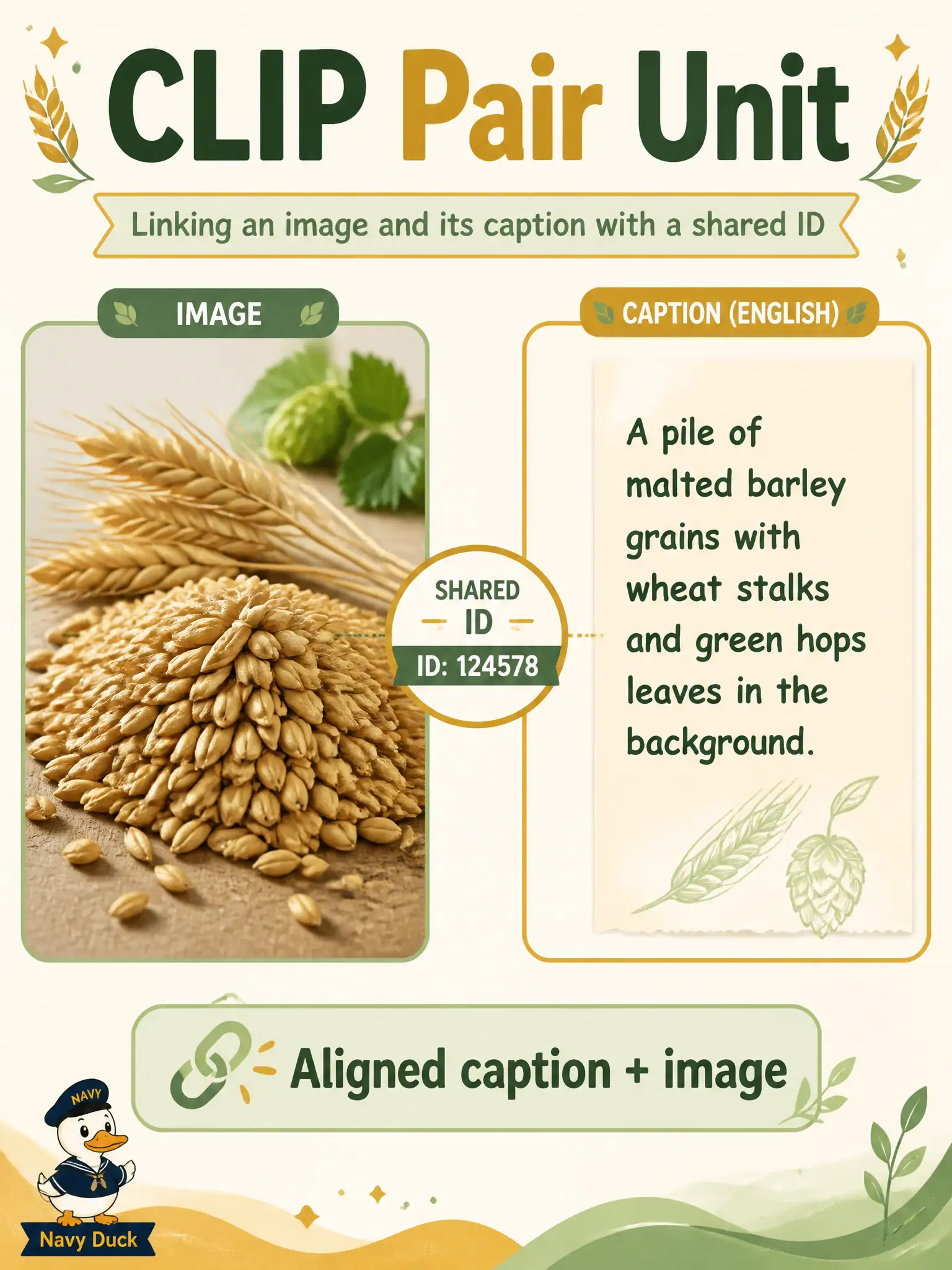
A malt-house floor snaps a floor-grain still and writes one English line that names what is in the frame. What is the CLIP data unit that describes?
Select an answer to reveal the explanation.
Short Explanation
CLIP learns from matched picture-and-sentence flash cards. One English line that truly names the grain still is that pair—the basic CLIP data unit.
Full Explanation
Official CLIP text–image work for associate multimodal data uses an aligned English caption paired with the still it describes. That unit is correct for the malt-house floor case because one English line that names what is in the grain still is exactly the paired flash-card CLIP learns from. Civic image catalogs—permit photos, shop-floor stills, public-works documentation—depend on that same caption–still join so retrieval and zero-shot labeling stay faithful to the frame residents and inspectors actually see.
An unpaired audio dump with no image and no caption fails because it supplies neither CLIP arm. A Riva pronunciation lexicon for malt-house jargon fails by concept: lexicons support speech customization, not text–image pairing. A Helm chart that deploys Riva without any text–image pairs fails by offering packaging infrastructure instead of the CLIP data unit. Public-works and workshop catalogs succeed only when that pairing unit is explicit, complete, and reviewable by a second civic reviewer who never saw the capture session.
Exam caveat: do not confuse speech assets or deploy charts with the CLIP pairing primitive. Operational check: for each civic still destined for CLIP, require one English caption that describes that frame, store them under a shared key, and reject rows missing either arm.