
A pewter bench records overlapping customers, and without turn boundaries the intent tagger cannot see where one request ends. What role do timestamps or turn segmentation play?
Select an answer to reveal the explanation.
Short Explanation
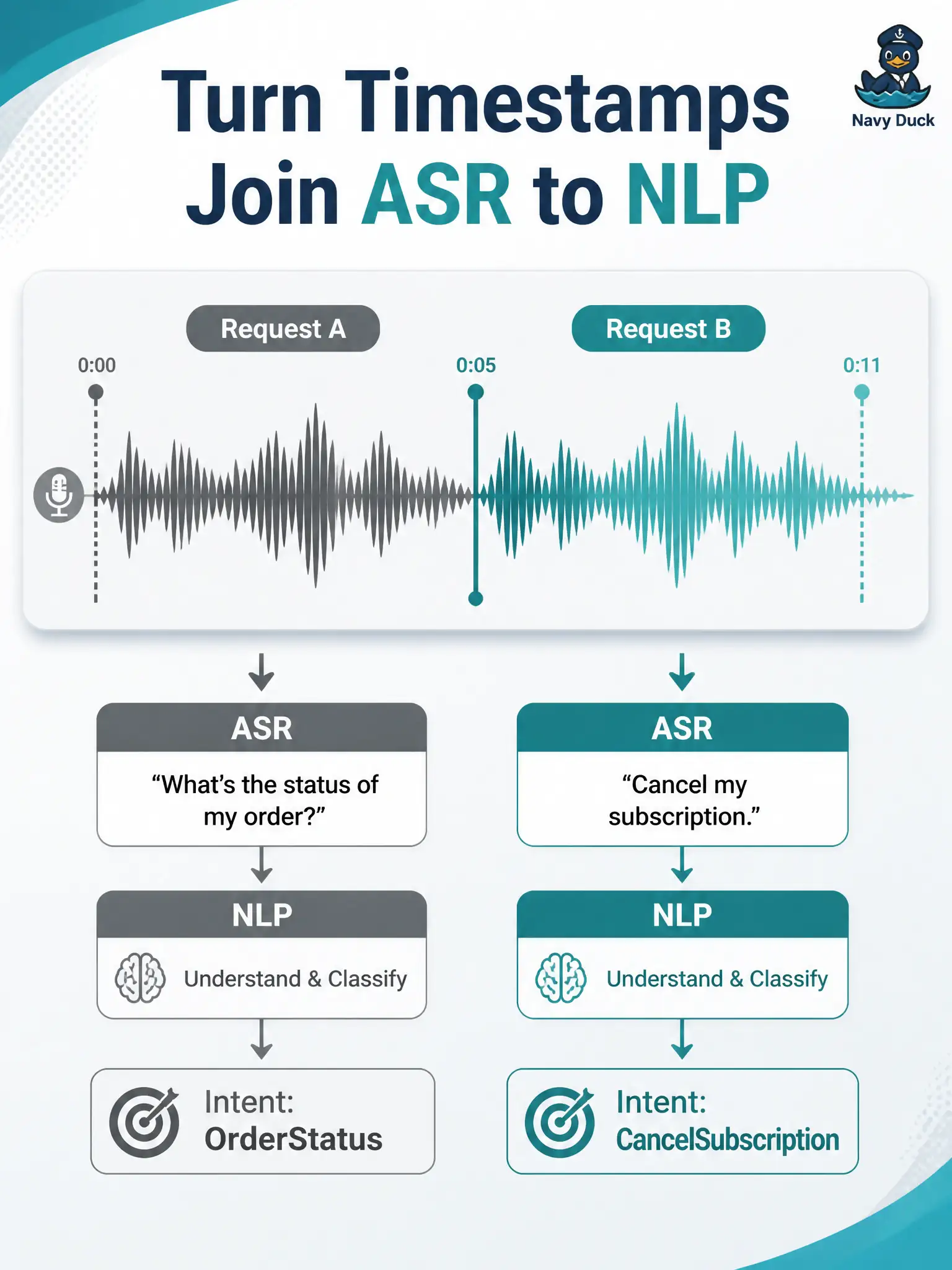
Overlapping chatter is a messy river; turn marks are the bridges. Timestamps tell NLP which words belong to which request so intent tagging can land on the right span.
Full Explanation
Timestamps or turn segmentation on a pewter bench with overlapping customers are alignment data that joins the ASR corpus to the NLP corpus for each turn so the intent tagger can see where one request ends. They are not optional cosmetics that NLP never needs when audio is continuous. They do not replace transcripts so intent can be guessed from silence alone. They are not Domain 1 guidance-scale settings for diffusion image quality. Exam caveat: turn boundaries are alignment joins between speech and NLP arms. Operational check: mark turn start/end on the overlapping civic recording, attach each segment’s transcript to its intent label, and verify the tagger receives segmented turns rather than one undifferentiated stream. Segment overlapping pewter turns with timestamps before intent tagging. Municipal operators closing q150 should file evidence that the correct concept was implemented on the civic assets named in the stem, that each rejected alternative fails for a distinct conceptual reason, and that an operational check appears in logs or dataset cards. Keeping that evidence with the run packet prevents silent drift back to distractor thinking during later maintenance. Municipal operators closing q150 should file evidence that the correct concept was implemented on the civic assets named in the stem, that each rejected alternative fails for a distinct conceptual reason, and that an operational check appears in logs or dataset cards. Keeping that evidence with the run packet prevents silent drift back to distractor thinking during later maintenance. Reference q150 in the evidence filename for traceability.