
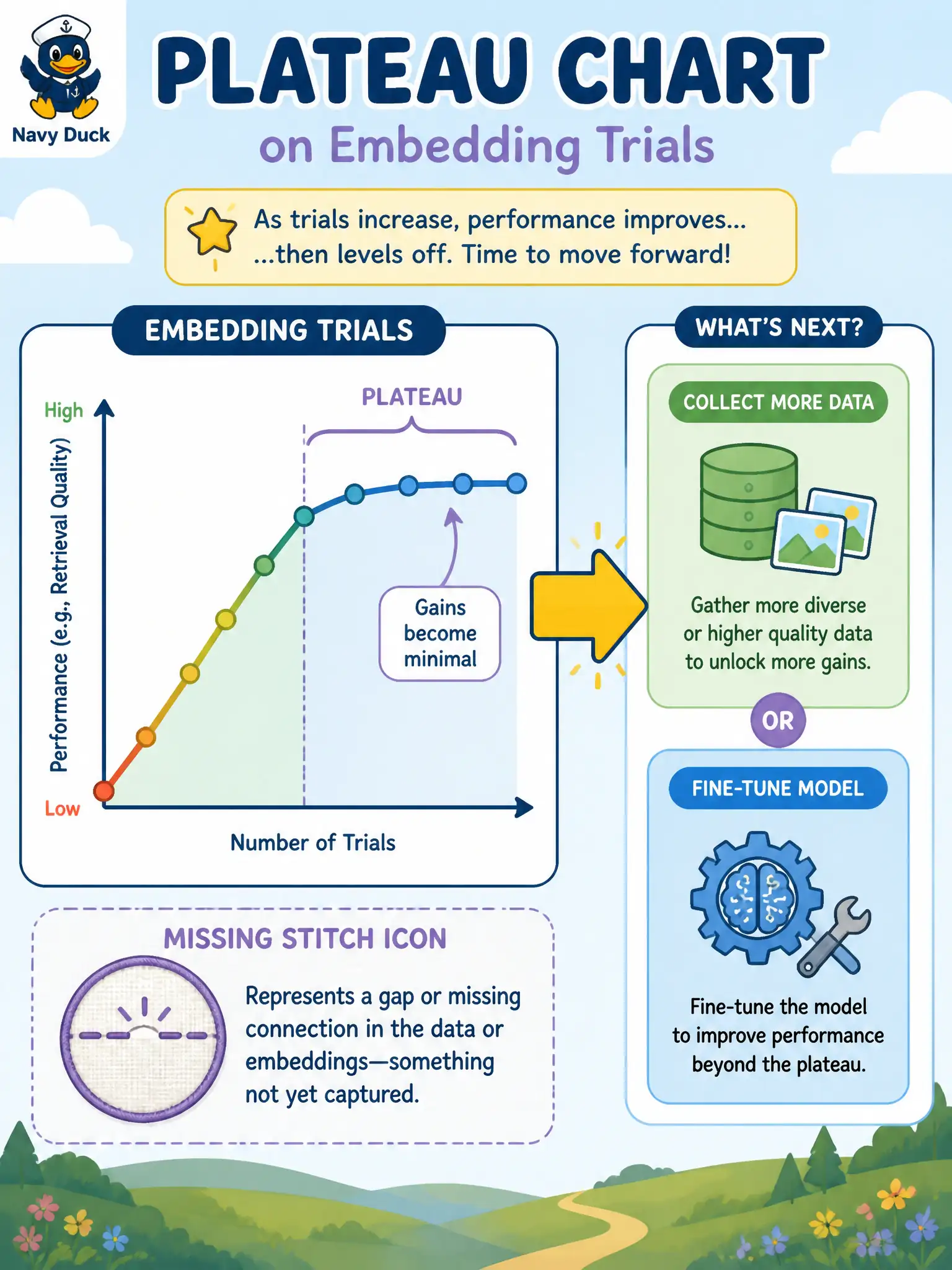
After a dozen wording trials, a lace card still cannot show a rare stitch the generator never saw. What should the associate do?
Select an answer to reveal the explanation.
Short Explanation
If the compass never points to a stitch the map never contained, stop spinning the compass. Bring new examples or teach the generator—embedding tweaks have plateaued.
Full Explanation
After a dozen wording trials, when a lace card still cannot show a rare stitch the generator never saw, the associate should end the embedding loop and move to a data or fine-tune experiment on the generator. Civic lace archives cannot invent stitches that were never in training by spinning the compass forever; public pattern documentation needs new examples or weight updates once embeddings plateau. Knowing when to stop prompt iteration protects volunteer time and municipal compute from empty cycles.
Keeping rewriting embeddings forever and never touching data or weights fails by denying the plateau and the missing-concept problem in the generator’s experience. Replacing the image task with InfiniBand congestion control fails by escaping into networking unrelated to rare stitches. Concluding that CLIP forbids any further training forever fails by misreading CLIP conditioning as a permanent ban on data collection or fine-tune work.
Exam caveat: when embeddings plateau on unseen visual concepts, escalate to data collection or generator fine-tune—not endless rewrites. Operational check: document the dozen failed wording trials and the missing stitch, gather rare-stitch examples or schedule a fine-tune, verify the concept appears in new renders, and only then reopen embedding iteration for polish.