
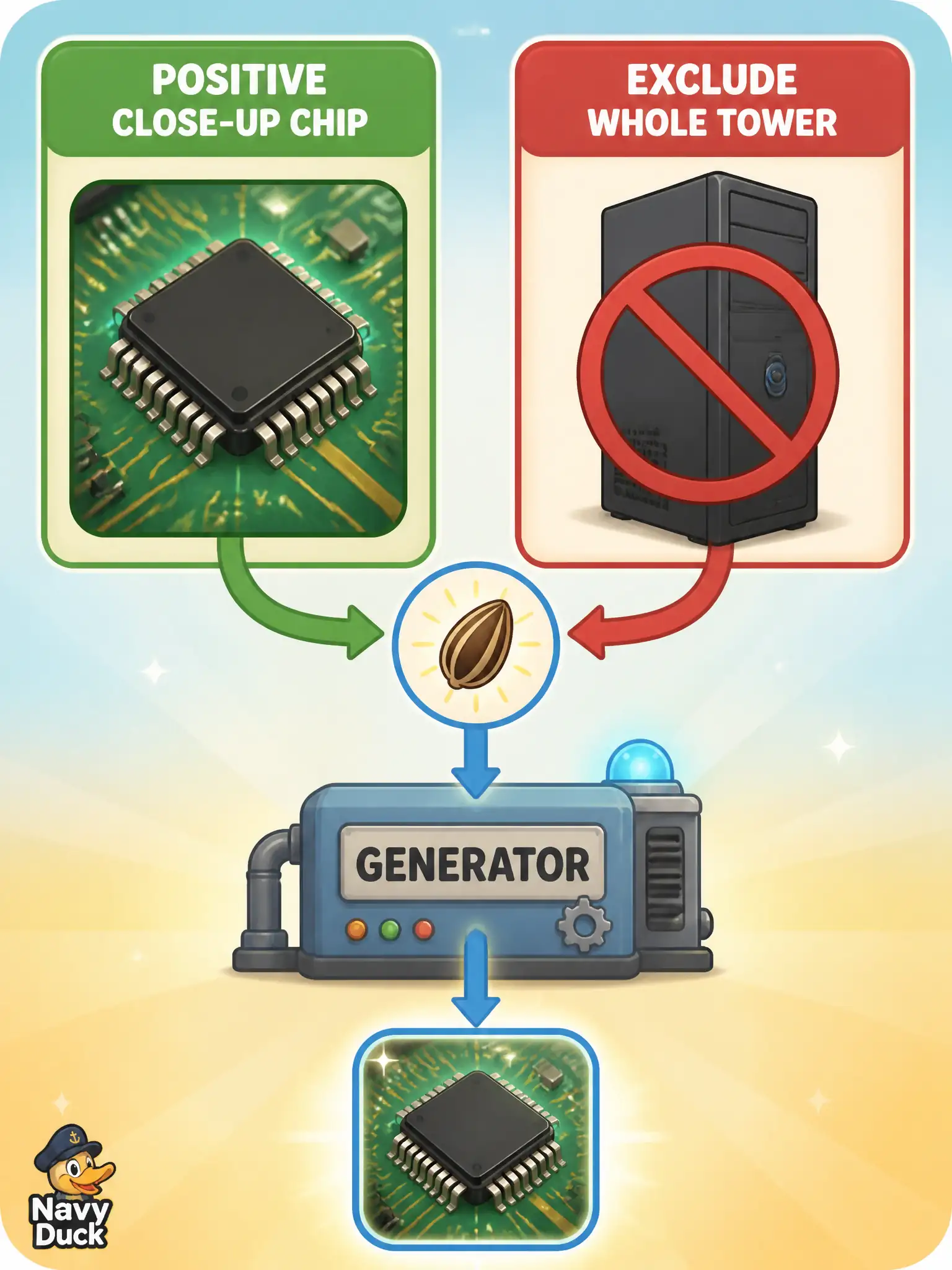
A wind-farm render keeps adding a whole tower behind a close-up chip. Staff compare adding a second context that rules the tower out versus only rewriting the positive line. What is being tested?
Select an answer to reveal the explanation.
Short Explanation
Sometimes you say what you want; sometimes you also say what to leave out. Comparing those two context levers on one seed is the embedding experiment—not networking or Helm trivia.
Full Explanation
A wind-farm render that keeps adding a whole tower behind a close-up chip, where staff compare adding a second context that rules the tower out versus only rewriting the positive line, is testing whether exclusion or negative context is an experimental embedding lever alongside positive rewrites—on the same seed. Civic inspection imagery for public safety needs both “what to show” and “what to exclude” as controllable language levers. Fair comparison on one seed keeps the embedding experiment readable for taxpayers.
Asking whether NCCL can exclude GPUs from the job fails by mistaking content exclusion for collective-network device exclusion. Asking whether Helm must delete the GPU request fails by treating packaging GPU requests as the way to remove towers from images. Asking whether OCR on PDFs can remove towers from photos fails by substituting document OCR for generative context control.
Exam caveat: negative/exclusion context is a valid embedding lever beside positive rewrites; compare them on a shared seed. Operational check: freeze seed and generator, A/B positive-only rewrite versus positive-plus-exclusion context, score presence of the chip and absence of the whole tower, and keep the lever that meets the inspection brief.