
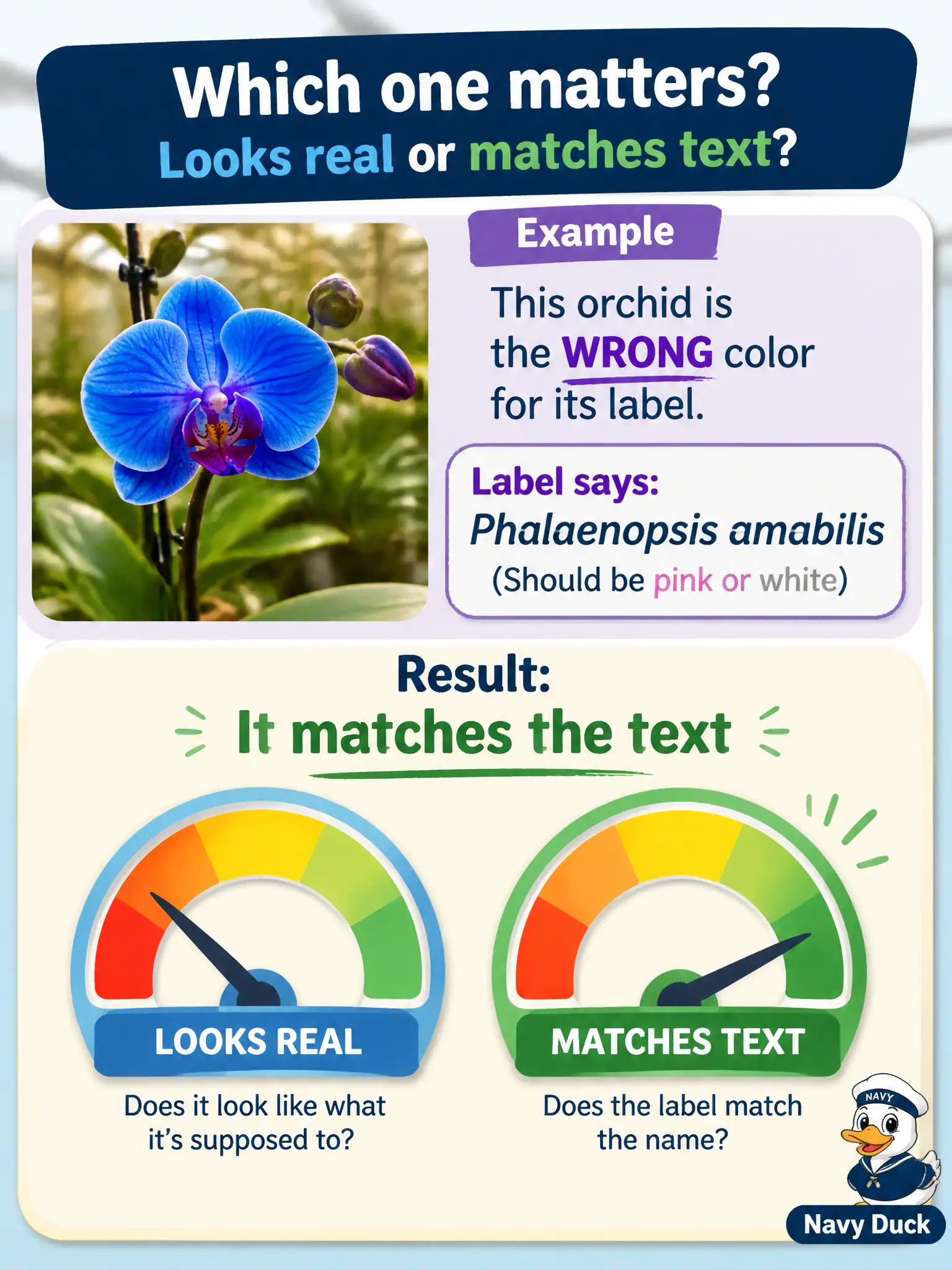
A generated orchid card looks crisp but shows the wrong species color next to the Latin line. How should the associate choose a quality measure for the claim “matches the sentence”?
Select an answer to reveal the explanation.
Short Explanation
A sharp photo of the wrong flower still fails the caption quiz. Measure whether the picture agrees with the sentence—or keep “looks real” and “matches text” as two different questions.
Full Explanation
A generated orchid card that looks crisp but shows the wrong species color next to the Latin line should use an image–text agreement measure—or report realism and agreement as separate questions—for the claim “matches the sentence.” Civic botanical education materials fail the public when sharp wrong flowers pass a realism-only score. Associate quality practice separates “looks real” from “matches text” so taxpayers get cards that teach the right species.
Using only a “looks like a real photo” score and ignoring text agreement fails by celebrating realism while missing caption mismatch. Treating any third-party metric acronym list as required NVIDIA canon fails by cargo-culting metric names instead of choosing measures that fit the claim. Scoring only GPU temperature as a proxy for caption match fails by substituting thermal telemetry for semantic agreement.
Exam caveat: “matches the sentence” needs image–text agreement (or explicitly separate realism vs agreement); realism alone is insufficient. Operational check: pair each render with its Latin line, score agreement with a checklist or image–text metric, optionally score realism separately, and reject cards that fail agreement even if they look photographic.