
A smokehouse wants tomorrow’s product cards to look like this smokehouse, not a generic shed. Which three image+text experiment levers should the associate compare?
Select an answer to reveal the explanation.
Short Explanation
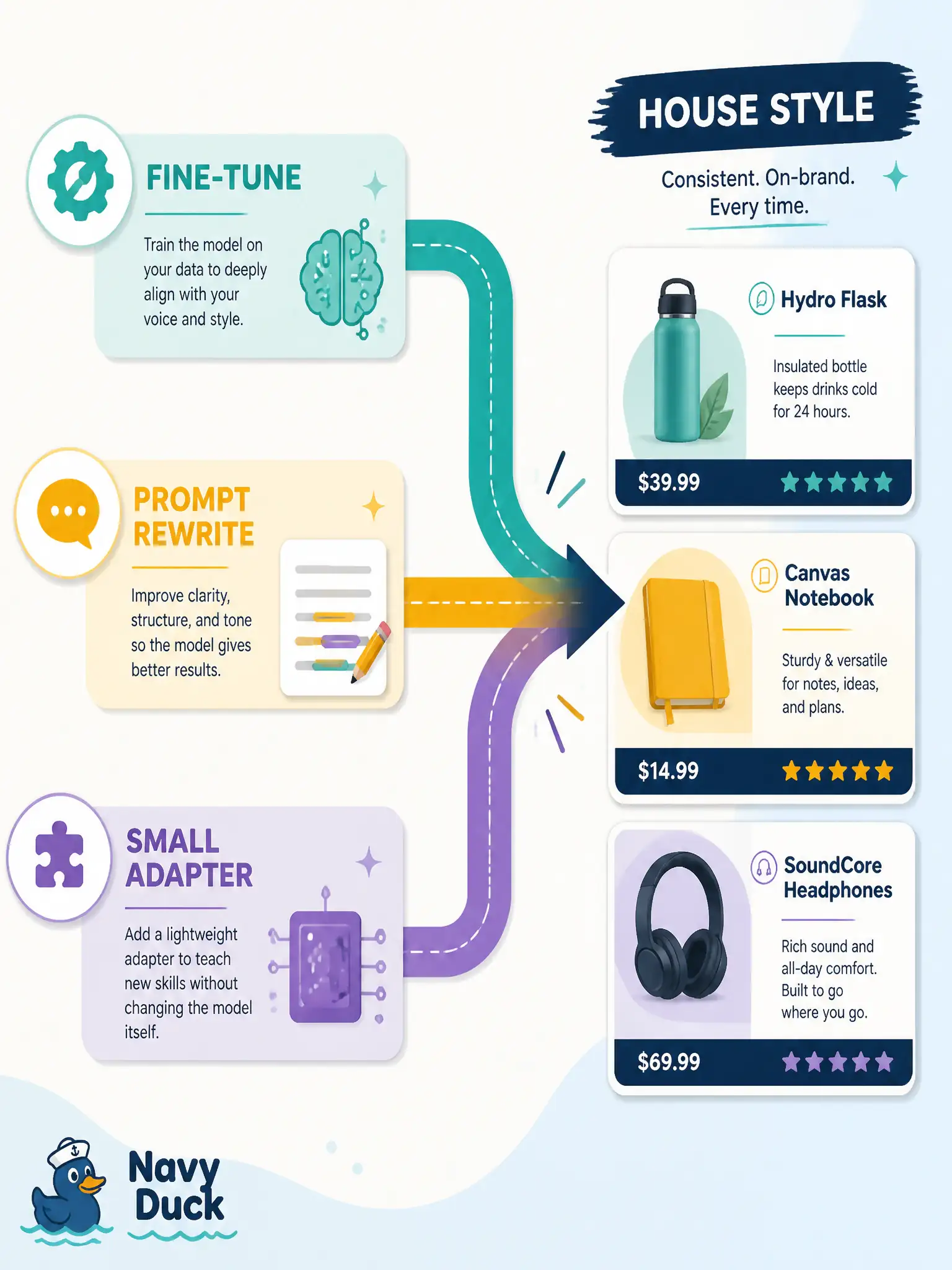
Three ways to teach “our smokehouse look”: retrain the whole oven, rewrite the recipe card, or clip on a small adapter. Compare those image+text levers—not LLM agent catalogs or rack networking.
Full Explanation
A smokehouse that wants tomorrow’s product cards to look like this smokehouse, not a generic shed, should compare three image+text experiment levers: full fine-tune of the generator on house photos, rewrite the sentence only, or attach a small adapter—and compare renders. Civic food brands and municipal market stalls need graded ways to teach house look without pretending agent catalogs or rack networking are the levers. Comparing those three keeps public creative ops inside associate multimodal generation practice.
Only LangChain tool routing with no image generator involved fails by abandoning image generation for a GENL-style agent framing. Only cluster job-scheduler priority classes fails by substituting batch priority for visual style learning. Only swapping Ethernet for InfiniBand on the training rack fails by treating networking as the path to house style.
Exam caveat: house-style image+text experiments compare fine-tune, prompt rewrite, and small adapters—not LangChain-only routing or fabric swaps. Operational check: hold evaluation prompts fixed where appropriate, run the three levers on house photos, score “looks like our smokehouse” with a fixed panel, and pick the cheapest lever that meets the civic brand bar.