
A paper-mill watermark intern is told the image generator starts from a random field and removes noise in steps until a mark appears. How should the candidate restate that process?
Select an answer to reveal the explanation.
Short Explanation
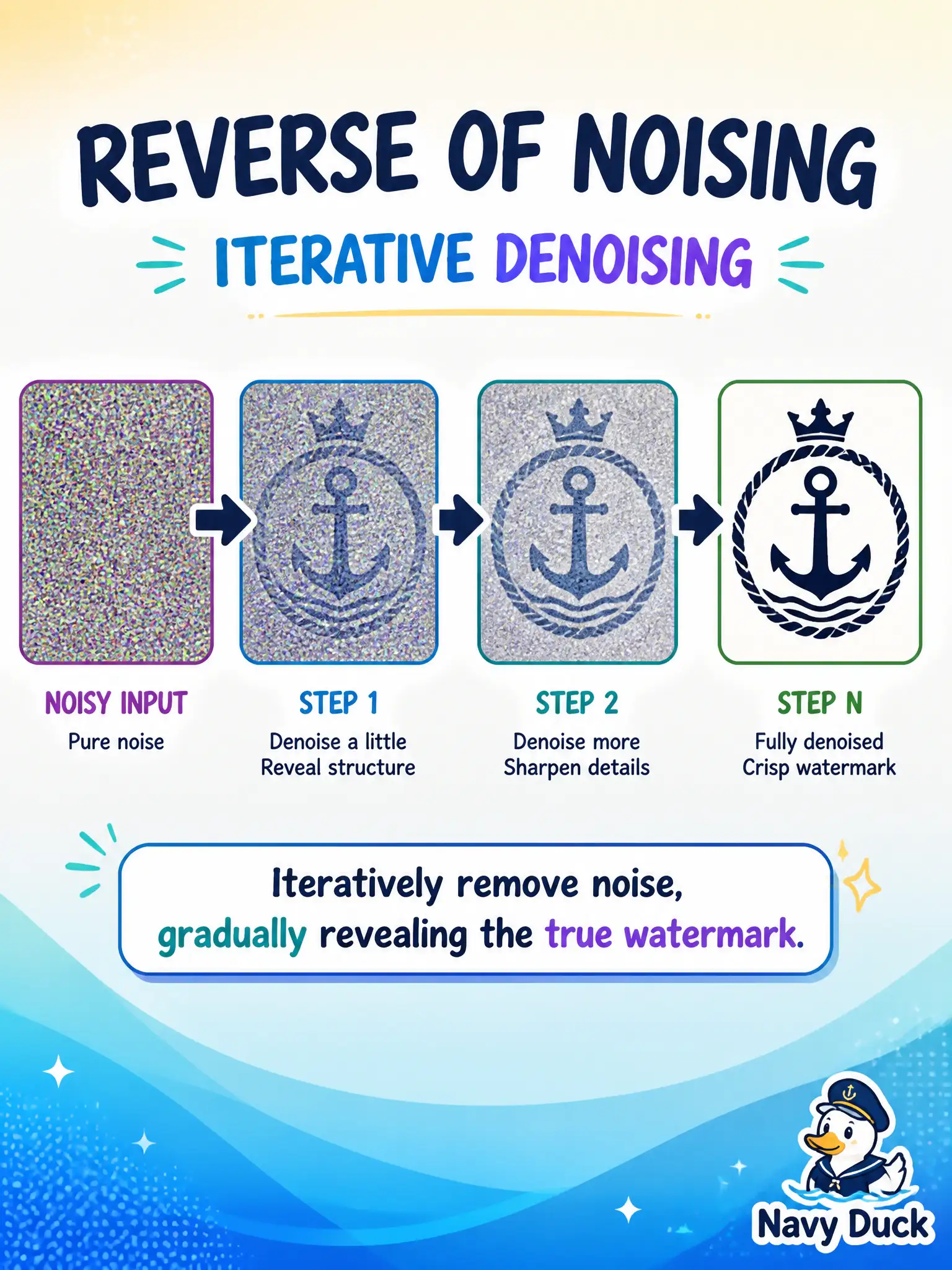
Picture starting with TV static and wiping the snow away until a clear watermark shows. That is denoising diffusion—the reverse of gradually adding noise—not copying a file or running speech recognition.
Full Explanation
A paper-mill watermark intern told that the image generator starts from a random field and removes noise in steps until a mark appears should restate that process as the reverse of a noising process: iterative denoising that yields an image. Civic heritage labs documenting watermarks need that correct mental model so public quality trials evaluate generative denoising rather than file copying or speech pipelines. Accurate restatement keeps mill experiments aligned with denoising diffusion concepts on the associate path.
Restating it as copying a watermark file byte-for-byte from the mill archive fails by describing retrieval/copy instead of generative denoising. Restating it as a speech ASR pipeline that transcribes mill floor noise fails by swapping modalities into recognition. Restating it as late fusion of two classifiers that never generate pixels fails by describing decision fusion without image generation.
Exam caveat: denoising diffusion is iterative denoising from noise to image—the reverse of a noising process—not copy, ASR, or classifier fusion. Operational check: in the trial write-up, require the team to state “generate-from-noise via iterative denoising,” ban copy-from-archive language, and evaluate output images—not transcripts or fused class scores—as the generation artifact.