
A town help-desk Helm chart lists a GPU for the NVIDIA Riva speech containers. A volunteer offers to write a custom CUDA kernel “so Kubernetes can see the device.” What should the associate keep in scope for this conversational experiment deploy?
Select an answer to reveal the explanation.
Short Explanation
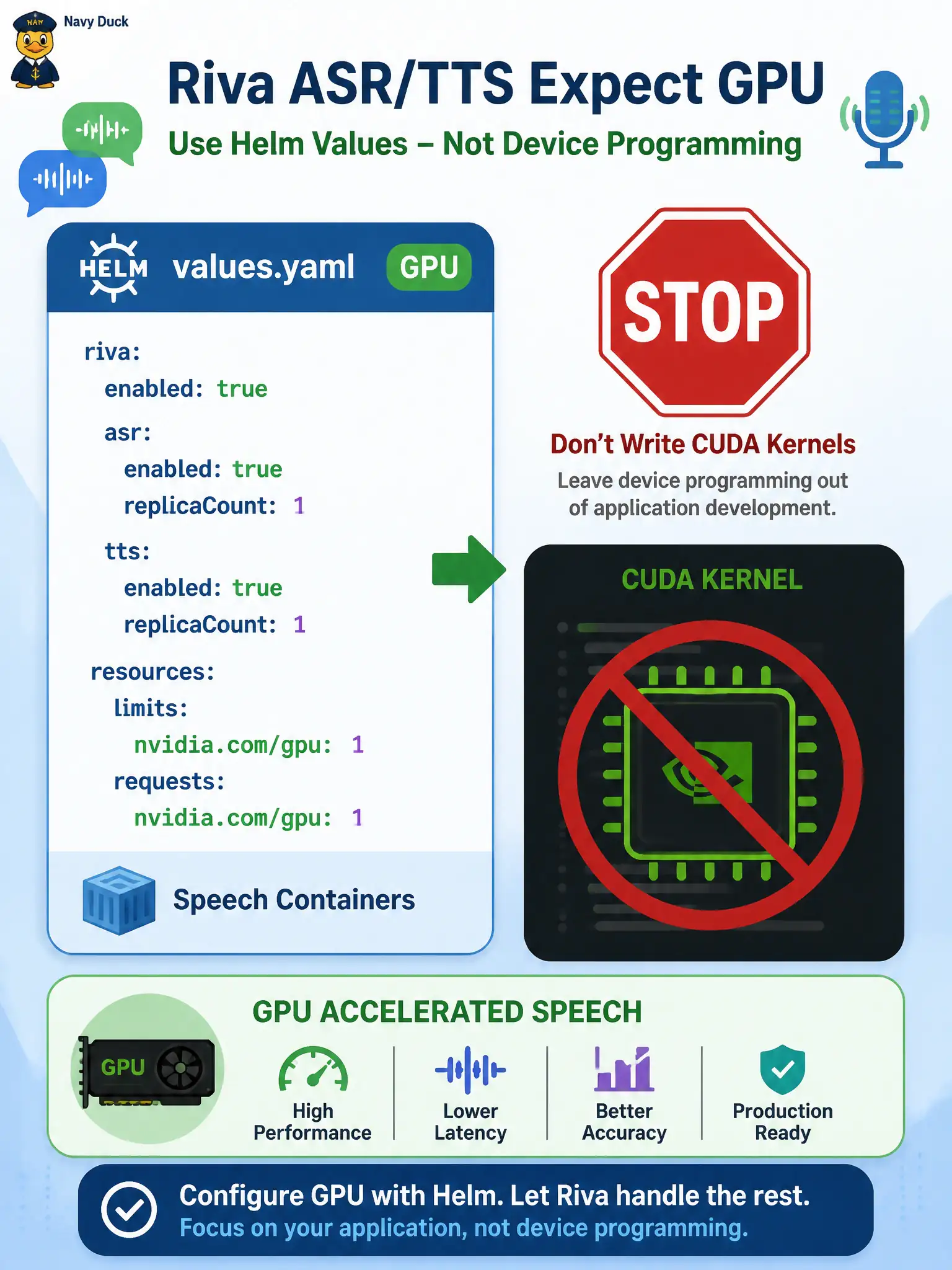
Think of the chart as a shipping label that already says “needs a GPU.” The associate’s job is to honor that label for Riva, not to carve a custom CUDA kernel or redesign the cluster fabric. Keep awareness at “speech needs a GPU” and move on.
Full Explanation
A town help-desk Helm chart that lists a GPU for NVIDIA Riva speech containers should confirm the speech services expect a GPU in the chart values and leave device programming out of the experiment when a volunteer offers a custom CUDA kernel “so Kubernetes can see the device.” Civic help desks need associate awareness that Riva speech expects GPU-backed packaging, not candidate-authored kernels or fabric redesigns. Honoring the chart’s GPU label keeps public deploy work inside scope.
Authoring a device kernel and rewriting the Kubernetes device plugin from scratch fails by escalating into platform engineering the conversational experiment does not require. Replacing Riva with a text-only LLM so the chart no longer needs a GPU fails by abandoning speech services to dodge GPU assignment. Treating GPU assignment as a cluster-fabric design problem and re-planning NCCL topology fails by importing collective-network work from other exam families.
Exam caveat: associate deploy scope is “speech needs a GPU in chart values,” not custom CUDA or NCCL topology for device visibility. Operational check: verify the Helm values request a GPU for Riva containers, confirm pods schedule on GPU nodes, and reject kernel/device-plugin rewrite tasks as out of scope for this conversational deploy experiment.