
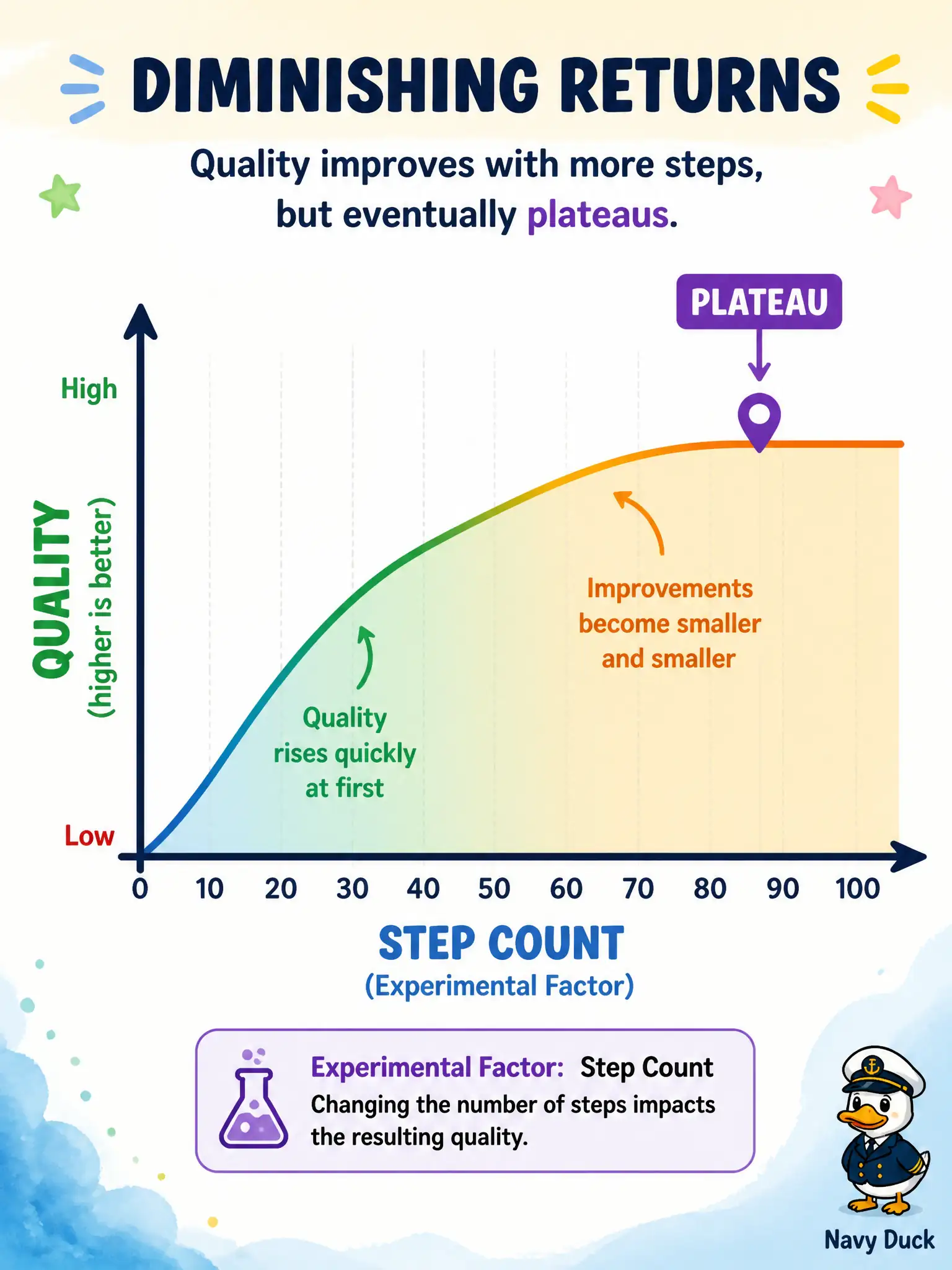
A dye-garden desk renders the same pigment card at several denoising-step counts. Smear fades, then further steps barely change the card. What should the quality experiment conclude about step count?
Select an answer to reveal the explanation.
Short Explanation
Like turning up an oven: past a point the cake does not get better, it just costs more time. Watch for the plateau in visual quality instead of assuming endless steps always help.
Full Explanation
A dye-garden desk that renders the same pigment card at several denoising-step counts and sees smear fade then plateau should treat step count as the factor and look for a quality plateau rather than assuming more is always better. Civic pigment catalogs should spend public compute where quality still moves; endless steps past the plateau waste time and energy without better cards for conservators, educators, and gardeners who rely on accurate swatches.
Always doubling steps forever because more denoising is strictly better fails by ignoring diminishing returns already visible in the plateau. Replacing step count with CUDA kernel occupancy as the only metric fails by substituting hardware occupancy for image quality of the pigment card. Stopping diffusion to switch the trial to RAPIDS tabular joins fails by abandoning the image generation experiment for out-of-scope dataframe work.
Exam caveat: denoising-step count is an experimental factor with possible quality plateaus—not a “more is always better” dial and not a kernel-occupancy proxy. Operational check: hold prompt and seed fixed, sweep step counts, plot a civic quality checklist or agreement score against steps, and pick the smallest step count at the plateau before production rendering.