
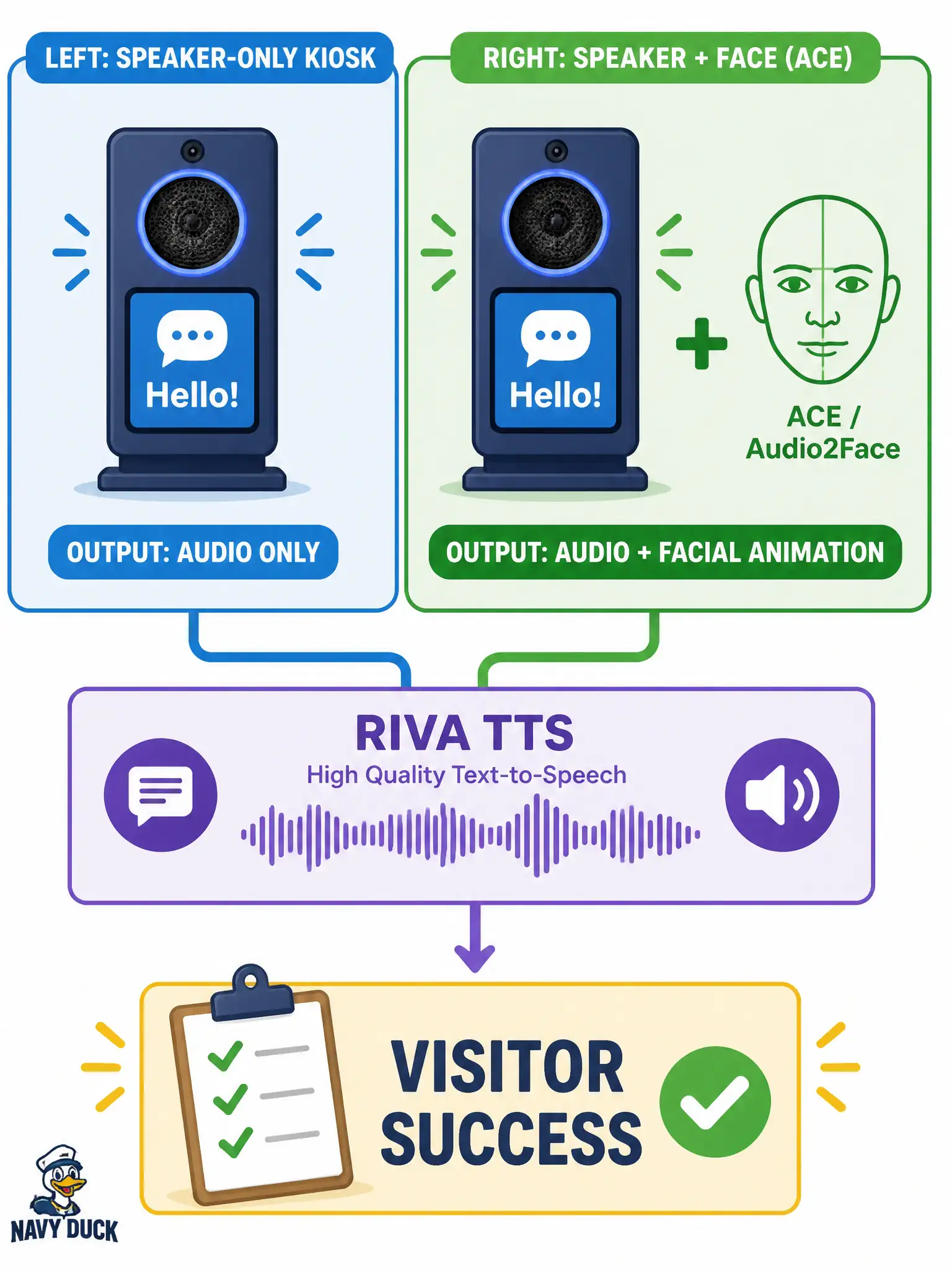
A marionette box office already speaks through a speaker. Leadership asks whether adding an ACE face driven by Audio2Face on the same Riva TTS would change visitor success. How should that request be framed?
Select an answer to reveal the explanation.
Short Explanation
Same voice, with or without a face—that is a visitor-outcome comparison, not a microservice rewrite. Pick the tools and measure success. Keep Riva TTS as the shared speech half.
Full Explanation
A marionette box office that already speaks through a speaker, when leadership asks whether adding an ACE face driven by Audio2Face on the same Riva TTS would change visitor success, should frame the request as a tool-selection and outcome-comparison experiment: voice-only booth versus ACE/Audio2Face face on the same TTS. Civic venues can measure whether a face improves visitor outcomes without rewriting ACE microservices or discarding working speech. Shared TTS keeps the comparison fair for public demo decisions.
Mandating a rewrite of ACE microservices and custom CUDA face shaders this sprint fails by turning tool selection into an implementation and kernel project. Treating the ask as an NCA-AIIO cooling and power study before any face can be shown fails by importing infrastructure exam scope. Claiming Riva TTS must be deleted before any talking-face trial fails by discarding the shared speech half that makes the comparison valid.
Exam caveat: ACE/Audio2Face is an optional face layer on existing Riva speech; compare visitor outcomes, do not re-architect power or delete TTS. Operational check: hold the TTS voice and script fixed, A/B voice-only versus face-on-same-TTS with a visitor success metric, and decide from measured outcomes.