
A harbor-museum team updates the recognizer vocabulary, the reply templates, and the TTS voice in one weekend and cannot tell what helped. How should the next sprint be redesigned?
Select an answer to reveal the explanation.
Short Explanation
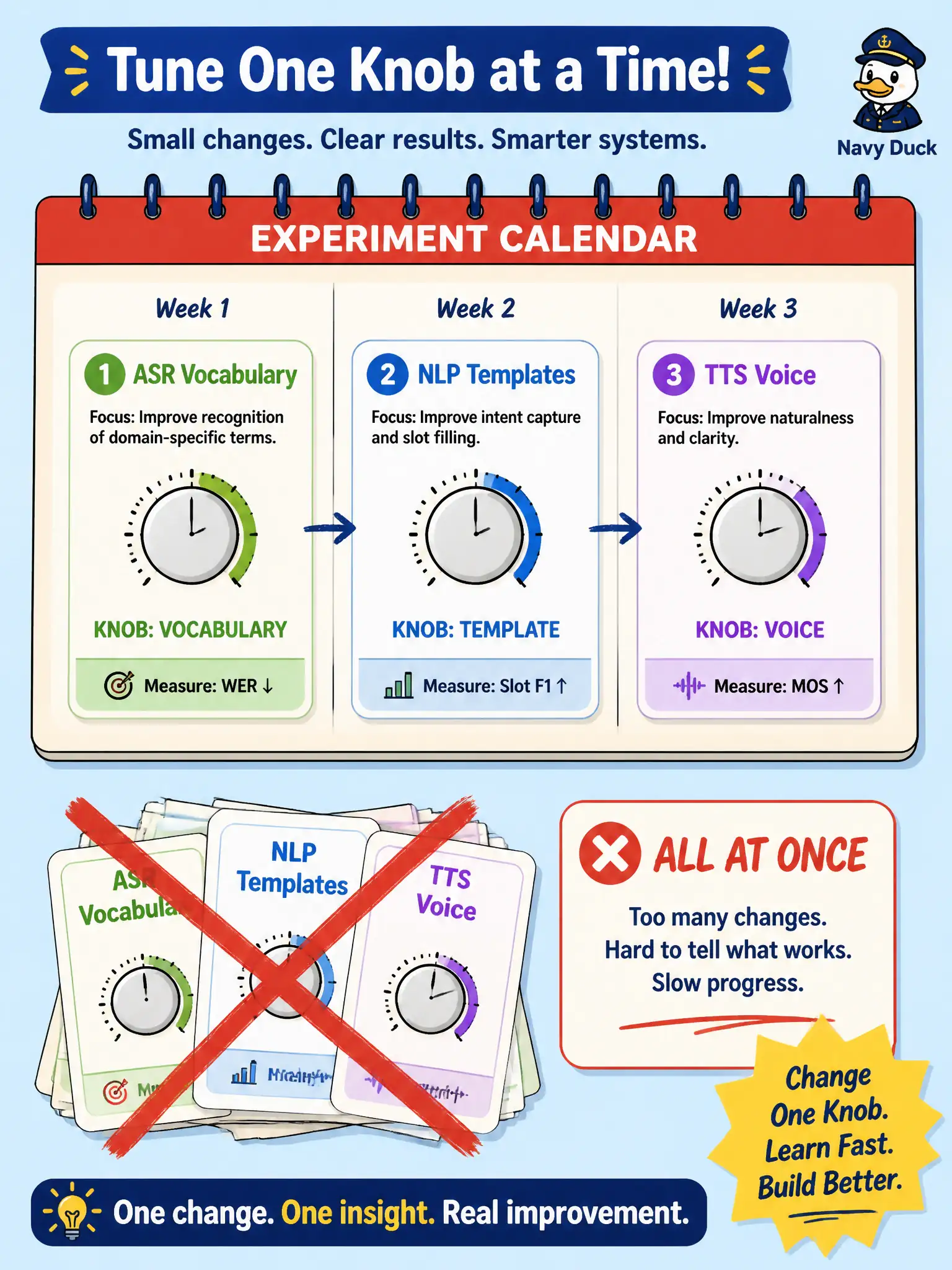
Changing ear, brain, and mouth together is a weekend blur—you cannot credit any one fix. Split the sprint into three sequential single-factor runs. One stage at a time, same evaluation set.
Full Explanation
A harbor-museum team that updated recognizer vocabulary, reply templates, and TTS voice in one weekend and cannot tell what helped should run three sequential single-factor experiments—vocabulary, then templates, then voice. Civic museum kiosks owe the public interpretable change control; weekend triple edits make attribution impossible and waste volunteer evaluation time when visitors later report regressions. Sequencing restores experimental hygiene across the full ASR–NLP–TTS pipeline so each civic improvement can be kept or rolled back with evidence.
Repeating the triple change every weekend until word error randomly improves fails by embracing uninterpretable thrashing as a method. Dropping speech metrics to track only Kubernetes pod readiness fails by substituting packaging health for conversational quality visitors actually hear. Merging the three stages into one undocumented black-box so fewer variables appear fails by hiding stages instead of controlling them.
Exam caveat: single-factor control applies across the whole conversational pipeline, not only inside one stage. Operational check: revert to the last known-good config, change vocabulary alone on a frozen eval set, then templates alone, then voice alone, and keep only the changes that improve the agreed speech metrics.