
A tide-mill kiosk keeps Riva ASR and TTS frozen and tries two different pretrained language heads on the same recognized lines. Why is that the right control?
Select an answer to reveal the explanation.
Short Explanation
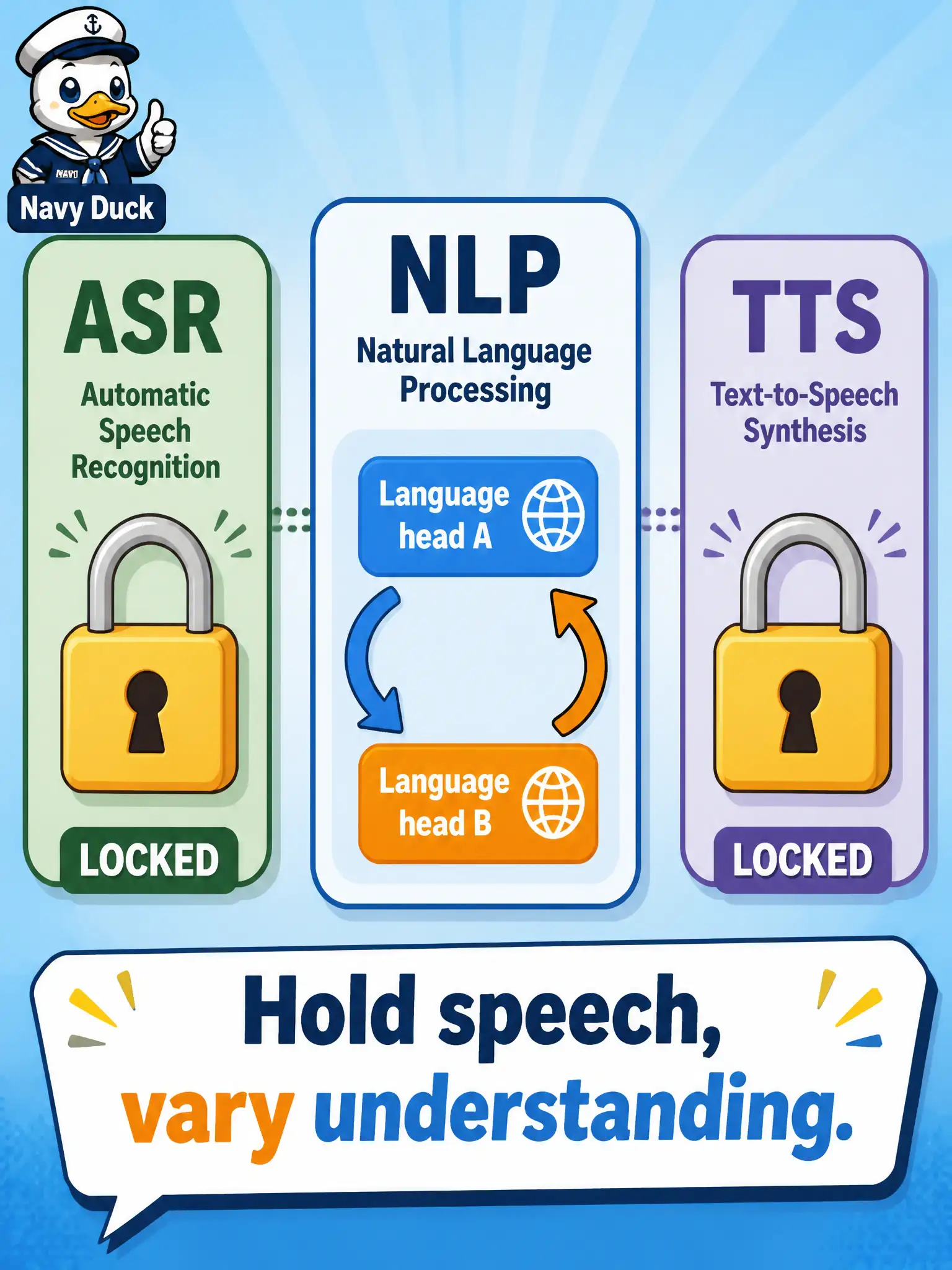
If the question is “did understanding get better,” lock the ear and the mouth and only swap the brain. Same recognized lines, same voice—then the language head is what you are testing.
Full Explanation
A tide-mill kiosk that keeps Riva ASR and TTS frozen while trying two pretrained language heads on the same recognized lines uses the right control because holding speech-in and speech-out fixed isolates whether understanding improved. Civic heritage kiosks need interpretable understanding trials so staff know a better reply came from the language head, not from a quieter mic or a different voice. Single-factor NLP control protects public go/no-go decisions from multimodal thrashing.
Changing ASR, NLP, and TTS together to “prove the whole stack is multimodal” fails by destroying attribution across stages. Insisting TTS must always change when the language head changes fails by adding an unnecessary synthesis confound. Treating Helm replica count as the only valid independent variable for understanding quality fails by substituting scale packaging for an NLP comparison.
Exam caveat: single-factor control in a Riva pipeline means varying only NLP while ASR input and TTS output stay constant. Operational check: freeze recognizer settings and TTS voice, feed both language heads the same recognized lines from a sealed set, and score understanding or task success before declaring a better brain.