
An ice-rink kiosk answers “your skates are in locker twelve” when a parent asked about a missing hat, yet the spoken words are crisp and clear. Which stage should the next experiment inspect?
Select an answer to reveal the explanation.
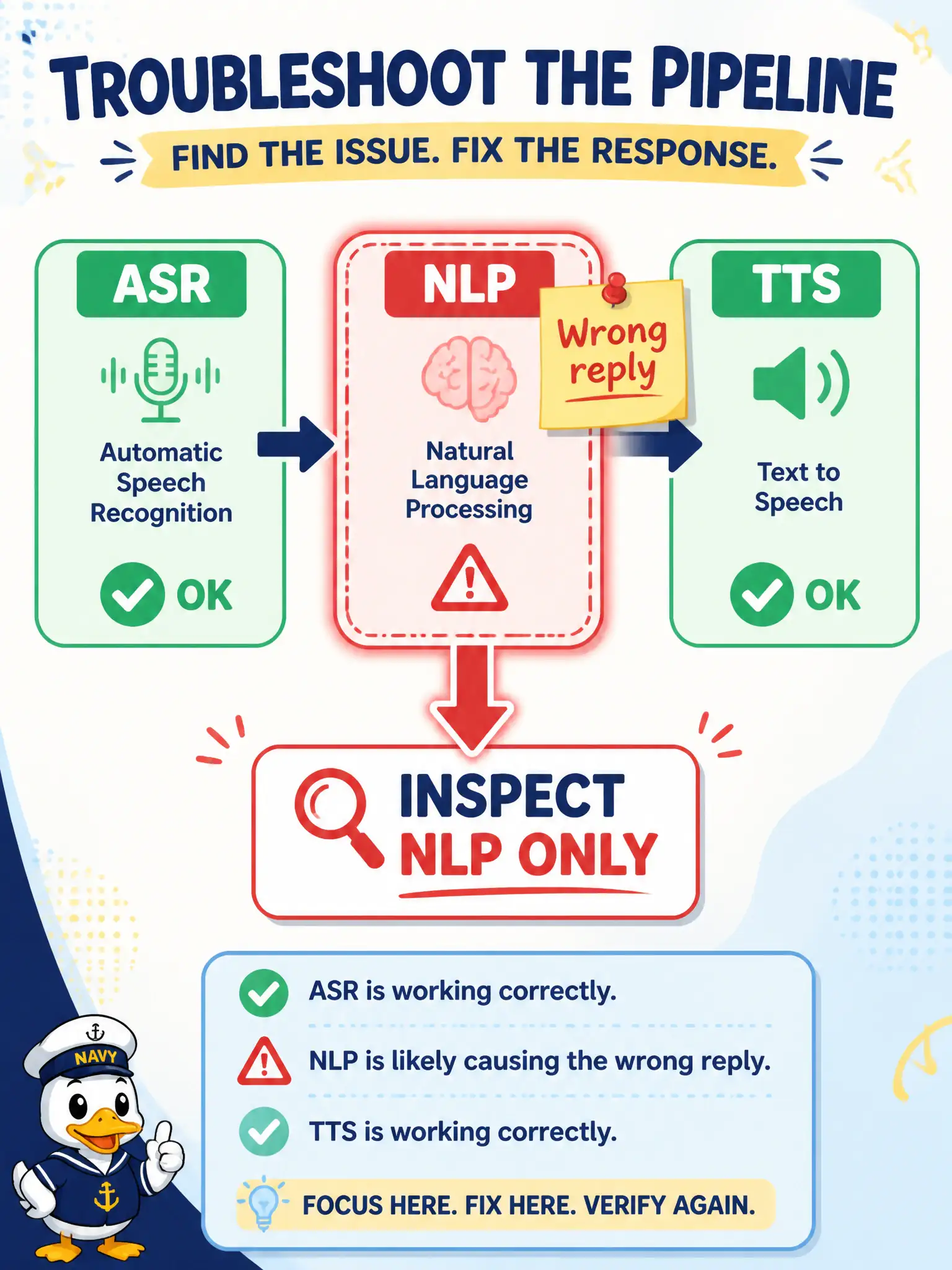
Short Explanation
The kiosk heard clearly and spoke clearly—but answered the wrong question. That points at understanding, not the ear or the mouth. Next experiment: swap or inspect only the NLP stage.
Full Explanation
An ice-rink kiosk that answers “your skates are in locker twelve” when a parent asked about a missing hat, yet speaks crisp clear words, should next inspect the NLP/language stage because recognition and synthesis sound fine while the meaning is wrong. Civic lost-and-found desks lose public trust when fluent wrong answers send families to the wrong locker; pipeline localization by symptom keeps repairs focused on understanding rather than randomly retuning ear or mouth.
Inspecting only outdoor microphone gain because wrong answers always mean capture failure fails when speech-in already sounds healthy and the error is semantic. Inspecting only Riva TTS because a wrong reply always means the voice hallucinated fails when diction is crisp and the content is the problem. Launching a new image-generation model because locker answers require a visual encoder fails by inventing a vision dependency the spoken wrong-answer symptom does not indicate.
Exam caveat: crisp ASR and TTS with a semantically wrong reply implicate NLP first on the associate conversational path. Operational check: compare recognized text to the parent’s question and the chosen reply template or model output; if ASR text is right and TTS is faithful to the reply string, vary only the NLP stage on a fixed speech test set.