
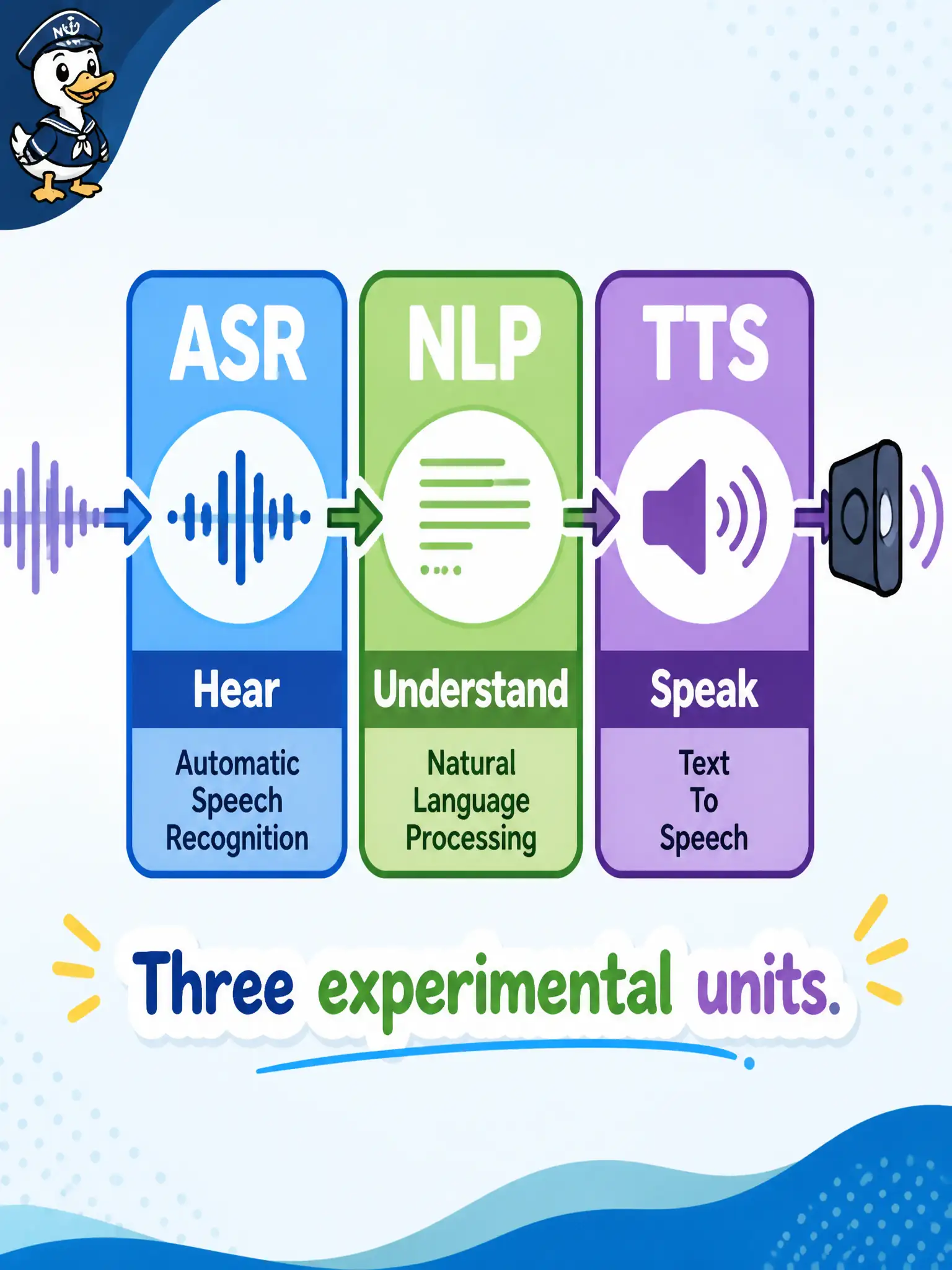
A night-market stall hears a shopper, decides what they asked, and speaks a reply. Which three experimental units map to that hear–understand–speak flow in a Riva conversational pipeline?
Select an answer to reveal the explanation.
Short Explanation
Hear, understand, speak—three jobs, three boxes on the whiteboard. Riva ASR hears, the NLP stage understands, Riva TTS speaks. Later trials can twist one knob without confusing the other two.
Full Explanation
A night-market stall that hears a shopper, decides what they asked, and speaks a reply maps experimentally to Riva ASR, an NLP/language stage, and Riva TTS. Naming those three units lets civic market offices change one conversational knob at a time without confusing hear, understand, and speak. Public visitor service improves when staff can localize faults and design trials against the correct stage of that triad instead of thrashing the whole booth at once.
Mapping the flow to CLIP image encoder, denoising diffusion, and a Helm chart fails by substituting a vision-generation-plus-packaging stack for the conversational speech triad. Naming NCCL collectives, vGPU pools, and CUDA kernel fusion fails by importing infrastructure exam objects that do not hear, understand, or speak to shoppers. Naming VIA Blueprint ingest, RAPIDS ETL, and TensorRT-LLM serving fails by mixing out-of-scope or wrong-family tools into the Riva conversational pipeline picture.
Exam caveat: the associate conversational triad is ASR → NLP → TTS; vision stacks, fabric, and GENL-style serving are not that triad. Operational check: draw the three boxes on the trial board, assign metrics per stage, and forbid changing more than one box per experiment when debugging the stall’s hear–understand–speak path.