
A marionette theater plans a later talking-face demo with ACE, Riva ASR/TTS, and Audio2Face. How should a successful Riva TTS customization be treated in today’s experiment plan?
Select an answer to reveal the explanation.
Short Explanation
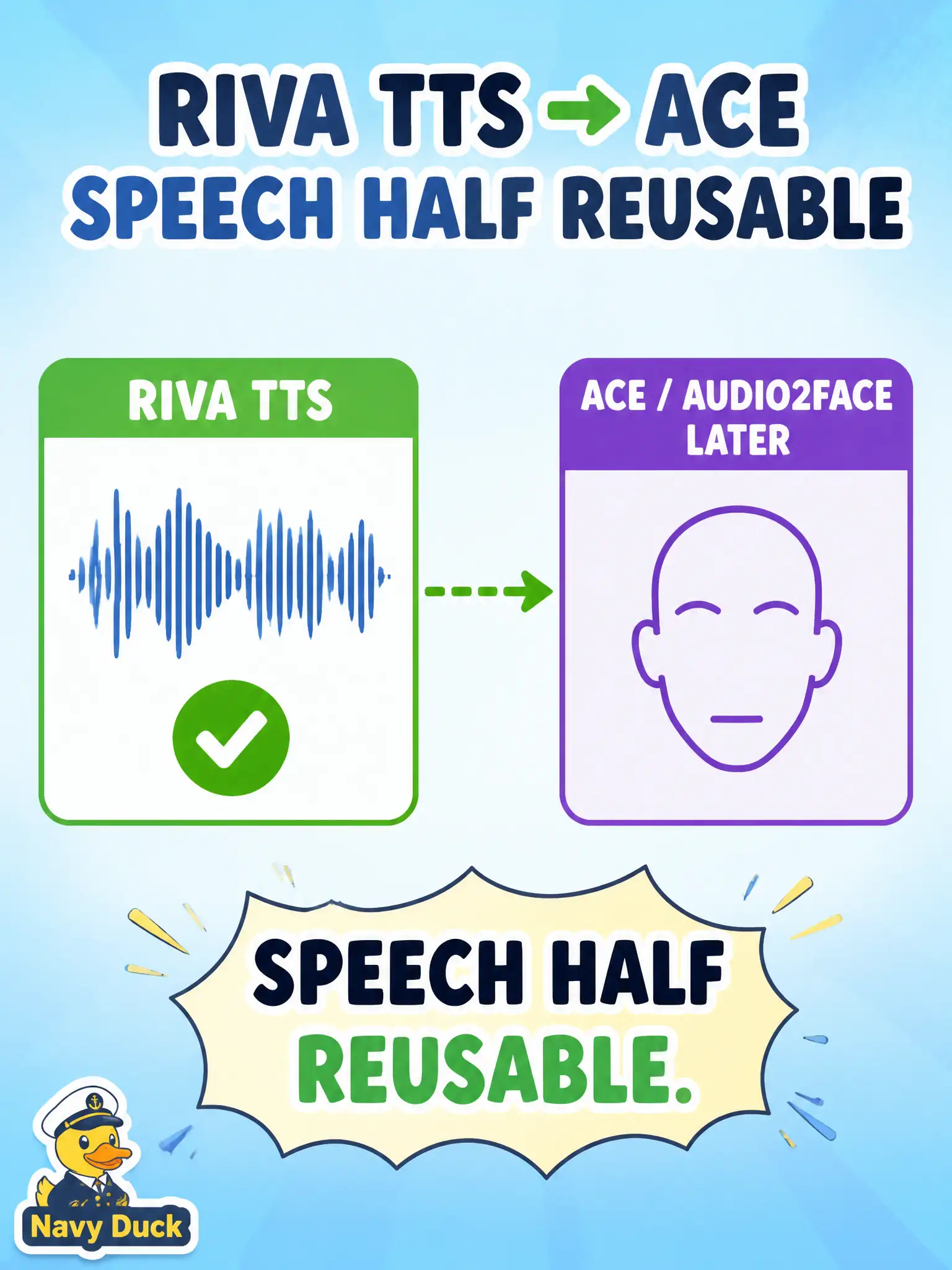
A solid TTS voice today is the soundtrack a later talking-face trial can plug into. You are picking tools and sequencing experiments—not writing ACE microservices this week. Keep the speech win reusable.
Full Explanation
A marionette theater planning a later talking-face demo with ACE, Riva ASR/TTS, and Audio2Face should treat a successful Riva TTS customization as the speech experiment whose audio half an ACE / Audio2Face talking-face trial can reuse later. Civic performance venues need sequenced tool selection: win the voice today, plug that audio into a face trial later, without pretending today’s sprint is an ACE microservice coding exam. Keeping the speech win reusable protects public demo budgets from throwaway voice work.
Treating the TTS win as a full ACE microservice implementation exam that must ship face animation this sprint fails by expanding associate tool-selection into an implementation project. Calling the TTS work obsolete because talking faces require discarding Riva for a VIA Blueprint fails by swapping stacks unnecessarily. Framing it as an NCA-AIIO GPU-virtualization proof before any voice can drive a face fails by importing infrastructure exam scope.
Exam caveat: associate depth links completed Riva TTS to later ACE/Audio2Face as shared speech audio—not ACE coding, VIA replacement, or vGPU proofs. Operational check: archive the customized TTS voice and evaluation script, document it as reusable audio for a future face trial, and keep today’s success criteria limited to listener quality on that voice.