
A salt-pan hut’s outdoor mic clips every gust. After three Riva vocabulary trials, word error barely moves. What should the next experiment target?
Select an answer to reveal the explanation.
Short Explanation
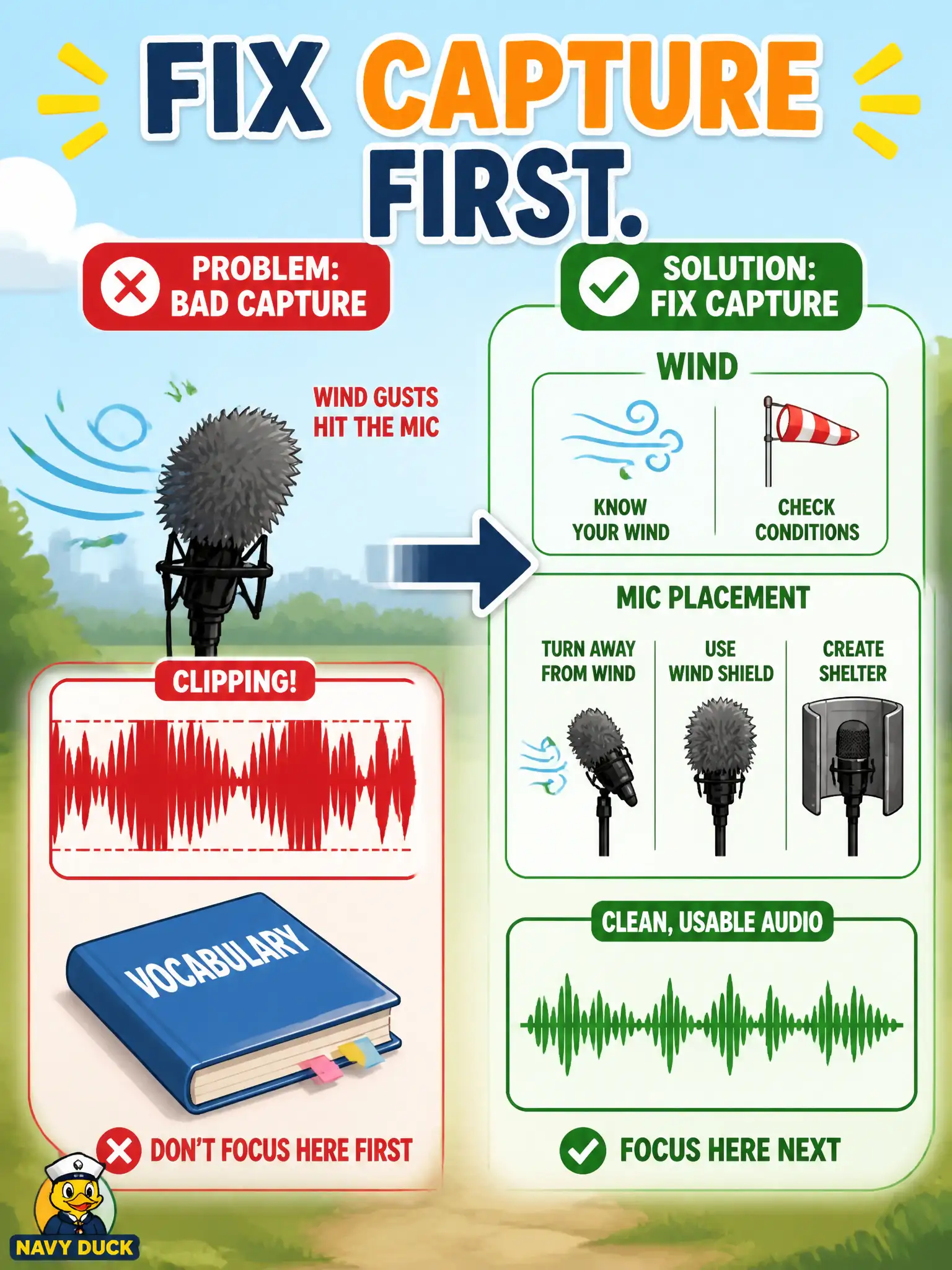
When wind clips the mic, teaching the model more words is like polishing glasses while the lens is cracked. Capture quality is the bottleneck. Fix placement or add a wind screen before another vocabulary run.
Full Explanation
A salt-pan hut whose outdoor mic clips every gust, and whose word error barely moves after three Riva vocabulary trials, should run a data-capture trial—microphone placement or a wind screen—rather than further ASR customization. Civic environmental kiosks fail the public when staff keep polishing the recognizer while the ear itself is clipped by wind. Flat error across vocabulary pushes is the signal to stop model tweaks and fix capture so taxpayers are not funding endless word lists that cannot hear clean audio.
A fourth, larger site vocabulary push assuming more terms will overcome clipping fails by treating a capture distortion as a vocabulary gap. Swapping only the TTS voice while leaving the clipped mic feed unchanged fails by changing synthesis when the bottleneck is corrupted speech-in. Redeploying with more Kubernetes replicas so clipping averages out across pods fails by confusing scale packaging with a microphone physics problem.
Exam caveat: ASR customization cannot repair systematically clipped audio; associate experiments separate capture from recognizer levers. Operational check: inspect waveforms for clipping, reposition or wind-screen the mic, re-record the same evaluation phrases, and only then reopen vocabulary trials if word error remains high on clean audio.