
A clocktower office hears that “Riva is using the GPU,” and an intern offers to write a custom CUDA kernel “to make the experiment fair.” What is the correct associate response?
Select an answer to reveal the explanation.
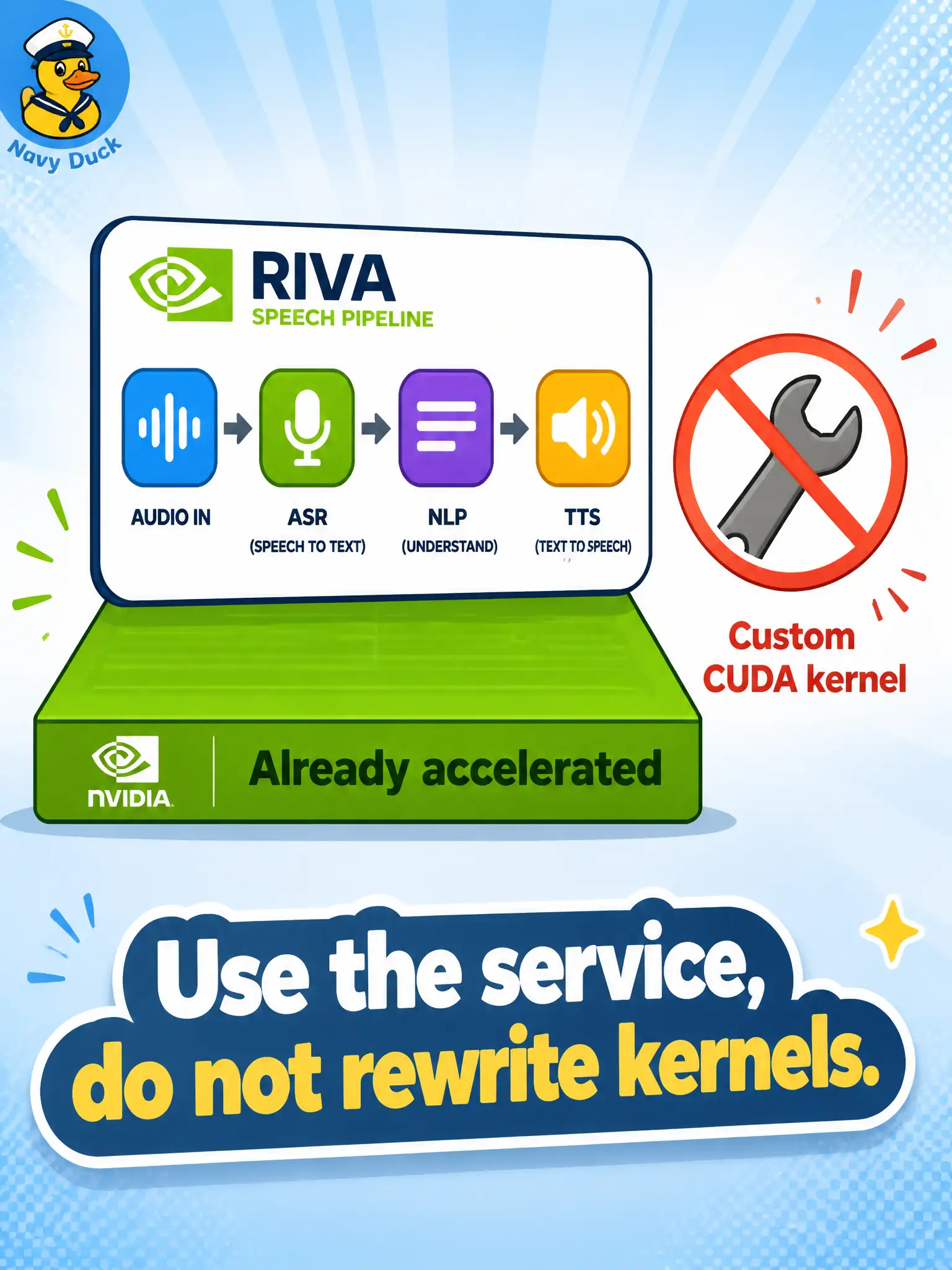
Short Explanation
Riva already runs speech on the GPU—you do not invent a new engine part to “make the race fair.” Custom CUDA kernels are out of scope. Ride the accelerated service and run the ASR/TTS experiment on top.
Full Explanation
When a clocktower office hears that “Riva is using the GPU” and an intern offers a custom CUDA kernel “to make the experiment fair,” the correct associate response is to refuse kernel work and treat GPU-backed Riva speech as the acceleration the experiment already rides on. Civic ASR/TTS trials inherit NVIDIA’s accelerated speech services; fairness comes from controlled vocabulary, voice, and evaluation audio—not from rewriting kernels. Refusing keeps public projects inside associate scope and away from engineer-exam distractions.
Pausing the ASR trial until a new NCCL topology is designed for the office LAN fails by importing collective-network design from other exam families. Accepting the kernel as a required acceleration layer before any Riva vocabulary A/B fails by inventing a prerequisite the associate stack does not require. Moving the trial to CPU-only so fairness does not depend on vendor GPU libraries fails by discarding the accelerated path Riva already provides.
Exam caveat: associate depth knows Riva uses GPUs without candidate-authored CUDA; do not redesign fabric or kernels to “fairness-wash” a speech A/B. Operational check: document that Riva GPU acceleration is in use, forbid custom kernel tasks in the trial charter, and proceed with vocabulary or TTS comparisons on fixed evaluation audio.