
A ropewalk loft updates Riva ASR site vocabulary, microphone gain, and the language pack in one weekend, then reports that recognition “got better.” What is the soundest next experimental move?
Select an answer to reveal the explanation.
Short Explanation
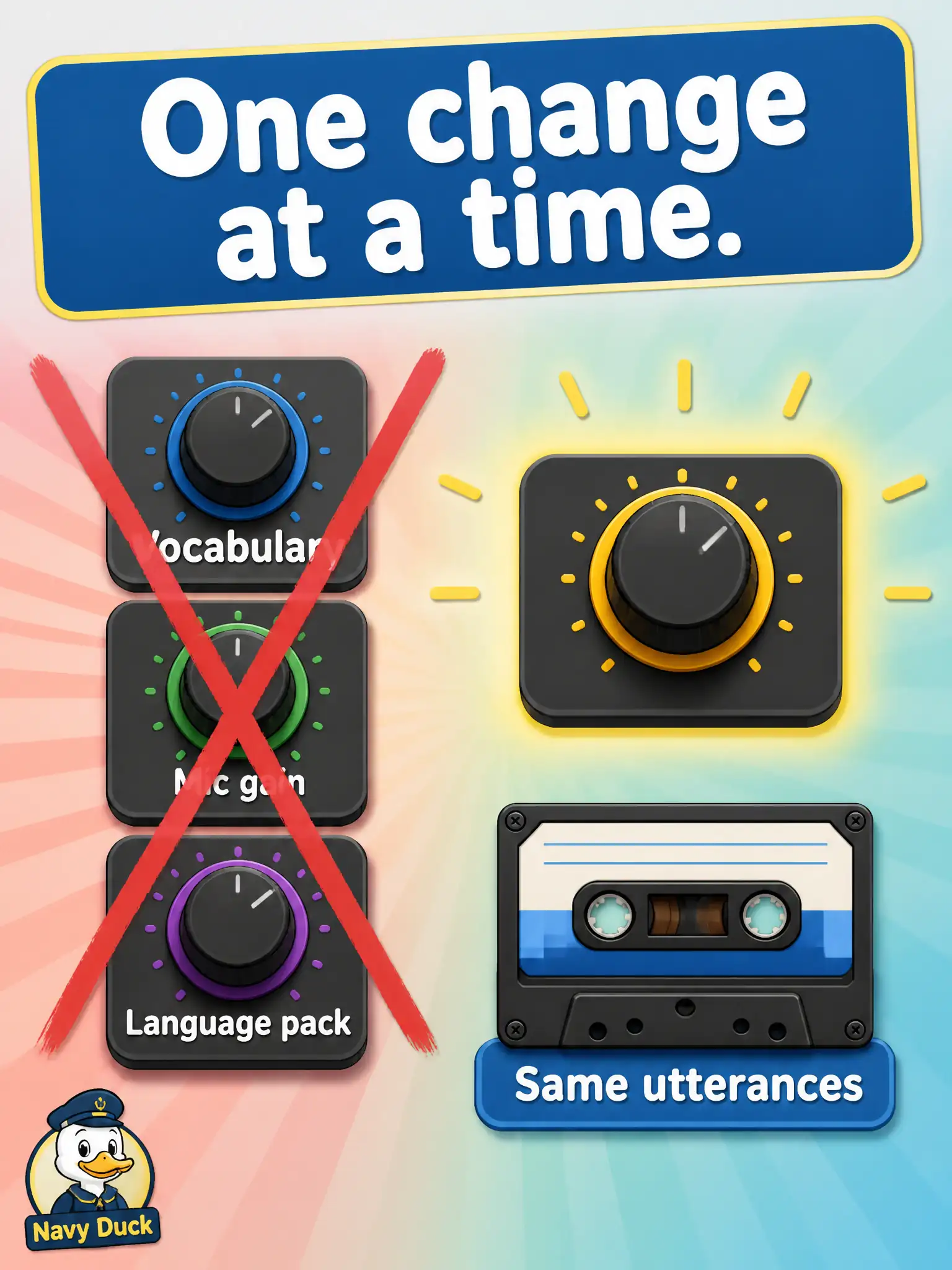
Changing vocabulary, gain, and language pack together is like adjusting three knobs and guessing which one fixed the radio. A valid ASR A/B moves one factor and holds the evaluation audio fixed. Same utterances, one change—then you know what helped.
Full Explanation
A ropewalk loft that updates Riva ASR site vocabulary, microphone gain, and language pack in one weekend cannot claim interpretable improvement. The soundest next move is to reject the claim, then rerun with one ASR customization at a time on the same evaluation utterances. Civic speech desks owe the public controlled experiments: when three knobs move together, taxpayers cannot know what helped recognition or which change to keep when something regresses later.
Deploying the triple change to every public kiosk before further measurement fails by scaling an uninterpretable weekend change into production risk across visitor-facing sites. Scoring the weekend with an image-generation quality metric fails by applying the wrong modality’s scoreboard to an ASR customization claim. Adding a custom CUDA kernel so three simultaneous changes become a “fair GPU experiment” fails by inventing out-of-scope kernel work instead of restoring single-factor control.
Exam caveat: ASR customization experiments isolate one variable—vocabulary, acoustics, or language pack—on fixed evaluation audio before any improvement claim. Operational check: restore the prior baseline configuration, change only one factor per run on the same held-out utterances, and accept improvement only when word-level error drops under that single documented change.