
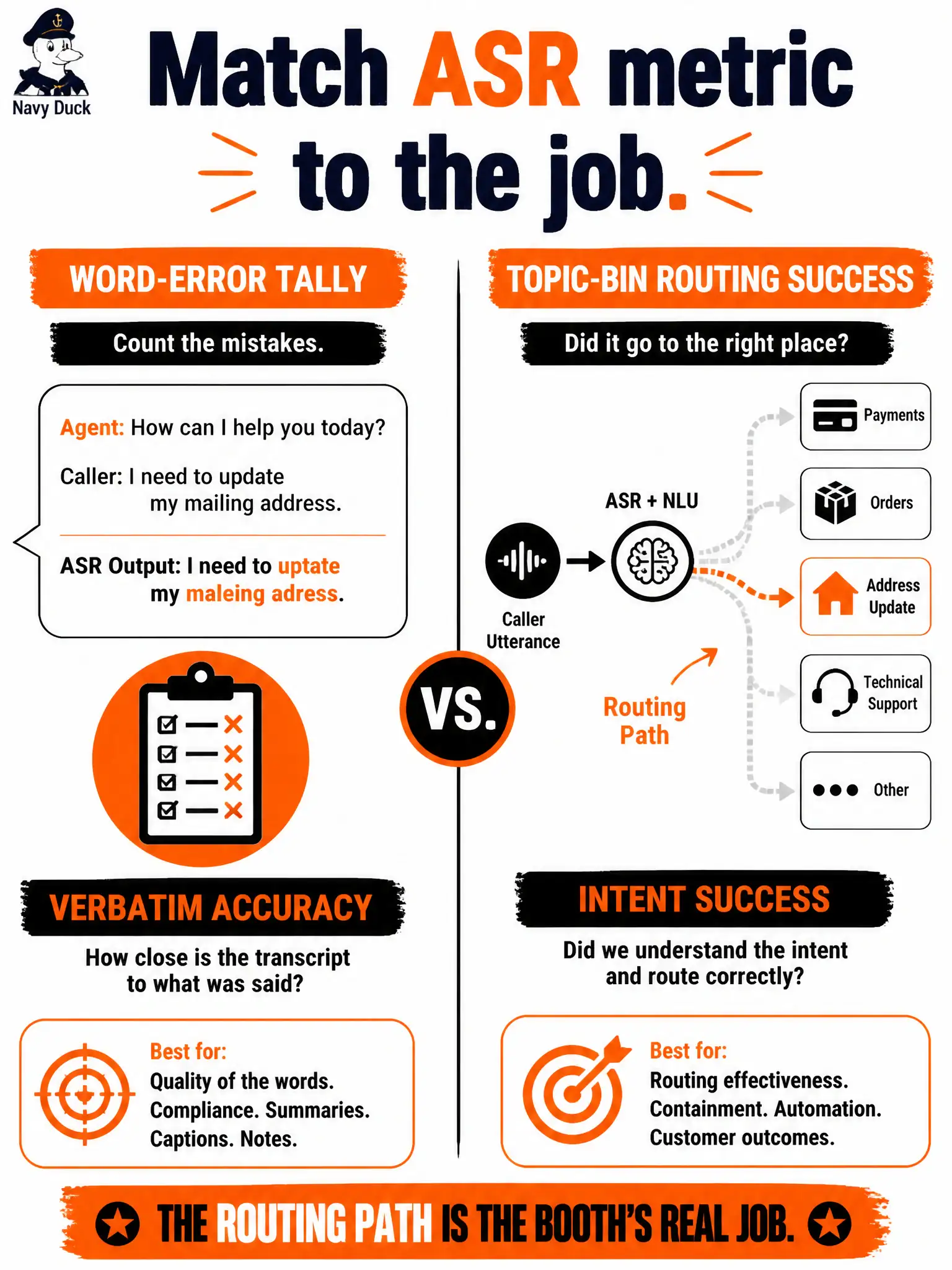
A community-radio call-in booth can score Riva ASR by counting wrong words or by asking whether the producer still routed the caller to the right topic bin. Which measure matches the booth’s real job?
Select an answer to reveal the explanation.
Short Explanation
If the booth’s job is getting callers into the right topic bin, celebrate that routing win. Perfect spelling on every word is nice, but it is not the job when intent survives.
Full Explanation
A community-radio call-in booth can score Riva ASR by wrong-word counts or by whether the producer still routed the caller to the right topic bin. When the booth’s real job is topic routing, downstream intent success is the measure that matches the civic decision. Public media desks should celebrate routing that serves listeners and producers; verbatim perfection matters more for transcript archives than for live intent when routing already succeeds and callers reach the right segment.
Verbatim word error alone even when routing never fails fails by optimizing transcript purity instead of the producer’s routing decision that defines booth success. Scoring how closely the transcript matches a CLIP image prompt fails by applying an image–text similarity metric to a speech-routing job that never asked for still matching. Counting how many GPUs the booth could theoretically reserve overnight fails by substituting capacity planning fantasy for task success on air.
Exam caveat: metrics follow the decision—intent/routing success here, not CLIP similarity or GPU reservation counts—and word error is secondary when routing is the product. Operational check: label caller topic bins on a held-out tape set, run ASR variants through the same router, and compare correct-bin rate as the primary score while optionally logging word error for archive quality notes.