
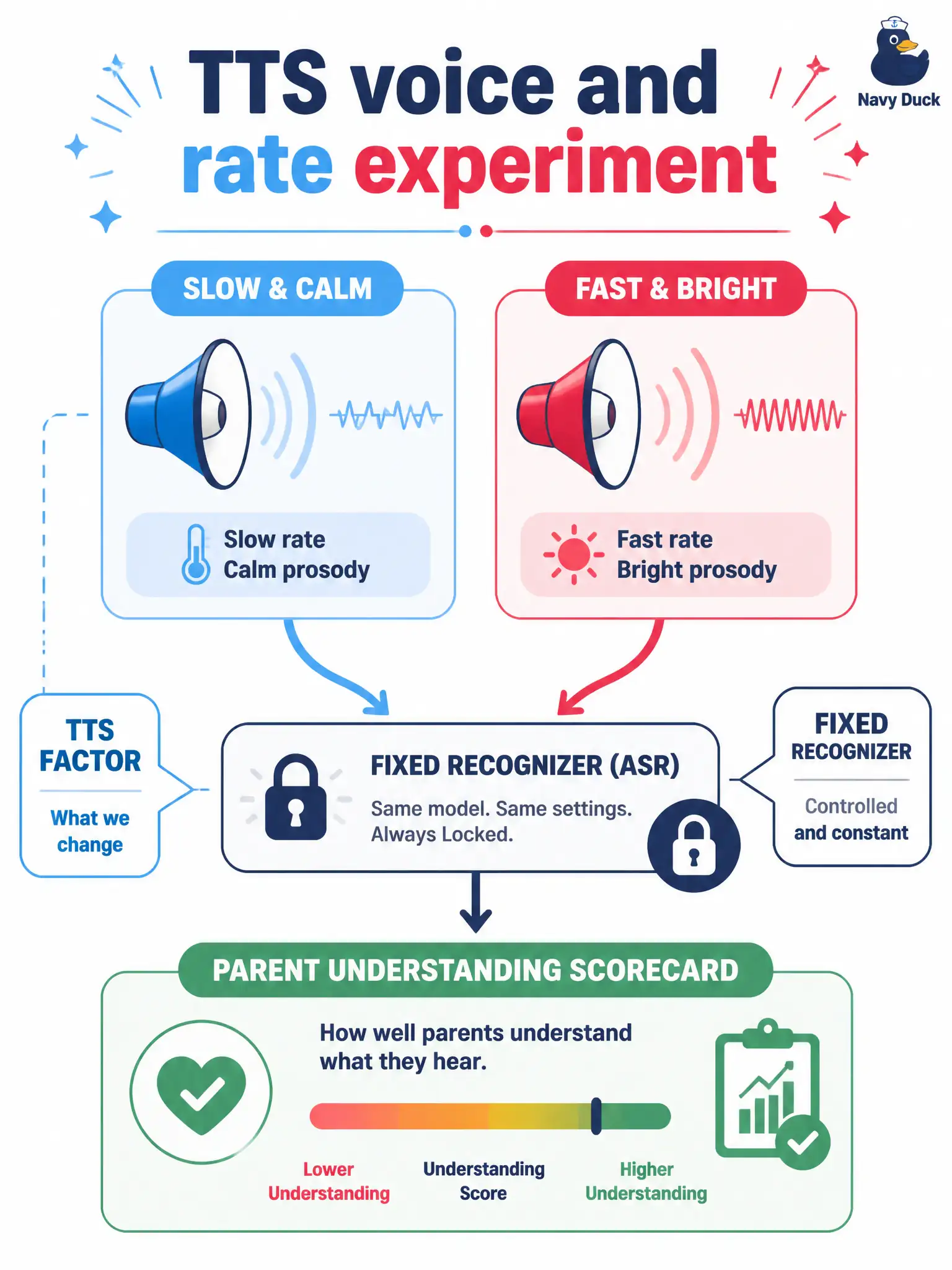
An ice-rink lost-child kiosk can speak slowly in a calm voice or quickly in a bright voice. The team keeps the recognizer fixed and only swaps Riva TTS settings, then asks parents which reply they understood. What is the experimental factor?
Select an answer to reveal the explanation.
Short Explanation
Only the speaking voice and pace change; the listening ear stays put. Parents’ understanding is the scoreboard — not a photo metric.
Full Explanation
An ice-rink lost-child kiosk that keeps the recognizer fixed and only swaps Riva TTS settings—slow calm versus quick bright—then asks parents which reply they understood is testing TTS voice and speaking rate as a controlled customization scored by listener understanding. Civic safety kiosks must optimize for comprehension under stress; isolating TTS while holding ASR fixed makes the experimental factor readable for public-service staff who cannot afford ambiguous stack changes during family emergencies.
Introducing a new image-similarity metric on rink photos fails by scoring the wrong modality for a TTS voice-and-rate trial. Retraining ASR on crowd noise while TTS stays untouched fails by moving the experimental factor to recognition instead of synthesis customization. Replacing Riva with a text-only summarizer for parents fails by abandoning spoken replies entirely when the booth’s job is audible guidance.
Exam caveat: with ASR fixed, voice and rate are the TTS factors; listener understanding is the fitting score, not vision metrics or a pivot to silent text. Operational check: hold script text and ASR fixed, A/B the two TTS settings with a parent panel in rink conditions, and record which voice/rate pair yields higher comprehension before adopting a default for the lost-child playlist.