
A library oral-history booth has hour-long transcripts next to a tray of portraits. Staff want a pretrained summarizer so a curator reads a short digest, then opens only the matching stills. What should the experiment evaluate?
Select an answer to reveal the explanation.
Short Explanation
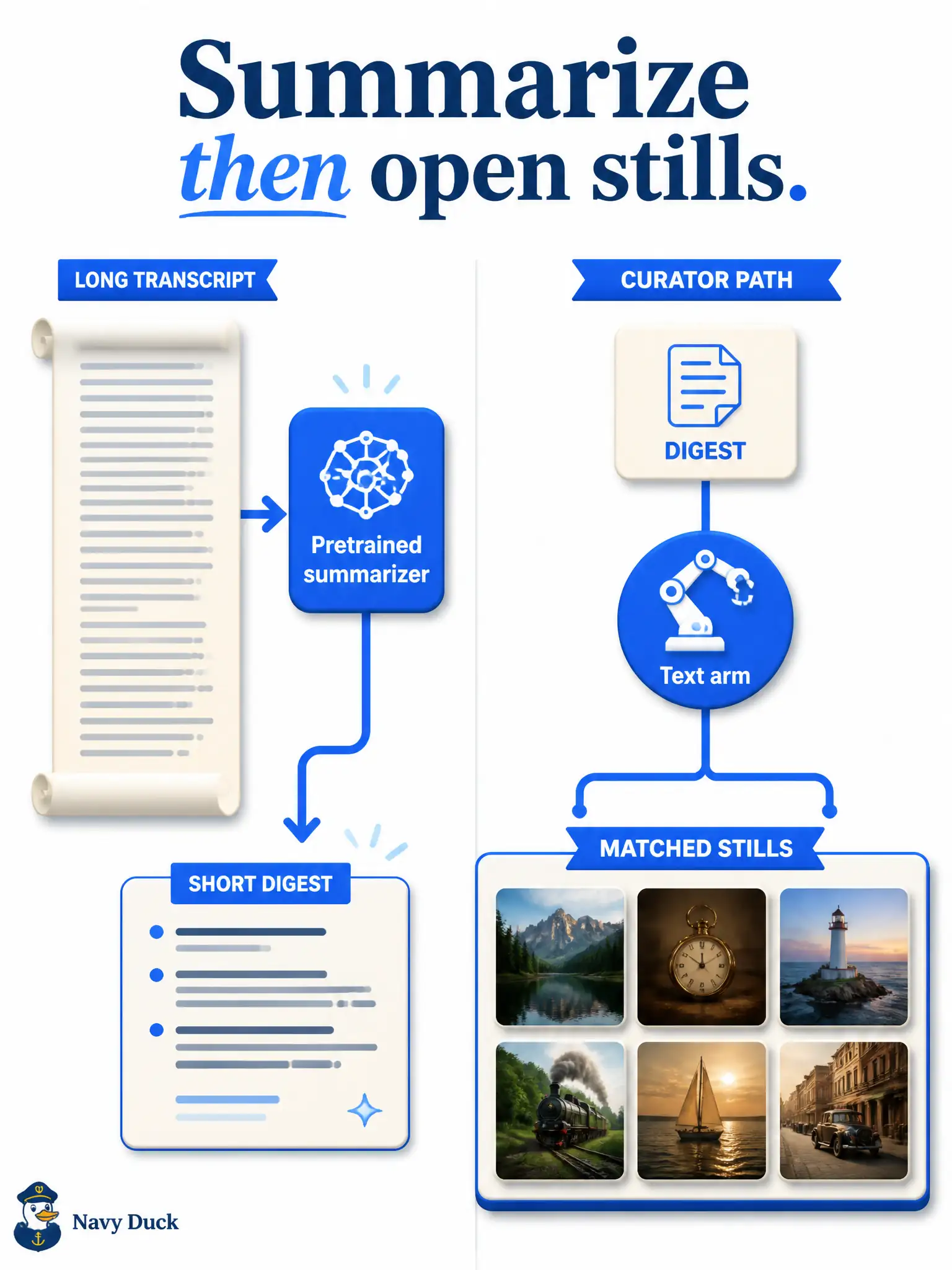
The long tape is a thick novel; the summary is the back-cover blurb that helps the curator pick the right portrait. Score the blurb — keep the photos out of the training loop for this trial.
Full Explanation
A library oral-history booth with hour-long transcripts beside portraits should evaluate summarization quality as the text arm that makes the audio archive usable next to images. Curators in civic memory institutions need short digests that point them to the right stills without forcing end-to-end retraining on portraits. Scoring the pretrained summarizer protects public access: better digests mean volunteers open matching portraits faster without corrupting the trial by feeding faces into the summarizer loop.
Asking whether portraits alone can retrain the summarizer end to end fails by turning a text-summarization evaluation into a vision-driven retrain. Deleting transcripts to improve portrait search fails by destroying the text evidence the digest depends on. Requiring a new speech recognizer before any summary is allowed fails by blocking useful text-arm evaluation when transcripts already exist.
Exam caveat: summarization quality is scored on text utility beside images; portraits are retrieval targets, not summarizer training fuel in this trial. Operational check: generate digests for held-out interviews, have curators select portraits from digests alone, and measure match rate against known interview–portrait pairs.