
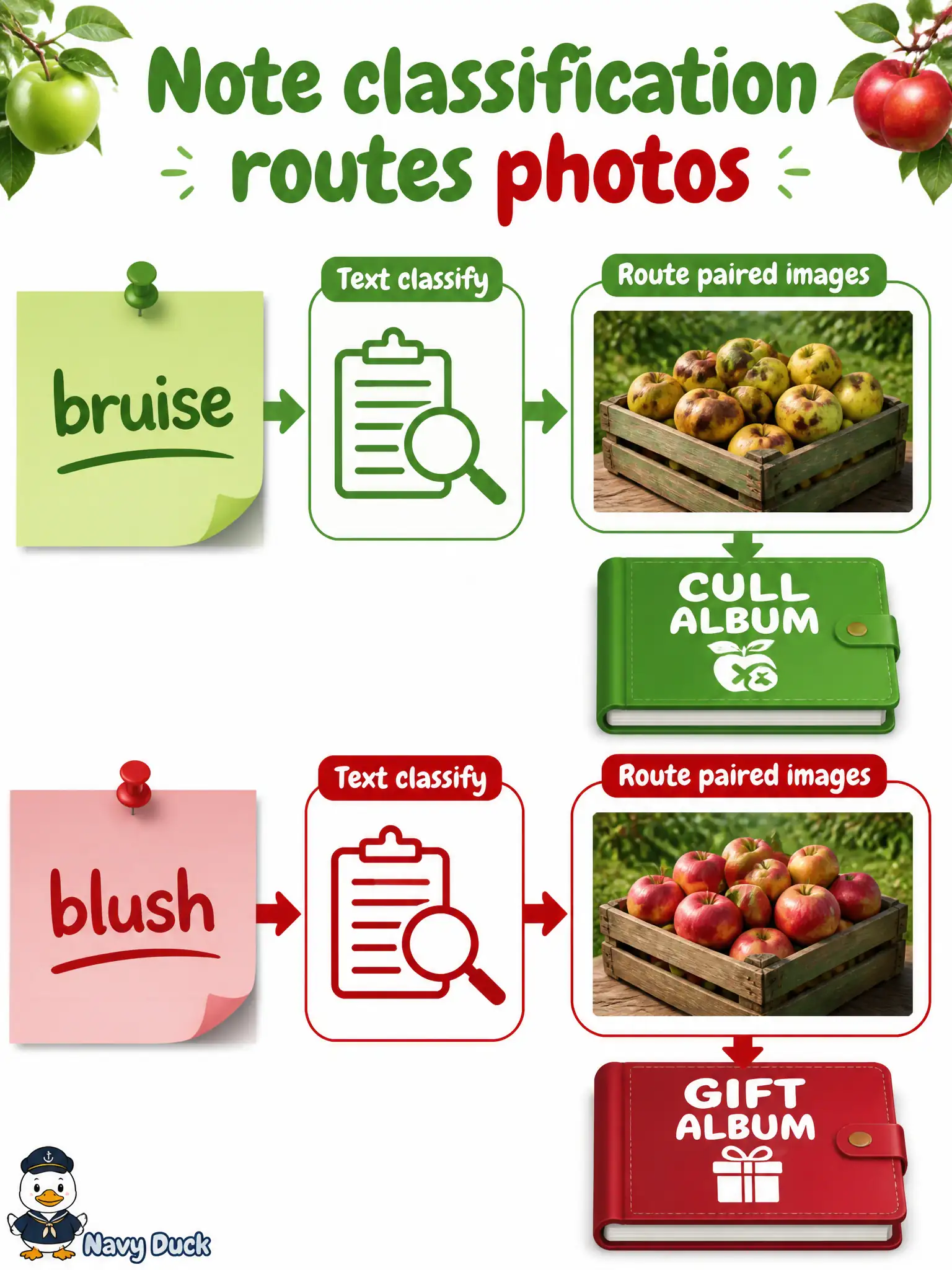
An orchard packing-shed pins a one-line note to each crate photo. A pretrained text classifier should send “bruise” notes to the cull album and “blush” notes to the gift album. What is the right first experiment when notes are present?
Select an answer to reveal the explanation.
Short Explanation
When the sticky note already says bruise or blush, sorting by that note is the cheap first pass. Retraining eyes on pixels can wait — and a missing note still needs a look at the fruit.
Full Explanation
An orchard packing-shed that pins a one-line note to each crate photo should first classify those notes to route paired photos—“bruise” to cull, “blush” to gift—before retraining a bruise detector on pixels. When notes are present, pretrained text classification is a cheap multimodal routing experiment that respects evidence already attached to civic produce workflows. Public food-quality desks save inspection capacity by sorting on trustworthy notes first while still knowing a missing note later needs eyes on the fruit.
Ignoring every note and immediately fine-tuning a vision model on unlabeled crates fails by skipping available text evidence and jumping to costly vision training. Replacing notes with overnight batch ASR when no audio was recorded fails by inventing a speech pipeline the shed does not have. Treating text classification as a substitute for visual inspection when the note is missing fails by over-claiming the text arm beyond its evidence.
Exam caveat: note routing is appropriate when notes exist; it is not permission to skip vision when text is absent. Operational check: run the classifier on present notes, measure routing accuracy to cull/gift albums, and separately flag missing-note crates for visual review.