
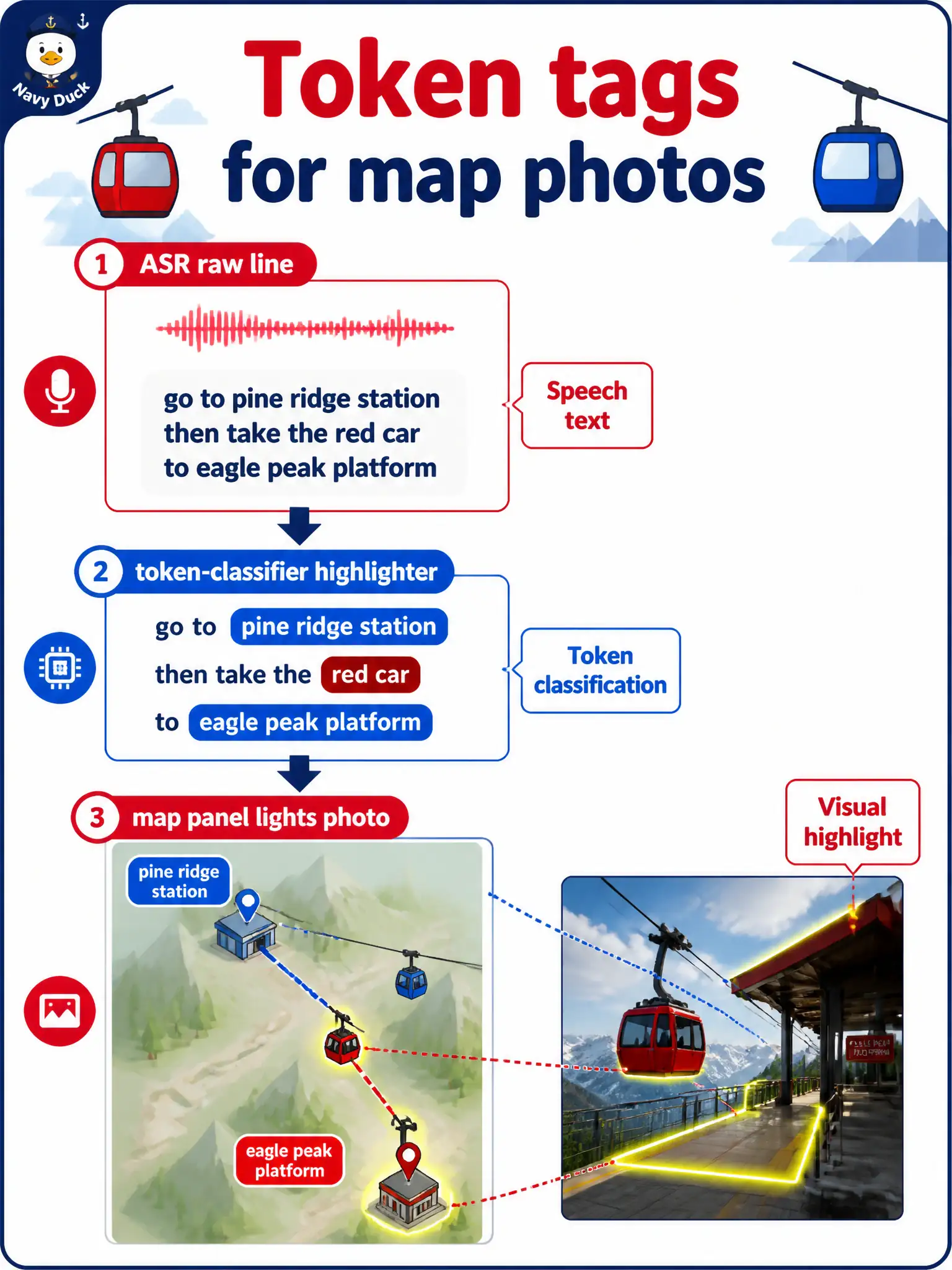
A funicular ticket window’s speech recognizer dumps a raw line. Staff then ask a pretrained token classifier to mark station names and car numbers so a map still can highlight the right platform photo. What is the text-arm experiment?
Select an answer to reveal the explanation.
Short Explanation
The ear already wrote a raw line. The next tool is a highlighter that tags station names and car numbers so the map can light the right photo. That highlighter sits on top of audio — it is not a new ear.
Full Explanation
A funicular ticket window whose speech recognizer dumps a raw line can apply a pretrained token classifier to mark station names and car numbers so a map still highlights the right platform photo. That is the text-arm experiment: NLP tagging on speech-derived text that feeds a visual map, without retraining acoustics or regenerating photos. Civic transit desks owe riders correct platform highlighting; tagging entities in the transcript is the proportional bridge between ASR output and the photo map.
Retraining the acoustic model from scratch on platform noise fails by moving the trial back into speech recognition when the raw line already exists. Generating new platform photos with a diffusion model fails by changing the visual archive instead of tagging text for the existing map. Measuring tram-motor vibration as an audio feature for routing fails by inventing an unrelated signal path outside the transcript-tagging design.
Exam caveat: pretrained token classification on recognizer text is NLP after ASR, not a new ear and not photo synthesis. Operational check: freeze ASR and map assets, tag station/car entities on held-out lines, and score whether highlighted platform photos match the tagged entities.