
A ropewalk sail-loft captioner has a frozen image encoder. Staff can rewrite instructions, attach a small extra module on the language side, or retrain the whole text stack on a few dozen loft notes. Which framing best describes these choices?
Select an answer to reveal the explanation.
Short Explanation
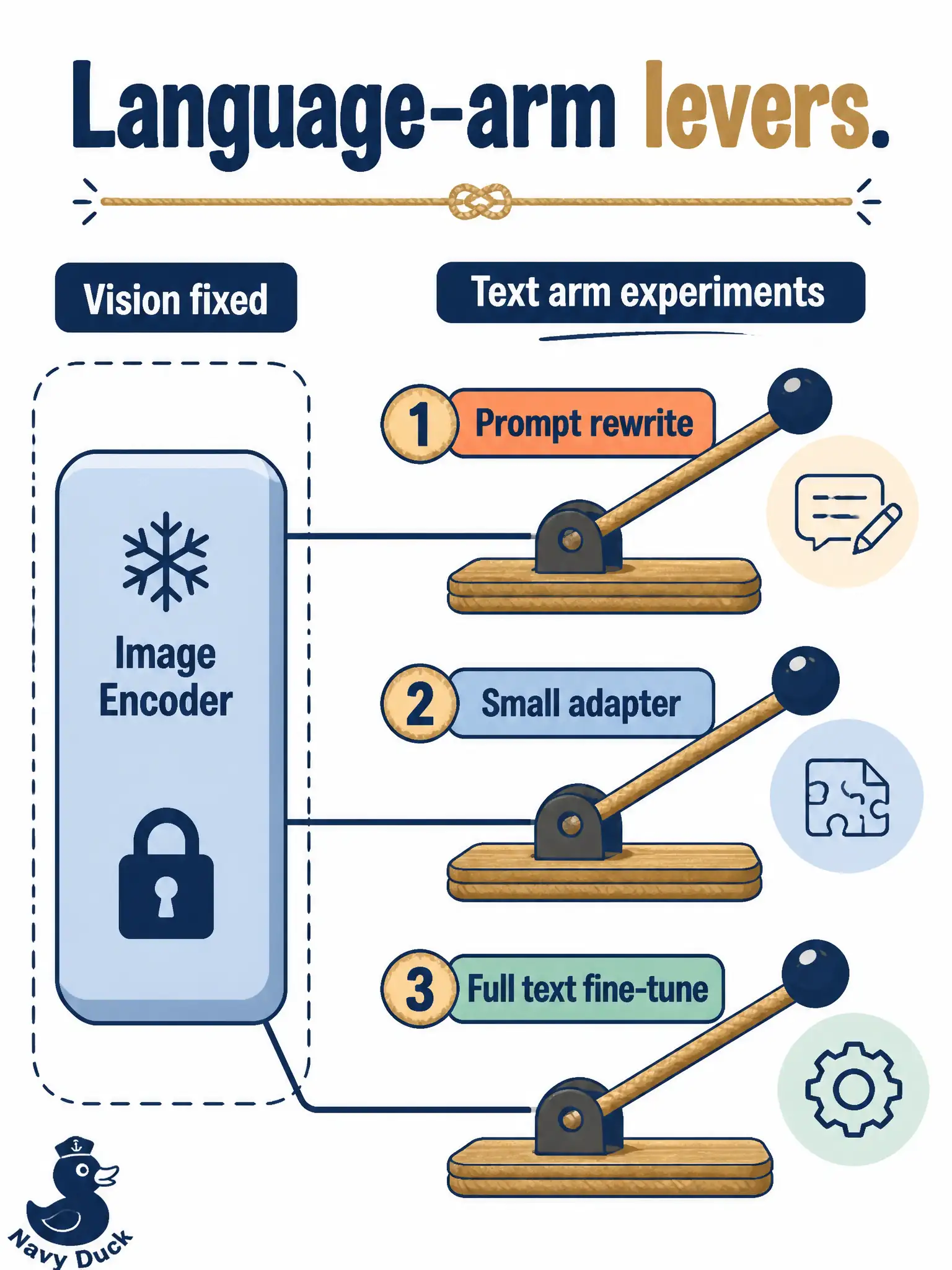
The eyes stay frozen; only the talking side changes. Prompt tweaks, a tiny add-on module, or a fuller text retrain are three knobs on that same language arm.
Full Explanation
A ropewalk sail-loft captioner with a frozen image encoder can rewrite instructions, attach a small language-side module, or retrain the whole text stack on loft notes. Those choices are three experiments on the language arm—prompt change, small adapter, or full text-side fine-tune—while the vision encoder stays fixed. Civic loft documentation needs graded, interpretable language interventions so public catalogs improve without needlessly rebuilding the visual encoder taxpayers already paid to freeze and validate.
Calling them three ways to rebuild the image encoder without touching language fails by inverting which arm actually moves. Requiring fine-tuning of every layer before any caption can be scored fails by denying cheaper prompt and adapter trials that associate practice encourages first. Claiming only from-scratch text training is valid fails by discarding prompt and adapter levers that often answer the loft’s caption quality question at lower cost.
Exam caveat: with vision frozen, compare language-arm intensity levels; do not smuggle a vision rebuild into the story. Operational check: hold the image encoder fixed, run prompt-only, adapter, and text fine-tune arms on the same loft notes, and compare caption metrics before escalating further.