
A cider-press tasting room dislikes a generated pour shot. One intern rewrites the accompanying sentence; another reruns the image generator from new noise. Which change is the text-arm experiment?
Select an answer to reveal the explanation.
Short Explanation
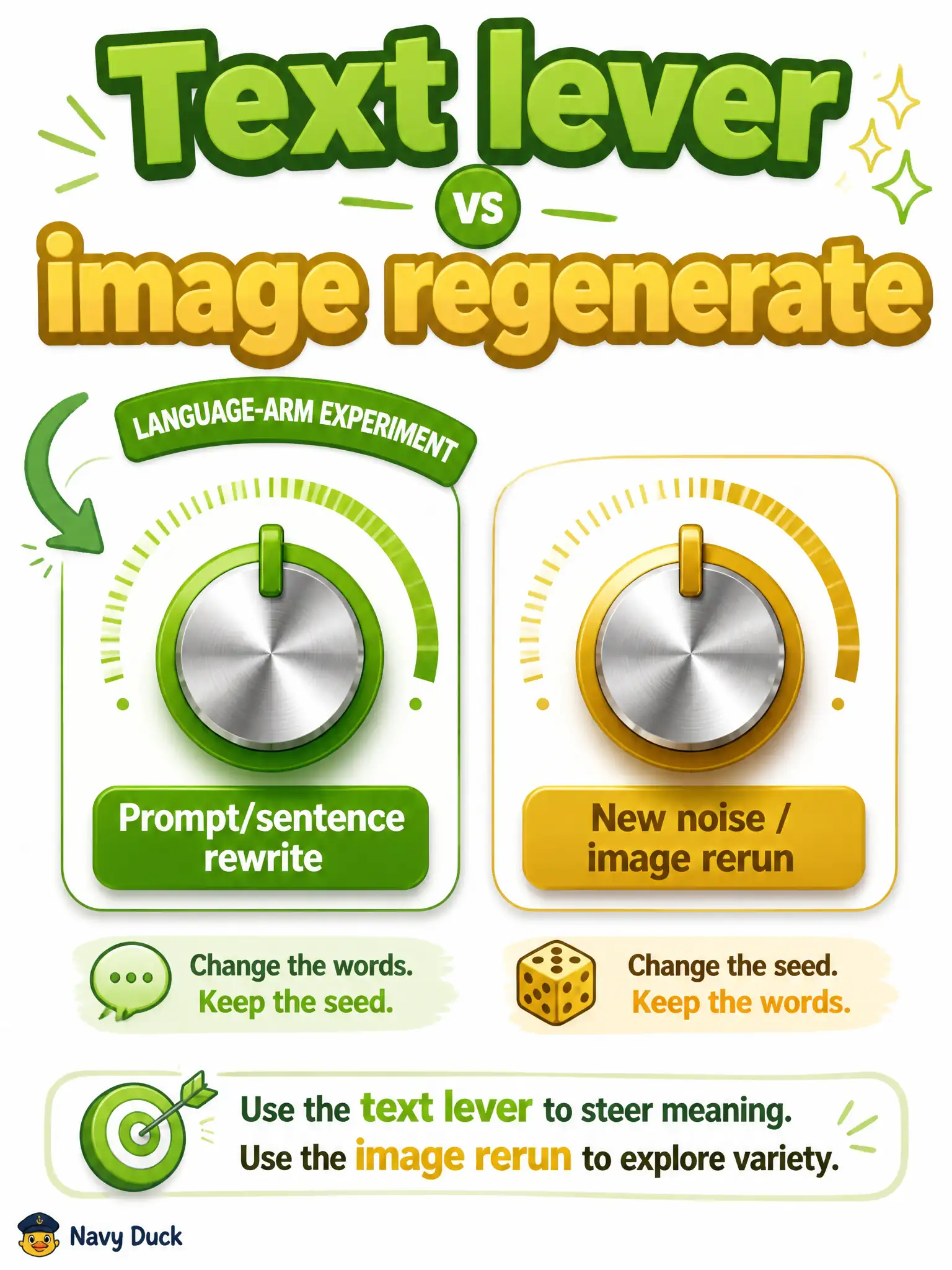
Changing the sentence is turning the language dial. Hitting regenerate from new noise is spinning the image wheel. Only the sentence rewrite is the text-arm trial.
Full Explanation
In a cider-press tasting room that dislikes a generated pour shot, rewriting the accompanying sentence that conditions the visual generator is the text-arm experiment. Multimodal generation stacks expose separate levers: language conditions versus image noise and sampler choices. Civic marketing and education desks need interpretable trials so staff know whether better pour imagery came from clearer wording or from a fresh visual draw—rewriting the sentence isolates the language lever taxpayers can understand.
Rerunning the image generator from new noise fails as a text-arm claim because it varies the visual generation path, not the conditioning sentence. Upscaling the pour shot without changing prompt or noise fails by applying a post-process that neither tests text conditioning nor controlled regeneration. Deleting the prompt and training a new acoustic model fails by abandoning the generation stack for an unrelated speech experiment.
Exam caveat: distinguish text-conditioning edits from image-noise reruns; both change outputs but only one is the text-arm trial. Operational check: hold seed/noise and vision backbone fixed, change only the conditioning sentence, and compare pour-shot quality against the prior wording on the same evaluation checklist.