
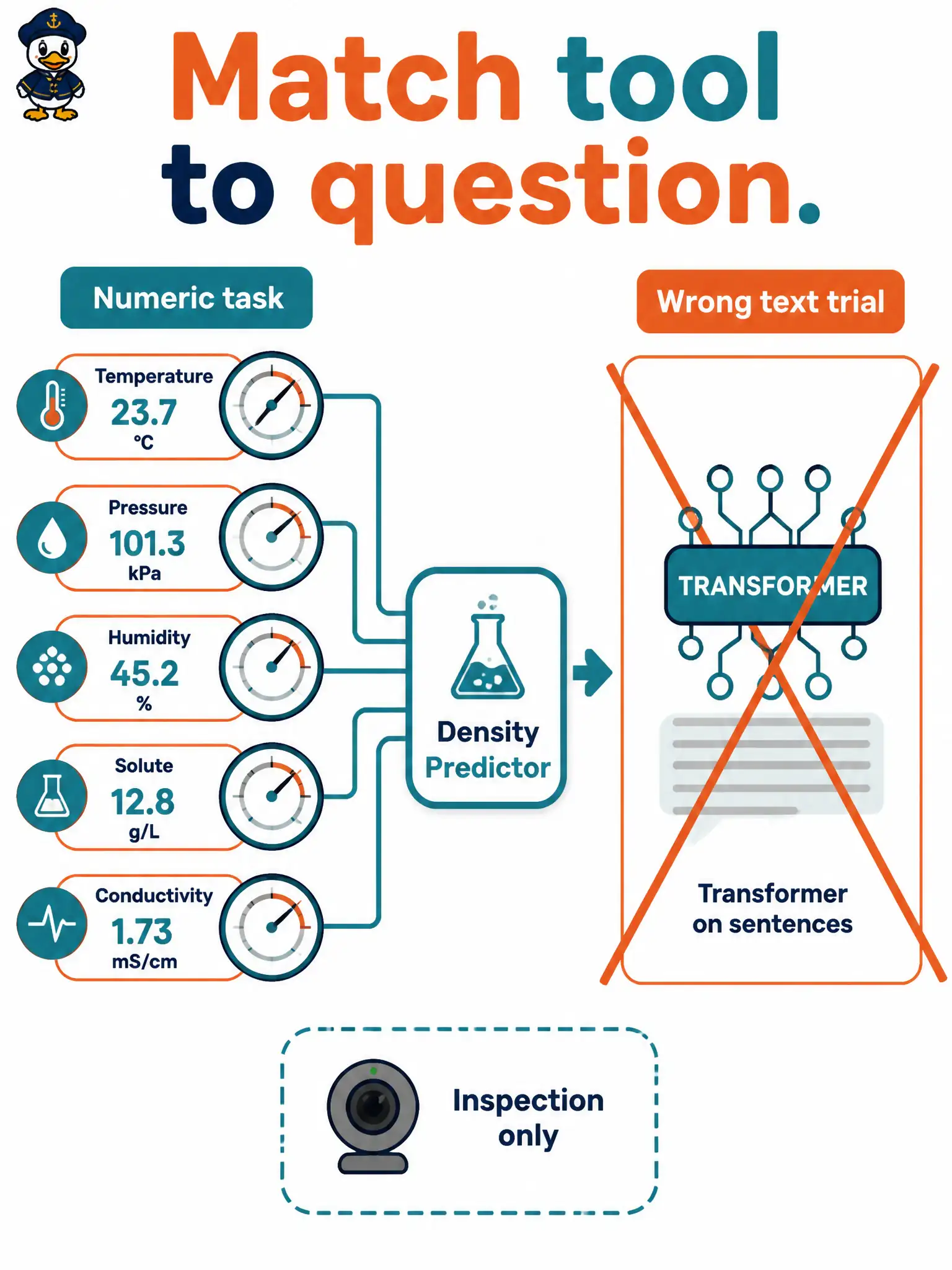
A salt-pan field station wants to predict overnight brine density from five numeric sensors beside a webcam used only for later inspection. A contractor says to run a transformer on the log sentences. What is the best response?
Select an answer to reveal the explanation.
Short Explanation
Five dials already hold the answer; the webcam is just a later glance. Asking a language model to invent stories about the logs is the wrong tool for a number prediction.
Full Explanation
A salt-pan field station predicting overnight brine density from five numeric sensors—with a webcam used only for later inspection—should decline a transformer text experiment because the decision is numeric, not a language task. Civic environmental desks must match the modality to the decision: sensor regression answers density, while nearby cameras for later inspection do not convert the job into multimodal text generation. Declining the language trial protects public monitoring budgets from glamorous but mismatched model work.
Accepting the transformer trial because any webcam nearby makes the task multimodal text generation fails by treating adjacency of a camera as a modality requirement for the prediction itself. Retraining a diffusion image model on brine photos instead of using the sensors fails by substituting generative vision for the numeric evidence that actually drives density. Replacing the sensors with OCR on handwritten density boards fails by discarding calibrated measurements for a brittle text detour.
Exam caveat: a webcam for later inspection does not redefine a sensor prediction problem as a transformer experiment. Operational check: confirm the labeled target is brine density from the five sensors, document the webcam as non-input inspection only, and refuse text-generation arms that cannot consume those numeric features.