
A paper-mill watermark lab already has a working still-image encoder. Staff want to try three transformer wordings for the accompanying note and leave the encoder untouched. Why is that a controlled multimodal experiment?
Select an answer to reveal the explanation.
Short Explanation
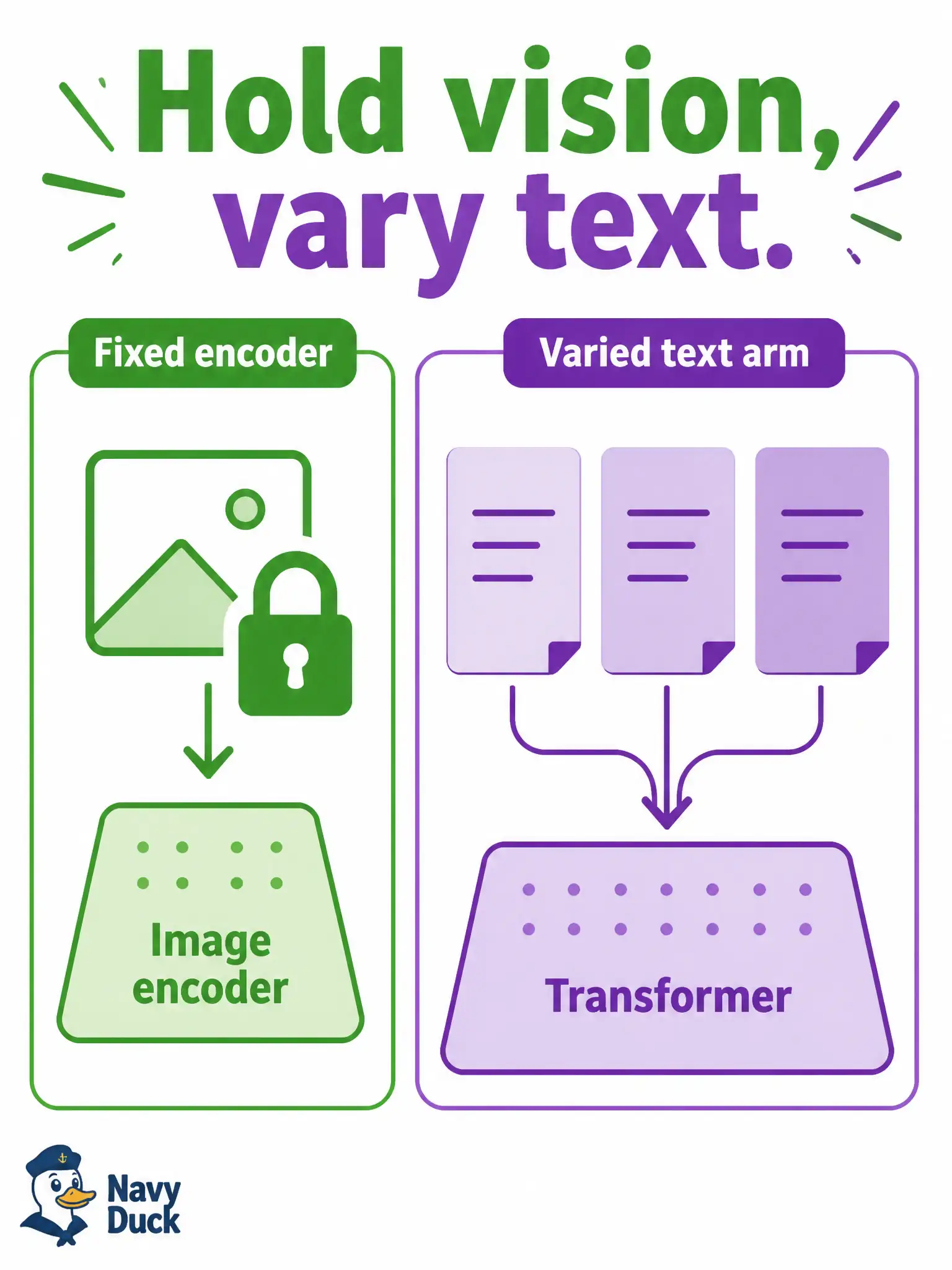
Keep one hand on the photo encoder and wiggle only the wording hand. That is how you learn whether better notes help without rebuilding the eyes of the system.
Full Explanation
A paper-mill watermark lab with a working still-image encoder can try three transformer wordings for the accompanying note while leaving the encoder untouched. That design is a controlled multimodal experiment because it changes only the text-generation arm and holds the vision model fixed, so any quality change can be attributed to wording rather than a rebuilt eye. Civic mills documenting watermarks for heritage and fraud review need experiments taxpayers can interpret; one-variable text trials protect that interpretability.
Claiming the trial invents a new vision architecture by rewriting captions fails by mislabeling a text-arm change as a vision redesign. Asserting it proves the image encoder was never needed once notes exist fails by discarding the visual arm the lab already trusts for watermark identity. Requiring regeneration of every watermark photo from pure noise first fails by injecting an unrelated diffusion experiment before the wording comparison can be read.
Exam caveat: control means vary one modality arm at a time—caption wording is not a stealth vision architecture change. Operational check: freeze encoder weights and evaluation images, swap only the three note wordings, and compare caption or retrieval metrics on the same watermark set.