
A granite-quarry visitor radio dumps raw speech to text full of slang and repeats. The team wants clean place names before a photo-of-the-face lookup. How should they frame the transformer step?
Select an answer to reveal the explanation.
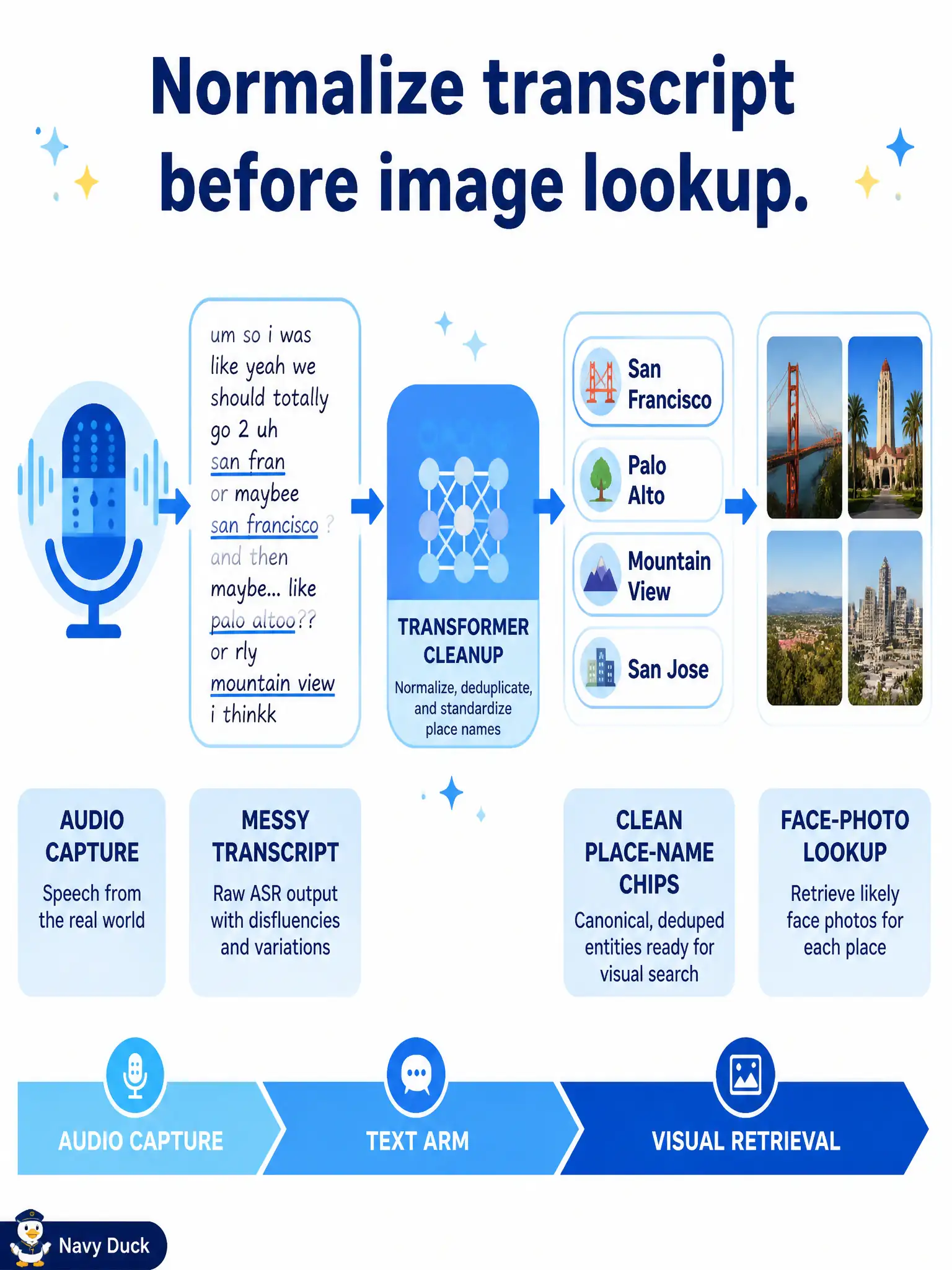
Short Explanation
The radio already turned speech into words. The transformer is the broom that sweeps slang and repeats so place names are usable. That sits between capture and the photo lookup — it is not a new ear for the radio.
Full Explanation
A granite-quarry visitor radio that dumps slang-heavy speech to text still needs clean place names before a photo-of-the-face lookup. Framing the transformer as a text-arm normalization experiment between audio capture and visual retrieval is correct because the recognizer has already produced words; the trial tests whether normalized place names improve the multimodal handoff without rebuilding acoustics or rewriting quarry photos. Civic visitor systems owe the public interpretable place tags that route to the right face photo, so cleaning the transcript is the proportional next experiment.
Treating the transformer as a brand-new acoustic model that replaces the speech recognizer fails by relocating the experiment into speech recognition rather than text normalization. Framing it as an image-augmentation pass that rewrites quarry photos fails by changing the visual modality instead of the transcript. Casting it as a cluster-scale GPU job that must retrain the whole radio stack fails by escalating to infrastructure and full-stack retraining when the associate question is a controlled text-arm cleanup.
Exam caveat: after ASR, transcript normalization is still a text experiment—do not confuse it with retraining the ear. Operational check: hold the recognizer and face-photo lookup fixed, normalize only the text, and measure whether place-name accuracy and correct photo hits improve on the same visitor utterances.