
A brew-house mash floor flips stills of the tun and leaves tasting sentences that say left tap running unchanged. How should that one-arm augmentation be analyzed?
Select an answer to reveal the explanation.
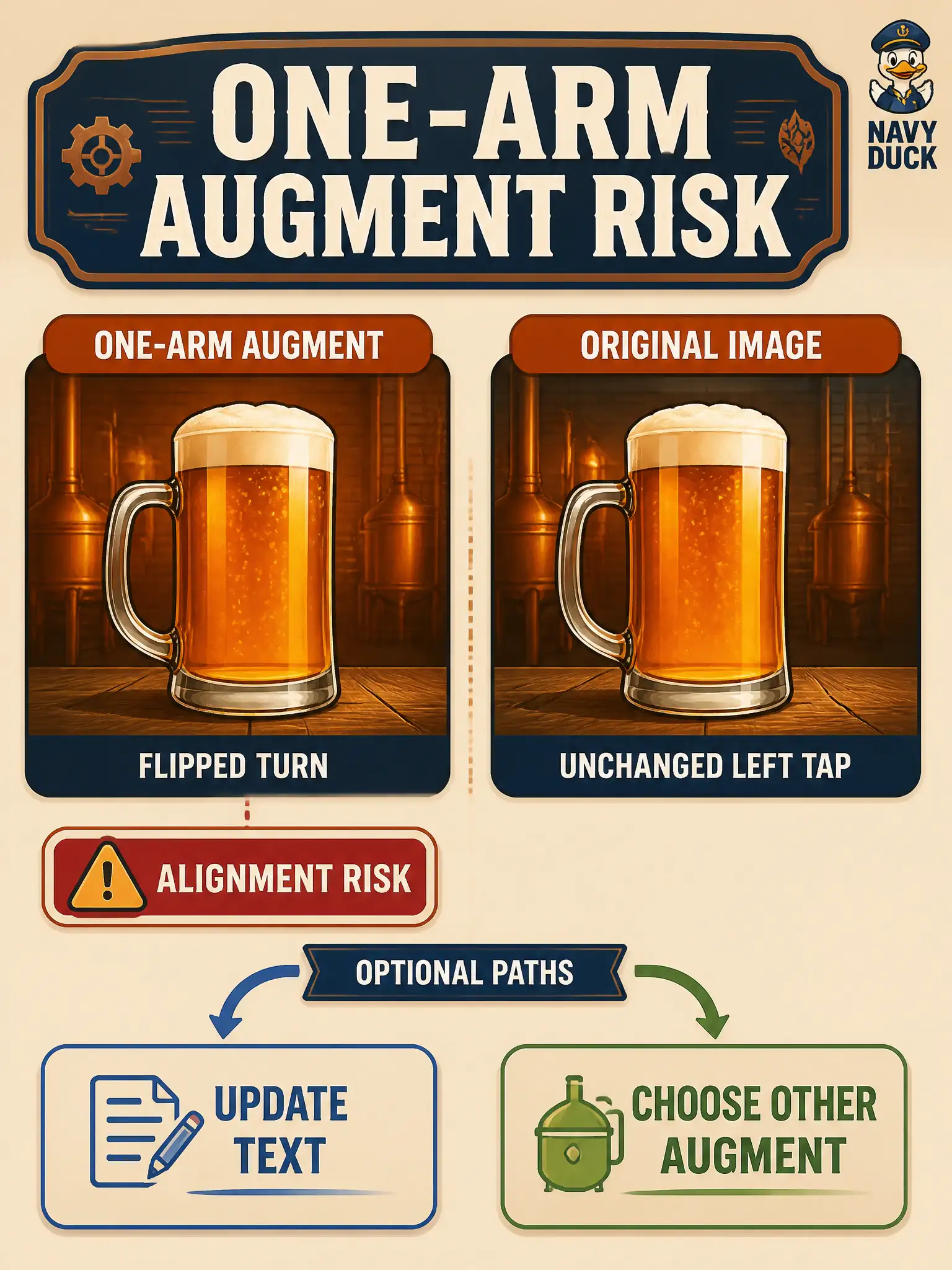
Short Explanation
Turning a photo of a left-hand faucet while the label still says left makes the label lie. Augmenting one arm without the other is an alignment risk, not free rows.
Full Explanation
Flipping mash-floor stills of the tun while leaving tasting sentences that say “left tap running” unchanged is a one-arm augmentation with alignment risk. Domain 5 analysis treats it as an alignment problem: either update those sentences or choose an augmentation that needs no text rewrite so the brew-house corpus stays consistent.
Calling the flips free extra rows with no alignment risk because text is separate fails because spatial or sided language in the text arm becomes false after image flips. Treating the issue as a Domain 4 requirement to redeploy Riva after every flip fails because speech serving is unrelated to still–caption geometric alignment. Using the case as proof that the image arm must be deleted from the corpus fails by discarding vision instead of fixing the transform or captions.
Exam caveat: one-arm image augmentations still threaten multimodal alignment whenever captions encode spatial layout. Text “being separate files” does not erase that risk.
Operational check: scan tasting notes for left/right or sided taps; block flips on those pairs or rewrite captions under review; document the brew-house augmentation policy so civic mash-floor demos do not train on contradictory left-tap language.