
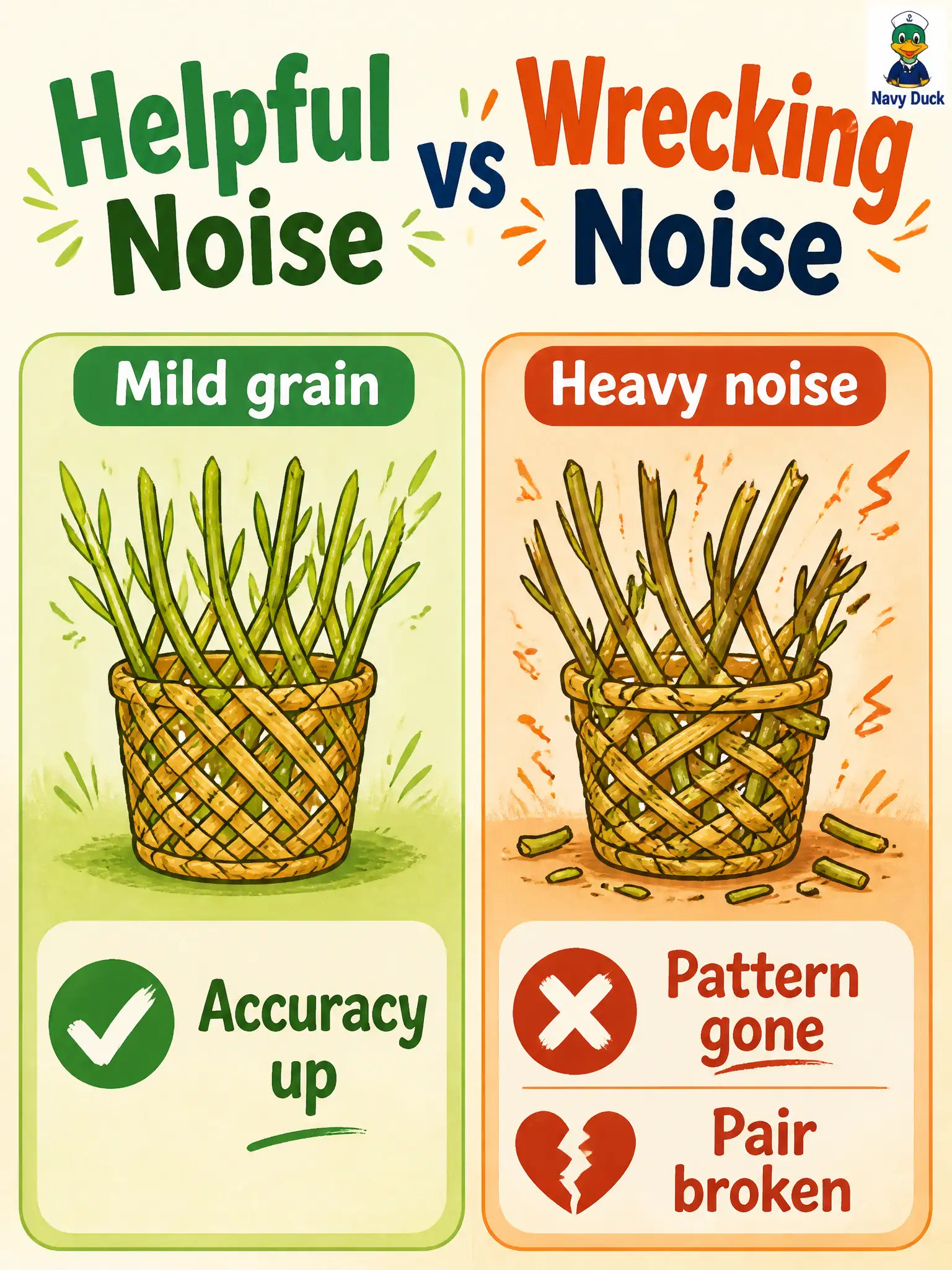
A trug-maker’s shed finds mild grain on harvest stills lifts holdout accuracy, while heavy noise erases the willow pattern though captions still say tight weave. Which trial matches the official augment-to-improve idea?
Select an answer to reveal the explanation.
Short Explanation
A pinch of salt can wake a soup; a cup of salt ruins it. Mild grain that helps accuracy and keeps the weave visible is the keep; noise that erases the pattern is the discard.
Full Explanation
Official augment-to-improve practice keeps trials that raise holdout accuracy while pairs still match. A trug-maker’s shed that sees mild grain lift accuracy with the willow weave still visible should keep that mild trial and discard wrecking heavy noise that erases the pattern while captions still say tight weave.
Keeping only the heavy noise because harder examples always win fails when the visual arm no longer matches the caption and accuracy does not justify the damage. Averaging both trials into one transform without checking the pair fails because mixing a helpful mild grain with a pair-breaking noise hides which policy is safe. Dropping all stills and keeping captions only after any noise trial fails by discarding the image arm instead of selecting the augmentation that helped.
Exam caveat: augmentation is judged by accuracy and pair fidelity together. “Harder” is not automatically better when captions describe patterns the noise destroyed.
Operational check: A/B mild grain versus heavy noise on a civic holdout; keep only transforms with accuracy gain and intact weave visibility versus caption; document the chosen policy in the shed’s Domain 5 log and ban the wrecking noise from the training recipe.