
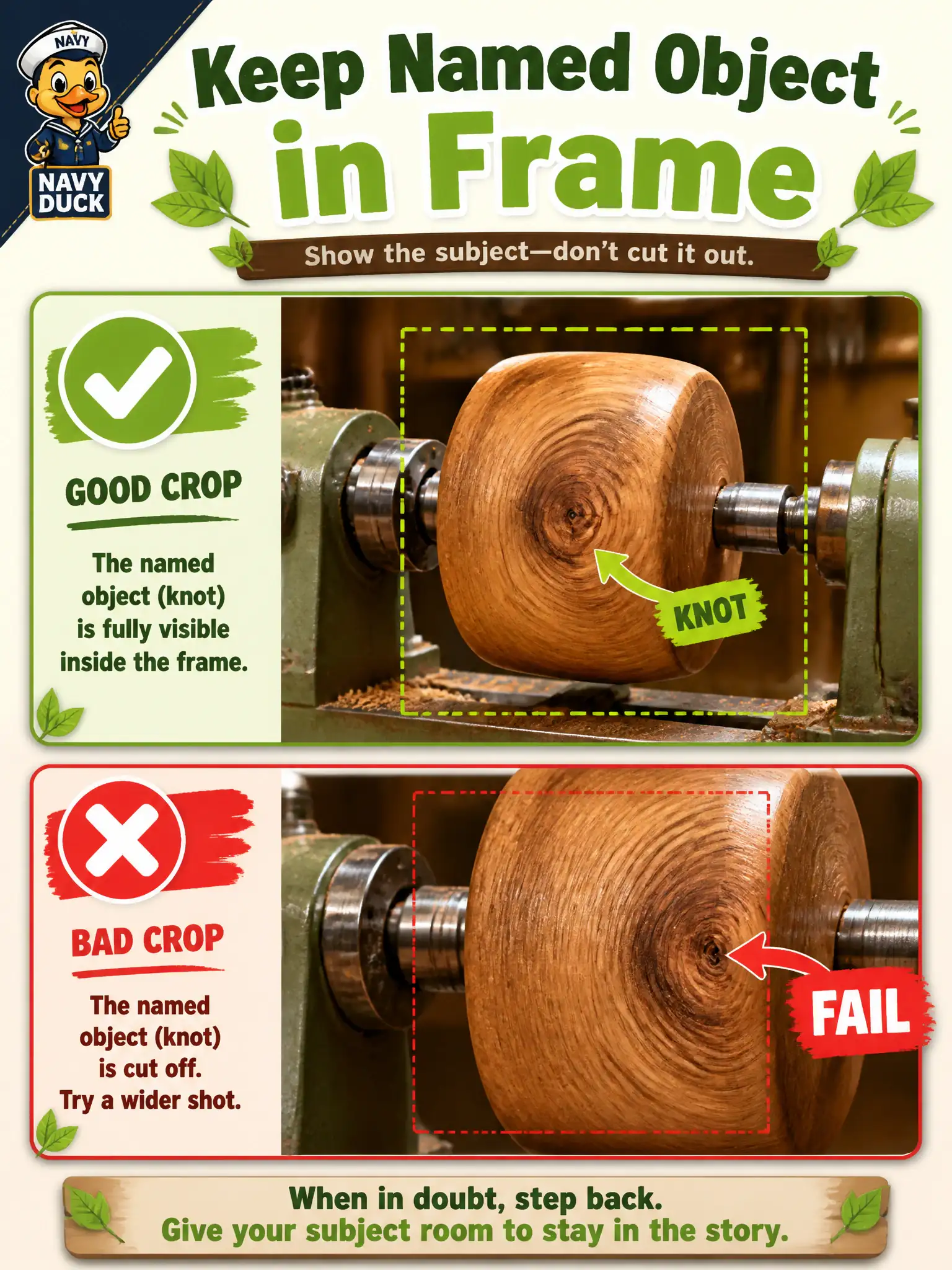
A bodger’s pole-lathe cards say knot on the grain. Random center-crops often drop the knot from the frame. What does Domain 5 analysis recommend?
Select an answer to reveal the explanation.
Short Explanation
Cropping a portrait until the face is gone leaves a caption that lies. Keep a gentler crop so the named knot stays in the picture.
Full Explanation
Bodger’s pole-lathe cards that name a knot on the grain are falsified when random center-crops drop the knot from the frame. Domain 5 analysis recommends a milder or constrained crop so the still still contains the object the sentence names—preserving visual grounding for the civic woodshop corpus.
Keeping random center-crops and deleting the knot phrases from every card fails by silencing the text arm instead of fixing the transform. Switching the entire corpus to audio-only so crops do not matter fails as modality abandonment unrelated to the still–caption alignment defect. Treating missing knots as Domain 7 deepfakes of the wood fails because crop-induced absence is an augmentation alignment issue, not an authenticity deepfake finding.
Exam caveat: object-naming captions require the named object to remain visible after crop. Aggressive random crops are unsafe when cards point at small landmarks.
Operational check: detect knot (or other named) regions; use constrained crops that keep the landmark; audit a sample of municipal lathe pairs post-augmentation and reject frames where the named knot is gone. Add a crop-policy note to the Domain 5 checklist so future batch jobs cannot silently unground the knot phrases.