
A Windsor-chair loft may later drive ACE / Audio2Face from official additional material. A helper speeds every spoken clip 1.4× for more audio. Why is that a poor Domain 5 augmentation choice?
Select an answer to reveal the explanation.
Short Explanation
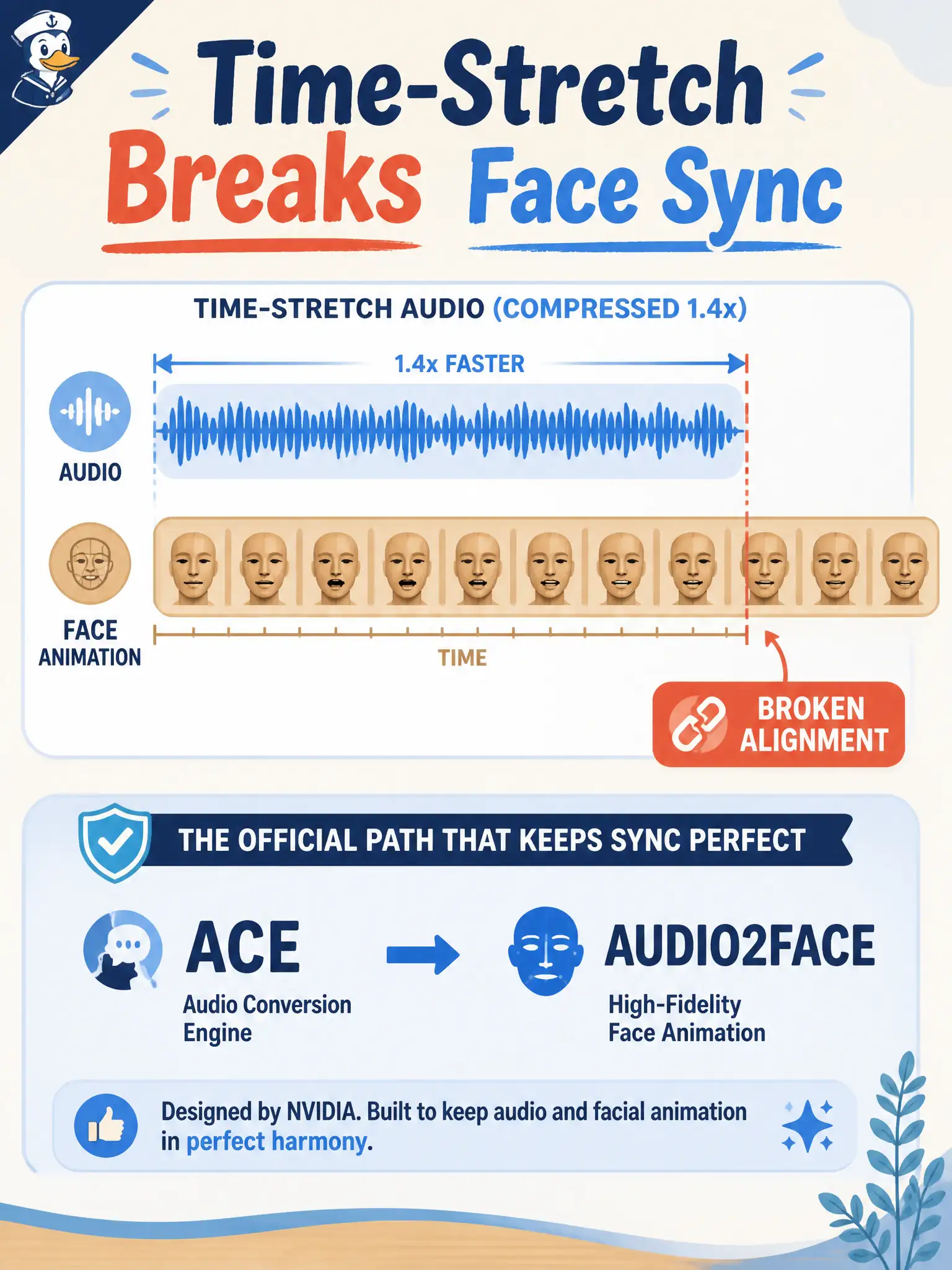
Play a song at 1.4× while a puppet’s mouth still moves at normal speed and the lips fight the voice. Speeding clips for count is a bad augmentation when a talking-face path needs alignment.
Full Explanation
A Windsor-chair loft that may later drive ACE / Audio2Face from official additional material should not speed every spoken clip 1.4× just to mint more audio. That Domain 5 augmentation choice is poor because the speech no longer lines up with a face: speech–face alignment on the avatar path breaks when time stretch desynchronizes mouth motion and audio.
Claiming faster audio always improves Riva ASR word error rate fails because time stretch can distort speech cues and is not a free ASR win. Saying Helm charts forbid any change to clip duration fails as a false constraint; the real issue is alignment, not a Helm ban on duration. Claiming CLIP cannot read waveforms after any time stretch fails because CLIP is not the avatar speech–face path under discussion—the defect is ACE/Audio2Face timing alignment.
Exam caveat: avatar-bound speech augmentations must preserve speech–face timing. “More audio” via speed-ups is unsafe when faces remain at original pace.
Operational check: if ACE/Audio2Face is in scope, forbid unilateral time-stretch on paired speech without retargeting face motion; prefer volume, mild noise, or other alignment-safe transforms; spot-check lip sync on municipal avatar rehearsals after any audio augmentation.