
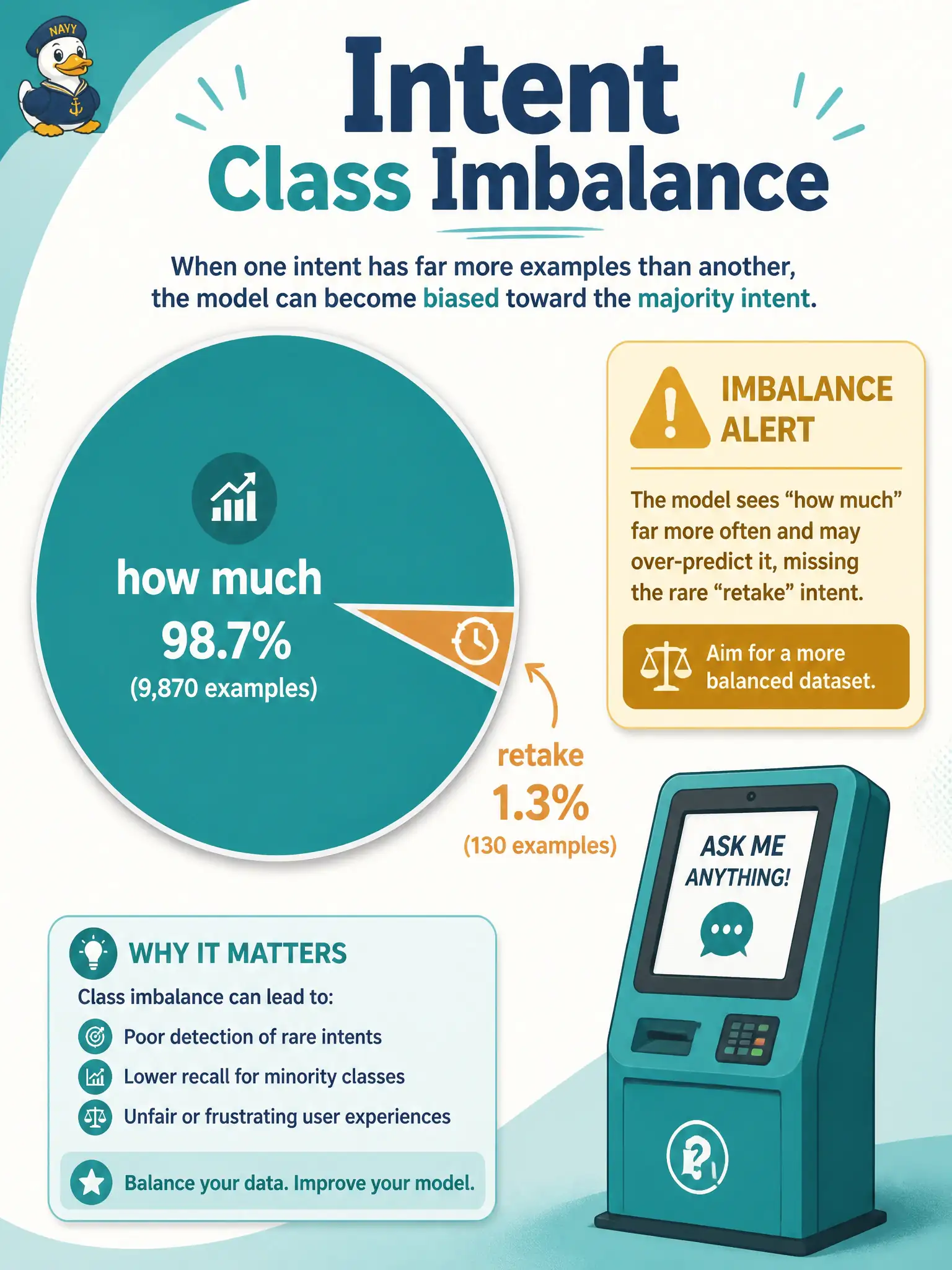
A city kiosk log for a tintype-style photo booth is about 90% "how much" and only a handful of "retake." A pie of intents makes the skew obvious. How should that finding be treated?
Select an answer to reveal the explanation.
Short Explanation
A pie that is almost all "how much" is a class-imbalance siren. File it as analysis of the conversational corpus—do not leap straight into transfer learning.
Full Explanation
A city kiosk pie that is about 90% “how much” and only a handful of “retake” intents is Domain 5 exploratory analysis of class balance on the conversational text arm. Extreme skew is a finding that may later bias any reply model toward price questions and under-serve rare intents. File it as analysis of the corpus, then plan balancing—do not leap domains.
Treating the pie as an immediate Domain 6 transfer-learning redesign of the whole stack fails because class-imbalance discovery is data analysis; transfer and scale come after the corpus finding is acted on. Deleting rare intents from the chart fails by hiding minority classes that the civic booth must still handle (retakes matter to visitors). Casting the skew as a Riva Helm deployment problem fails because replica count does not create missing intent examples in the conversational corpus.
Exam caveat: intent pies diagnose label balance. Imbalance findings stay in Domain 5 until you deliberately move to collection, resampling, or later model work—do not treat charts as Helm or transfer tickets by default.
Operational check: export intent frequencies from the tintype-style booth log; set a minority-intent floor; collect more retake (and other rare) dialogues or reweight evaluation; re-pie before any reply-model fine-tune so municipal kiosk answers do not collapse to price-only behavior.