
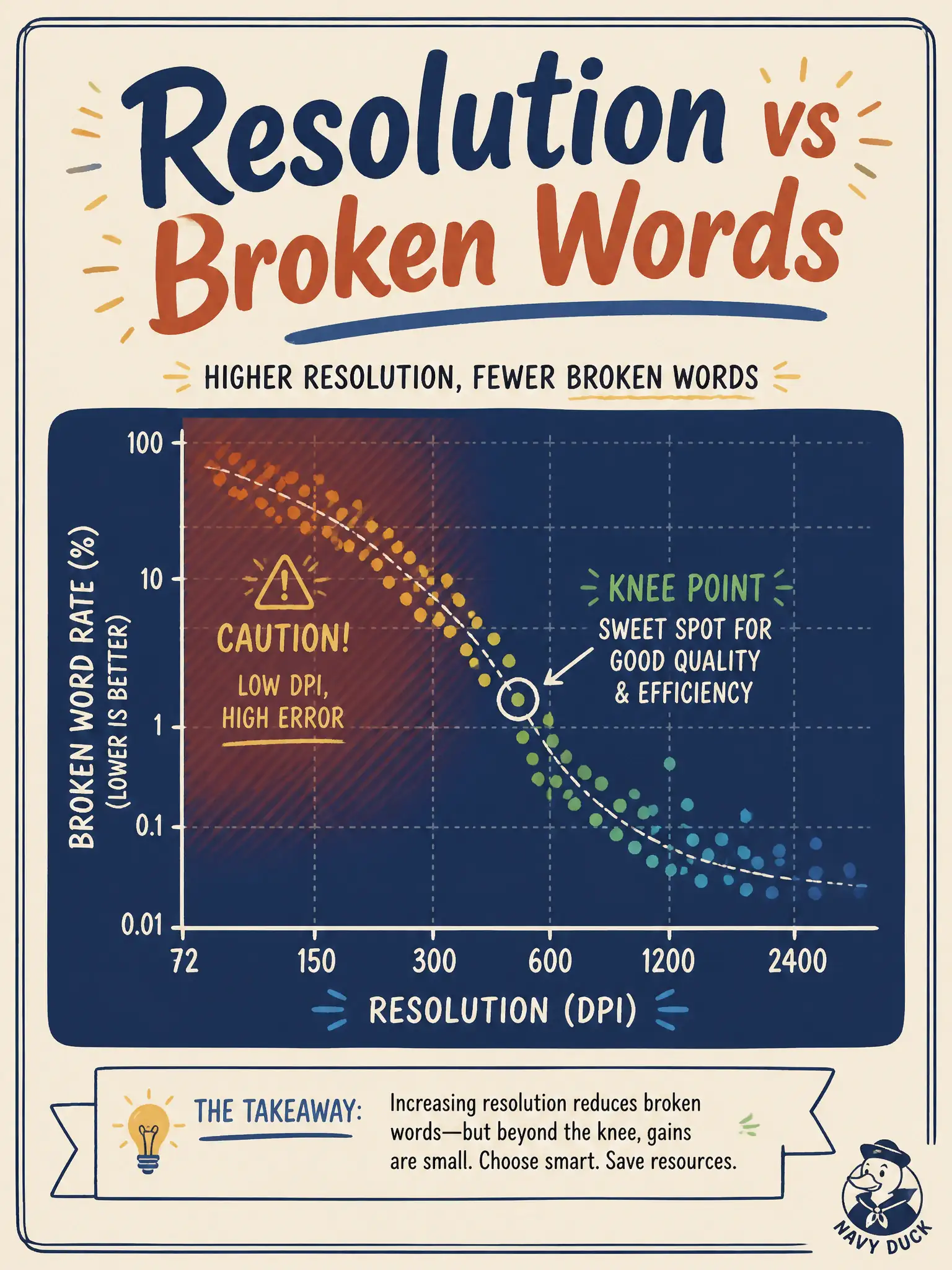
A camera-obscura civic booth scans old handbills at mixed dpi and types what comes back. A scatter of resolution versus broken-word rate shows a clear knee. What is that plot for?
Select an answer to reveal the explanation.
Short Explanation
When broken words fall off a cliff below a certain dpi, the scatter is picking winners for a later OCR pass—not asking you to invent tensors yet.
Full Explanation
A camera-obscura civic booth that scatters scan resolution against broken-word rate is doing Domain 5 document-quality analysis. The knee in the scatter shows where OCR errors climb as dpi falls. That plot decides which scans merit a cleaner PDF/OCR pass from quality versus error rate—not which pages become tensors today.
Claiming every scan must become a training tensor before any charting fails because exploratory quality charts precede training packaging; analysis can triage without tensorizing everything first. Redesigning fusion type from dpi alone fails because dpi-versus-error is a document-analysis finding, not a Domain 2 fusion architecture brief. Replacing OCR with a diffusion image generator for the handbills fails the task: the stem is about extracting and charting text quality, not synthesizing new images.
Exam caveat: resolution-versus-error scatters are triage tools for OCR passes. Do not confuse them with fusion redesign or generative substitution for document text.
Operational check: plot dpi against broken-word rate on a municipal sample; mark the knee; queue sub-knee pages for higher-quality rescans or OCR settings; only then feed cleaned text into later multimodal joins with civic handbill stills.