
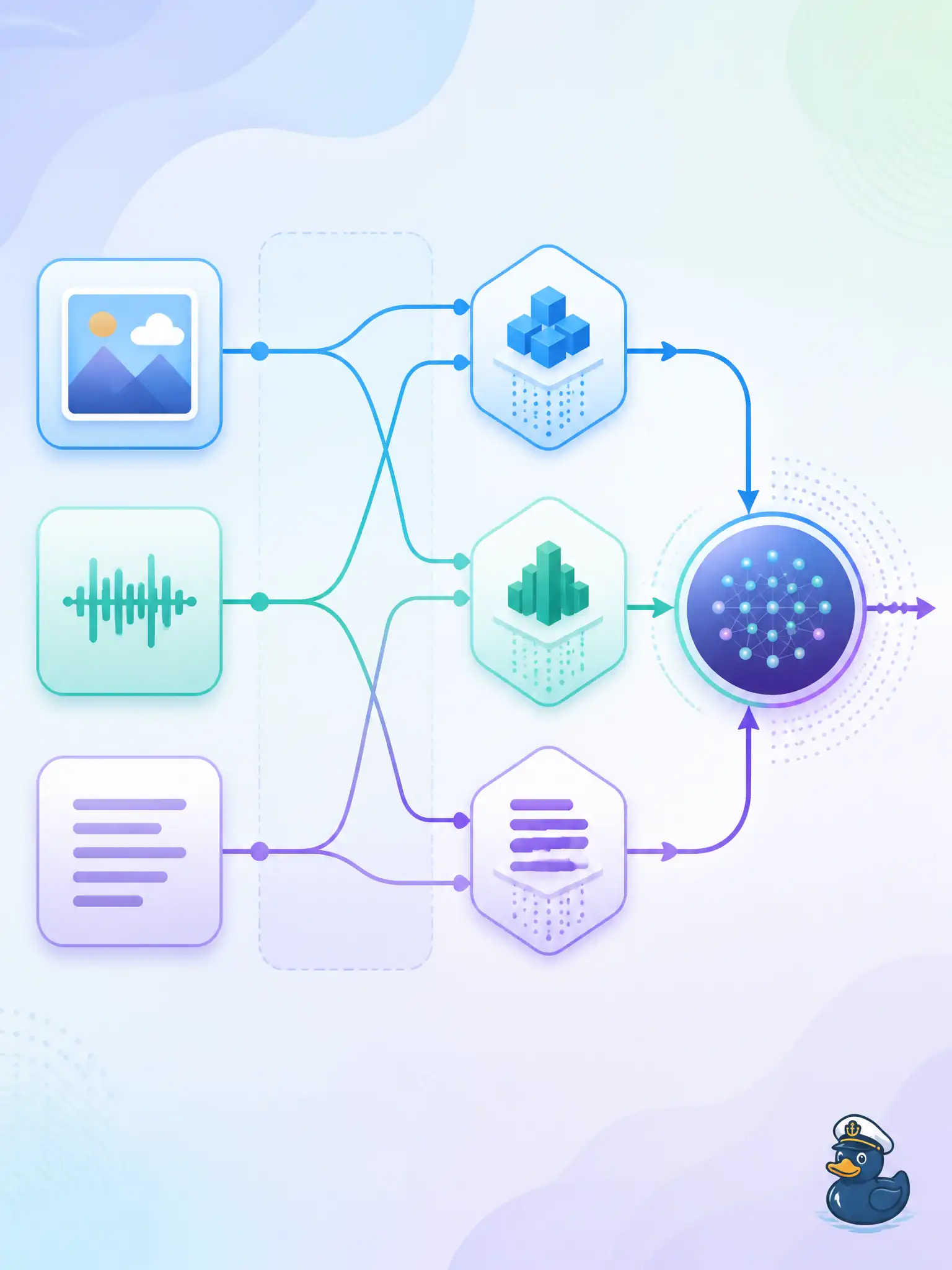
A ferry-ticket office has a still of a pass, a spoken request, and a typed note. Something must decide which encoder each stream enters and when those streams may meet. What is that routing of data types called?
Select an answer to reveal the explanation.
Short Explanation
Modality orchestration is the traffic cop for data types: which encoder gets the still, the speech, or the note, and when those lanes are allowed to merge.
Full Explanation
Something that decides which encoder a ferry-ticket still, spoken request, and typed note each enter—and when those streams may meet—is modality orchestration: scheduling and routing modalities through encoders and fusion. That routing is not identical to late fusion’s averaging of final labels. Agent orchestration is about sequencing acts/tools/roles, not defined as averaging pixel tensors. A context-window hyperparameter limits text capacity; it is not the routing role. Exam caveat: modality orchestration = route by data type through encoders/fusion. Operational check: draw a router that sends pass images, speech, and notes to the correct encoders and gates when fusion occurs; label that diagram modality orchestration. Implement a ferry-office router test that sends each modality to the correct encoder stub. Modality orchestration routes ferry stills, speech, and notes into encoders and fusion schedules. Implement ferry-office router tests that assert each of still, speech, and note enters the matching encoder stub and that fusion is scheduled explicitly. Close q128 with a municipal evidence note that records why the correct mechanism fits this civic multimodal scenario, why each of the three distractors fails by a distinct concept, and which operational check was observed in logs or dataset cards before promotion. File that note with the run packet so later maintenance cannot silently revive a rejected framing.