
An ice-house must choose a fusion type. Leadership either wants to “swap the stills model next month without touching text” or needs “the caption to point at a region.” How should those constraints map?
Select an answer to reveal the explanation.
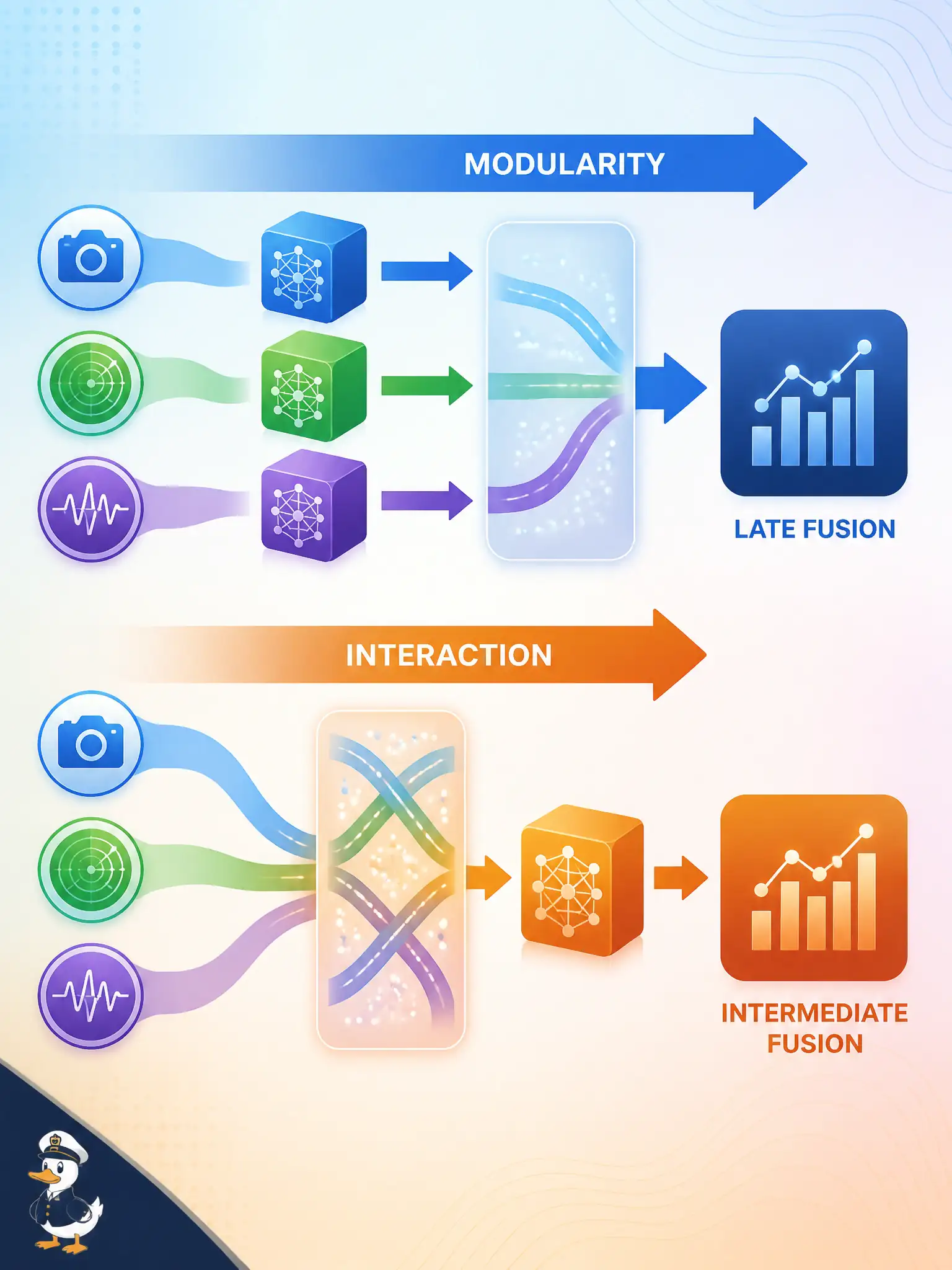
Short Explanation
Swap-without-touching points to late fusion’s modularity. Caption-must-point-at-a-region points to intermediate fusion’s mid-network talk. Match the constraint to the meeting place.
Full Explanation
Leadership constraints at an ice-house map cleanly: wanting to swap the stills model next month without touching text favors late fusion’s modularity; needing the caption to point at a region requires cross-modal interaction and maps to intermediate fusion. Both constraints do not force early raw concat only. Swapping the mapping—modularity to intermediate and interaction to late—reverses the fit. Deleting text solves neither modularity nor grounded captioning. Exam caveat: choose fusion type from modularity versus interaction needs. Operational check: write the civic constraint (“swap vision later” versus “ground caption to region”) and pick late versus intermediate fusion explicitly in the design note. Write the ice-house decision matrix: swap-modularity→late; grounded caption→intermediate. Map ice-house needs: modularity→late fusion; caption-to-region interaction→intermediate fusion. Capture the ice-house constraint matrix in the design ADR: swap-without-retrain maps to late fusion; grounded captioning maps to intermediate fusion. Write the modularity-versus-grounding choice into the ice-house ADR so late versus intermediate fusion is an explicit decision, not a slogan. Close q127 with a municipal evidence note that records why the correct mechanism fits this civic multimodal scenario, why each of the three distractors fails by a distinct concept, and which operational check was observed in logs or dataset cards before promotion. File that note with the run packet so later maintenance cannot silently revive a rejected framing.