
A windmill flour loft concatenates millions of pixel numbers with a twelve-token note, and the stills drown the sentence. What known early-fusion weakness does that illustrate?
Select an answer to reveal the explanation.
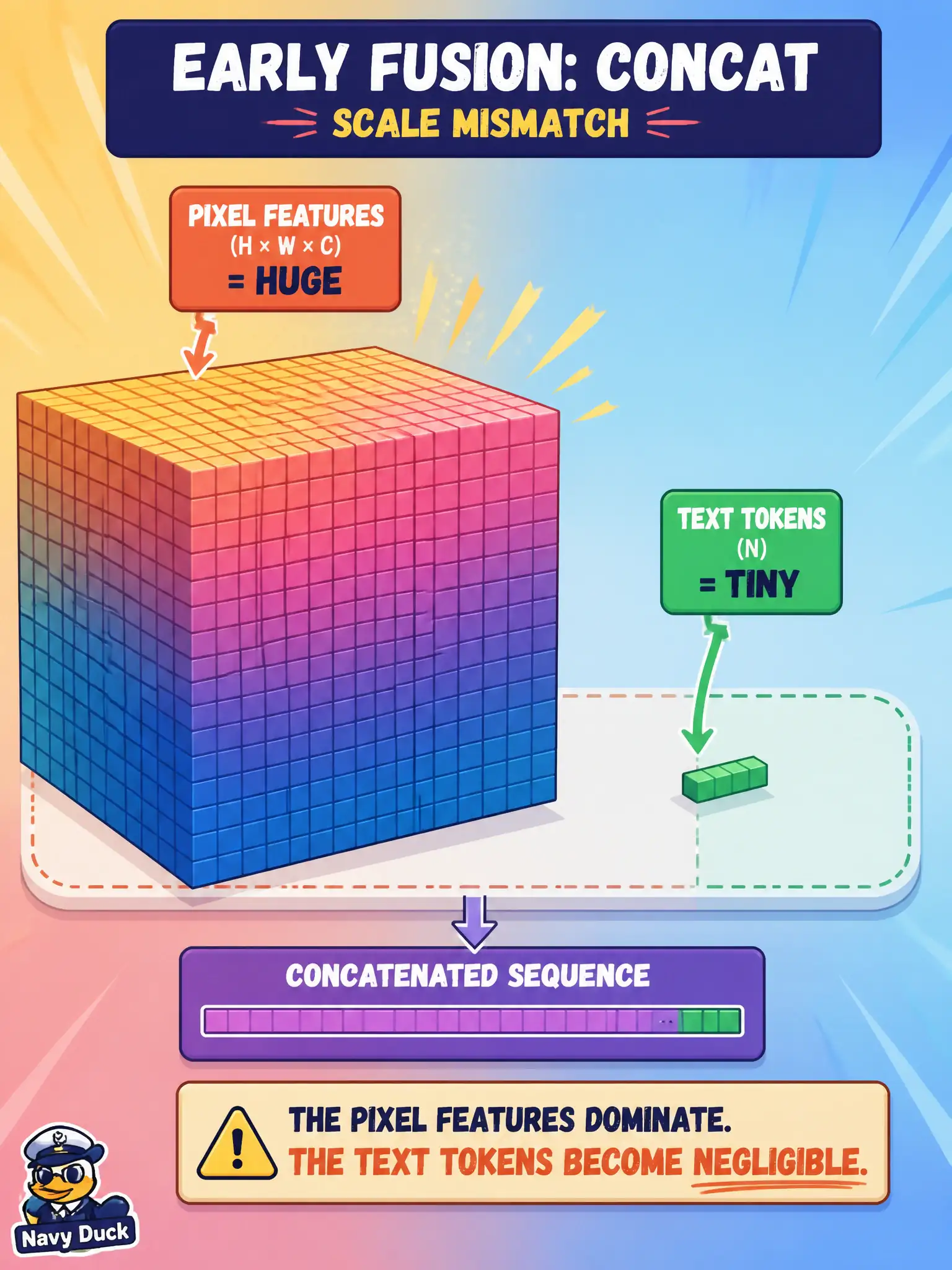
Short Explanation
Glue a mountain of pixels to a short note and the mountain wins. Early fusion’s classic weakness is raw scale mismatch before the sides are made comparable.
Full Explanation
When a windmill flour loft concatenates millions of pixel numbers with a twelve-token note and the stills drown the sentence, that illustrates a known early-fusion weakness: raw scale mismatch can let one modality dominate when representations are not yet comparable. Early fusion does not always delete text tokens by rule, so encoding and balancing still matter. Late fusion is not identical to early concat, and dominance can occur in early raw joins. Cross-attention can and does exist in multimodal systems; this failure mode does not abolish it. Exam caveat: early fusion risks dominance when scales differ drastically. Operational check: inspect feature magnitudes or learn projection/normalization before concat; if the civic note’s gradient vanishes beside pixel floods, stop treating raw concat as balanced fusion. Monitor text-token gradient share after pixel concat; rebalance if flour-loft notes are drowned. Raw early concat can let millions of pixels drown a twelve-token flour note; balance or project before joining. After flour-loft early concat, track the fraction of gradient energy on text tokens; if near zero, project or reweight before declaring balanced fusion. Close q121 with a municipal evidence note that records why the correct mechanism fits this civic multimodal scenario, why each of the three distractors fails by a distinct concept, and which operational check was observed in logs or dataset cards before promotion. File that note with the run packet so later maintenance cannot silently revive a rejected framing.