
An ink-making shop already trusts a stills grader and a smell-note grader and only needs a final mix. Updating one specialist must not retrain the other. Which fusion choice best fits?
Select an answer to reveal the explanation.
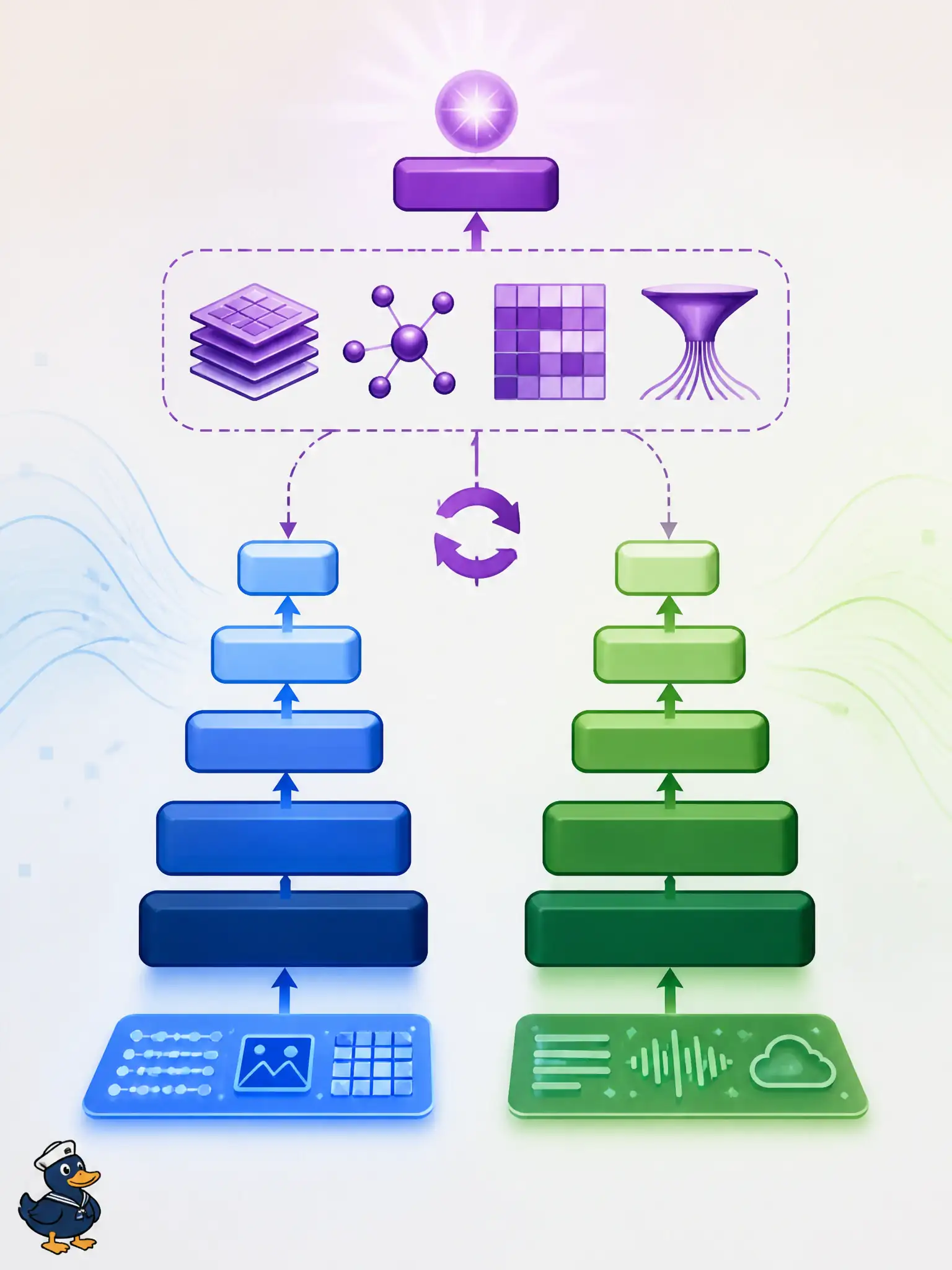
Short Explanation
When each specialist must stay replaceable, late fusion is the modular choice. Mix the finished grades at the end; do not weld the models together at the input.
Full Explanation
An ink-making shop that already trusts a stills grader and a smell-note grader and only needs a final mix—while requiring that updating one specialist must not retrain the other—fits late fusion, so independent modality models remain swappable. Early fusion of raw pixels and tokens into one inseparable stack couples training. Discarding both specialists to train only on filenames abandons useful models. Forcing intermediate cross-attention when no cross-modal talk is required adds coupling the shop explicitly wants to avoid. Exam caveat: modularity and independent updates map to late fusion. Operational check: swap or retrain one civic grader, keep the other frozen, and combine outputs at decision time without a joint raw-input retrain. Practice swapping one ink-shop specialist under late fusion to prove modularity before go-live. Choose late fusion when ink-shop specialists must stay independently swappable without joint raw retrain. Demonstrate ink-shop modularity by retraining one late-fusion specialist while freezing the other, then recomputing only the final mix. Close q122 with a municipal evidence note that records why the correct mechanism fits this civic multimodal scenario, why each of the three distractors fails by a distinct concept, and which operational check was observed in logs or dataset cards before promotion. File that note with the run packet so later maintenance cannot silently revive a rejected framing.