
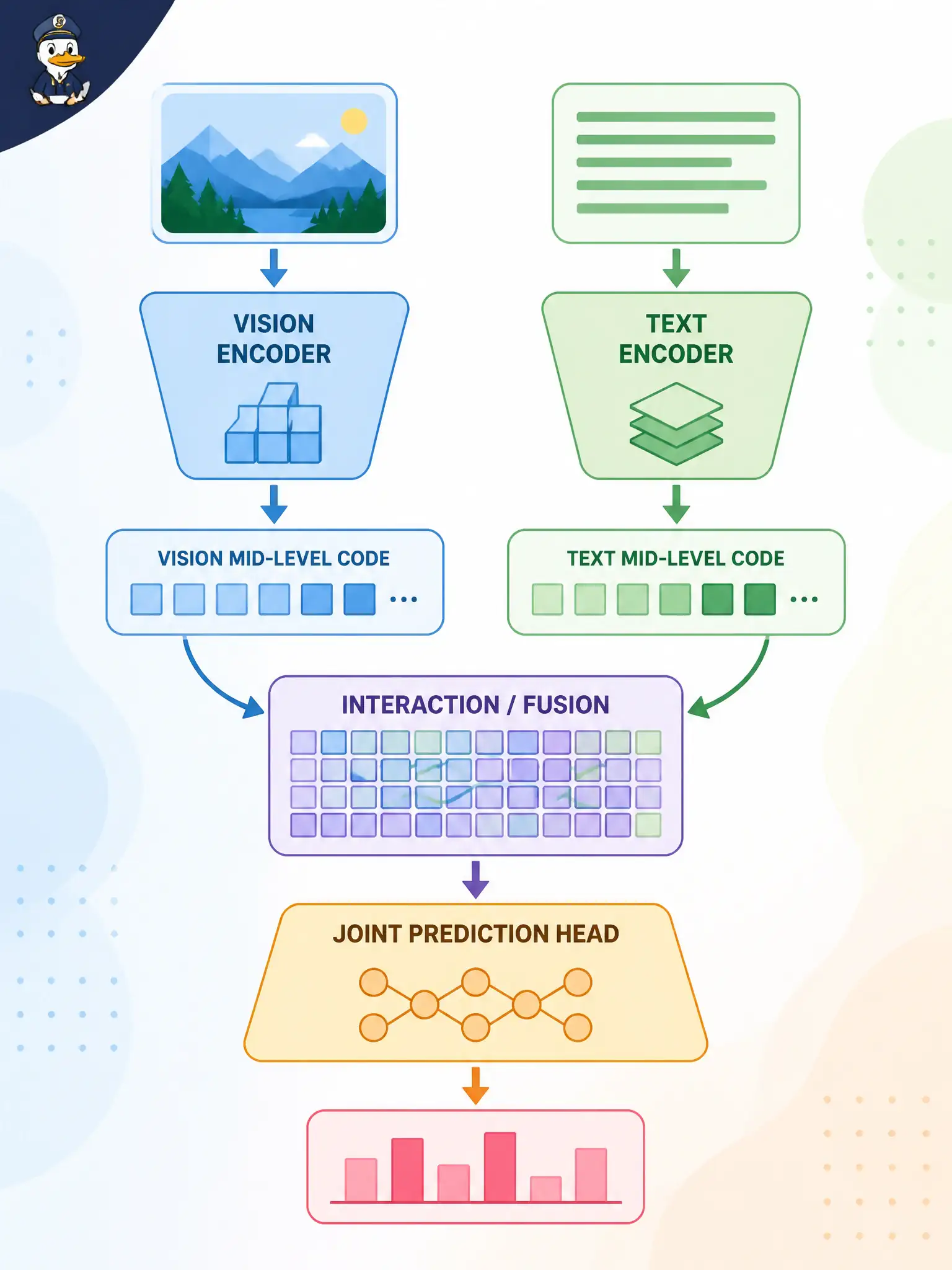
A felt-hat factory runs a vision encoder and a text encoder to mid-level codes, then lets those codes interact—often by cross-attention—before a joint head. Which fusion type is that?
Select an answer to reveal the explanation.
Short Explanation
Intermediate fusion is a workshop in the middle: each encoder builds a mid-level code, those codes talk (often via cross-attention), then a joint head decides.
Full Explanation
A felt-hat factory that runs a vision encoder and a text encoder to mid-level codes, then lets those codes interact—often by cross-attention—before a joint head is practicing intermediate fusion: learned representations merge before the final decision. Late fusion forbids interaction until after final labels. Early fusion at raw input without trained encoders is a different meeting point. A context-window setting is an LLM capacity limit, not a fusion-type definition. Exam caveat: intermediate = mid-level merge before the head. Operational check: confirm encoders produce codes, interaction layers mix them, then a joint head decides—document that as intermediate fusion for the civic hat line. Document mid-level cross-attention as intermediate fusion for the felt-hat joint head. Intermediate fusion merges mid-level vision/text codes—often via cross-attention—before the felt-hat joint head. Document felt-hat intermediate fusion as encoder codes → interaction (often cross-attention) → joint head, and refuse to call raw input concat by that name. Close q120 with a municipal evidence note that records why the correct mechanism fits this civic multimodal scenario, why each of the three distractors fails by a distinct concept, and which operational check was observed in logs or dataset cards before promotion. File that note with the run packet so later maintenance cannot silently revive a rejected framing.