
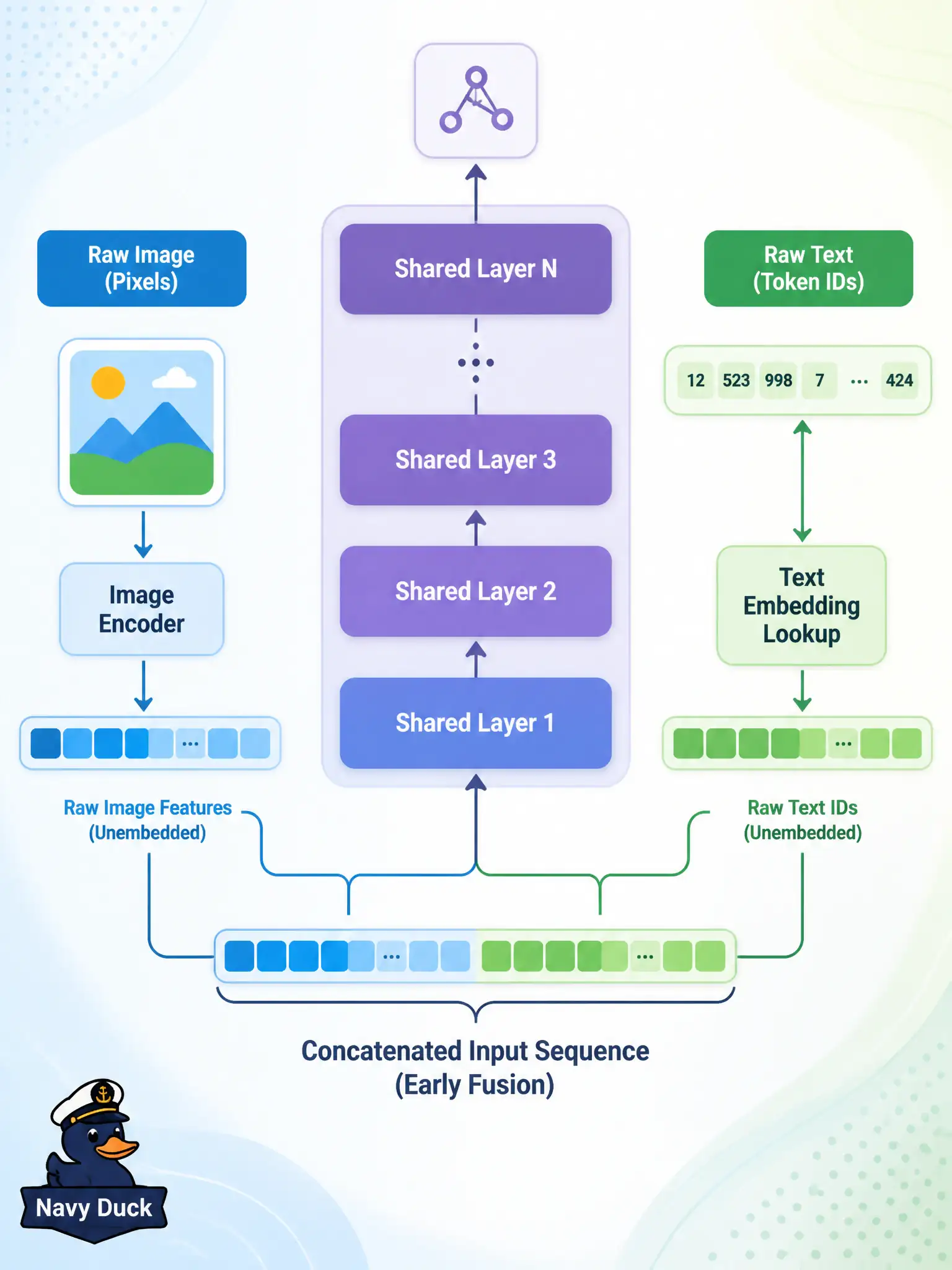
A bone-china studio concatenates raw pixel values next to raw token ids and feeds that concat into one stack. Which fusion type is that?
Select an answer to reveal the explanation.
Short Explanation
Early fusion is glue at the door: pixels and token ids meet before either side gets its own deep tower. That input-level join is the tell.
Full Explanation
Concatenating raw pixel values next to raw token ids and feeding that concat into one stack is early fusion: modalities meet at the input before each has its own deep specialist stack. Late fusion averages or combines decisions after separate specialists finish—opposite timing. Agent orchestration is a planner choosing next acts, not raw input concat. Intermediate fusion merges mid-level learned codes after separate encoders; raw concat at input is earlier than that pattern. Exam caveat: fusion type names when streams meet—early means at input. Operational check: on the bone-china studio diagram, if pixels and token ids are concatenated before deep towers, label early fusion; do not call it late fusion or agent planning. Label the bone-china raw concat path as early fusion in architecture diagrams reviewed by stewards. Early fusion meets at input concat of pixels and token ids—before deep specialist towers—on the bone-china stack. On bone-china diagrams, label raw pixel–token concat as early fusion and keep agent-planning boxes on a separate orchestration sheet. Close q118 with a municipal evidence note that records why the correct mechanism fits this civic multimodal scenario, why each of the three distractors fails by a distinct concept, and which operational check was observed in logs or dataset cards before promotion. File that note with the run packet so later maintenance cannot silently revive a rejected framing.