
A copper-roofing shop has JPEG stills of seams ready for a vision model. What readiness step makes those stills neural-network ready?
Select an answer to reveal the explanation.
Short Explanation
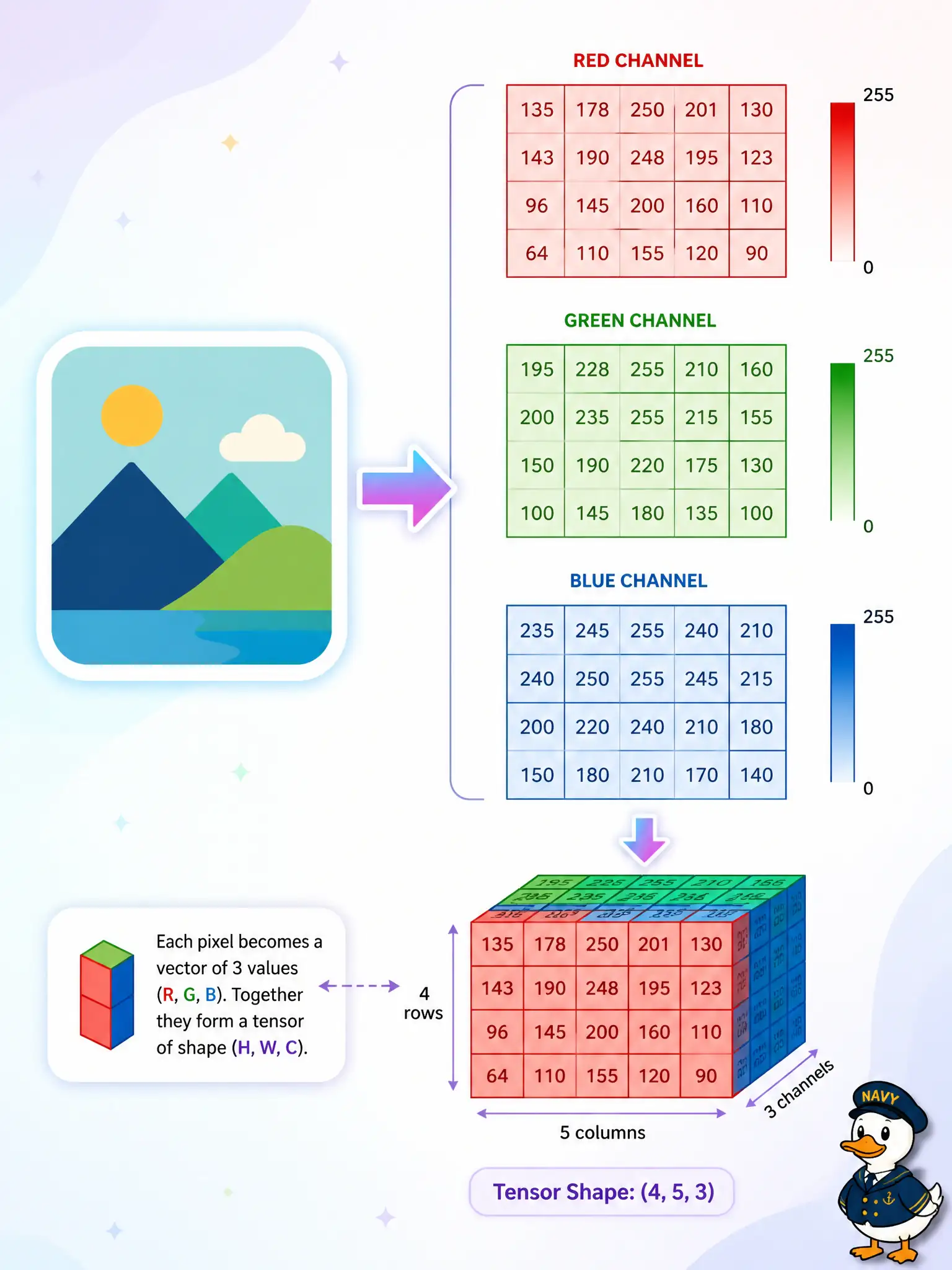
Networks eat numbers, not folders. Decode the JPEG into a grid of channel values (a tensor) and scale it sensibly before the model ever runs.
Full Explanation
JPEG stills of copper-roof seams become neural-network ready when converted into a numeric tensor—a regular grid of channel values at a sensible scale—not when left as unopened files on disk. Passing only the filename string skips decoding pixels. Keeping the JPEG compressed bitstream untouched assumes networks read file bytes directly, which they do not in standard vision pipelines. Replacing every still with a handwritten paragraph abandons the image modality the vision model needs. Exam caveat: readiness means decode-and-tensorize, not path strings or raw containers. Operational check: decode a civic seam JPEG, resize/normalize to the model’s expected tensor layout, and confirm shape (N, C, H, W or equivalent) before training or inference. Automate JPEG decode and normalize in the copper-roof dataloader; fail fast on path-only inputs. Decode copper-roof JPEGs to scaled channel tensors; path strings and compressed bitstreams are not vision inputs. Automate decode-and-normalize for seam JPEGs in the copper-roof dataloader, and reject path-only batches during civic CI checks before any training job is marked green. Close q108 with a municipal evidence note that records why the correct mechanism fits this civic multimodal scenario, why each of the three distractors fails by a distinct concept, and which operational check was observed in logs or dataset cards before promotion. File that note with the run packet so later maintenance cannot silently revive a rejected framing.