
A municipal pigeon-loft log runs for many pages. Staff ask why a modern language model uses a transformer instead of stepping through the log with a long recurrent chain. What is the architectural reason?
Select an answer to reveal the explanation.
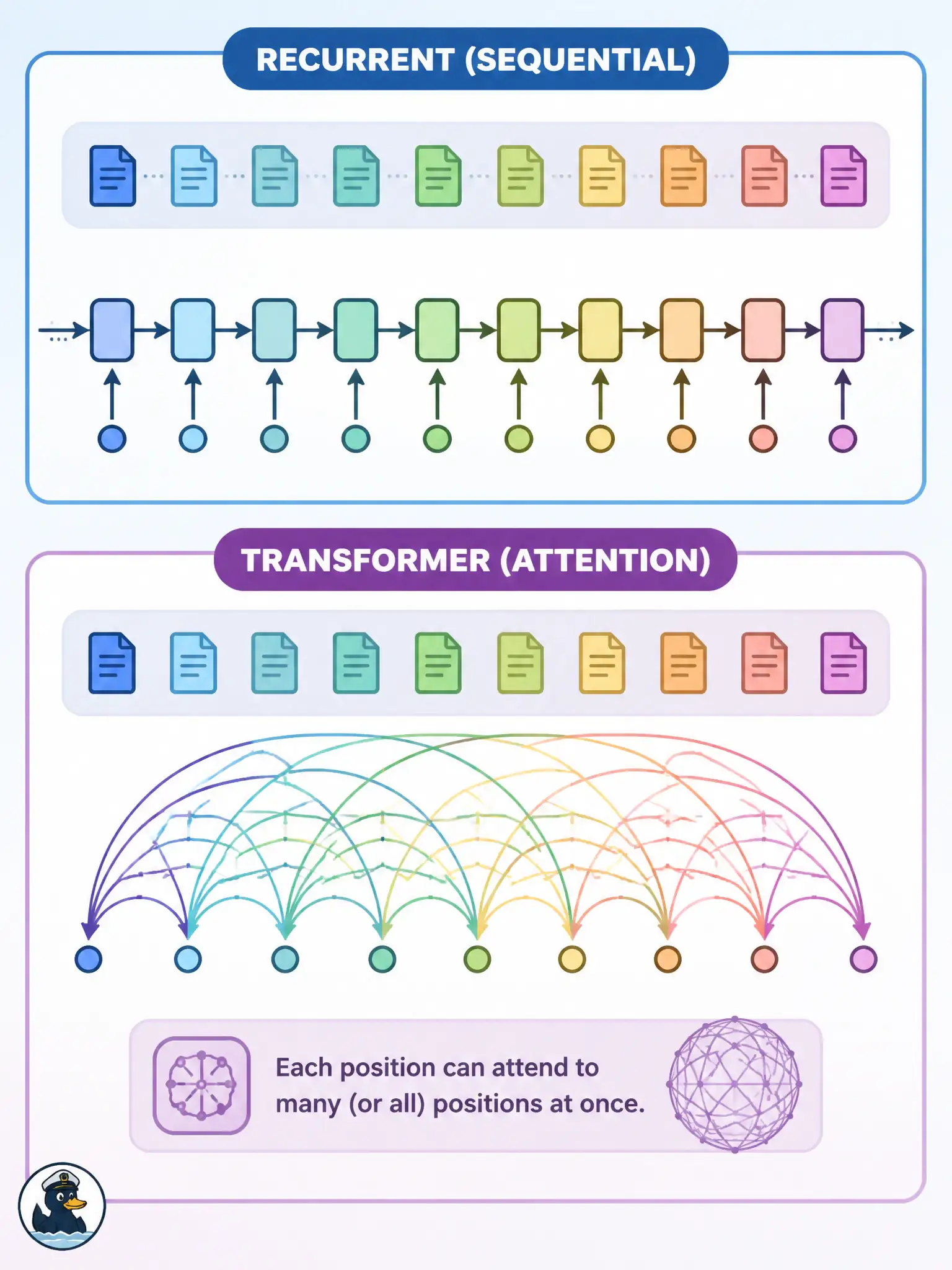
Short Explanation
Think of the loft log as a long hallway. A recurrent chain walks door to door; attention can glance across many doors at once. That whole-sequence view is why transformers became the LLM building block.
Full Explanation
A municipal pigeon-loft log that runs for many pages motivates transformers over long recurrent chains because self-attention can relate positions across the note in parallel instead of stepping token-by-token through a recurrent state. That parallel relational capacity is the architectural reason, not a claim that transformers store every page on a separate GPU. Transformers do not replace text with images to dodge sequence length. Recurrent chains do not already attend to every token at once; that is precisely what full self-attention adds relative to step-by-step recurrence. Exam caveat: contrast attention’s parallel pairwise relations with recurrence’s sequential state—not cluster topology. Operational check: on a long civic log excerpt, prefer a transformer language backbone and verify the model can use distant context without requiring a hand-rolled recurrent chain through each bird entry. Prefer transformer backbones for long loft logs and reserve recurrence for explicitly sequential control tasks if any. Self-attention relates distant loft-log positions in parallel; recurrence’s step-by-step state is the contrasting limitation. Prefer transformers for long municipal logs unless a sequential control need is explicit.