
A city flax-retting pond office needs three text jobs: a stack that only reads a note, a stack that only writes a new note, and a stack that reads one note then writes another. Which transformer layouts match those three roles?
Select an answer to reveal the explanation.
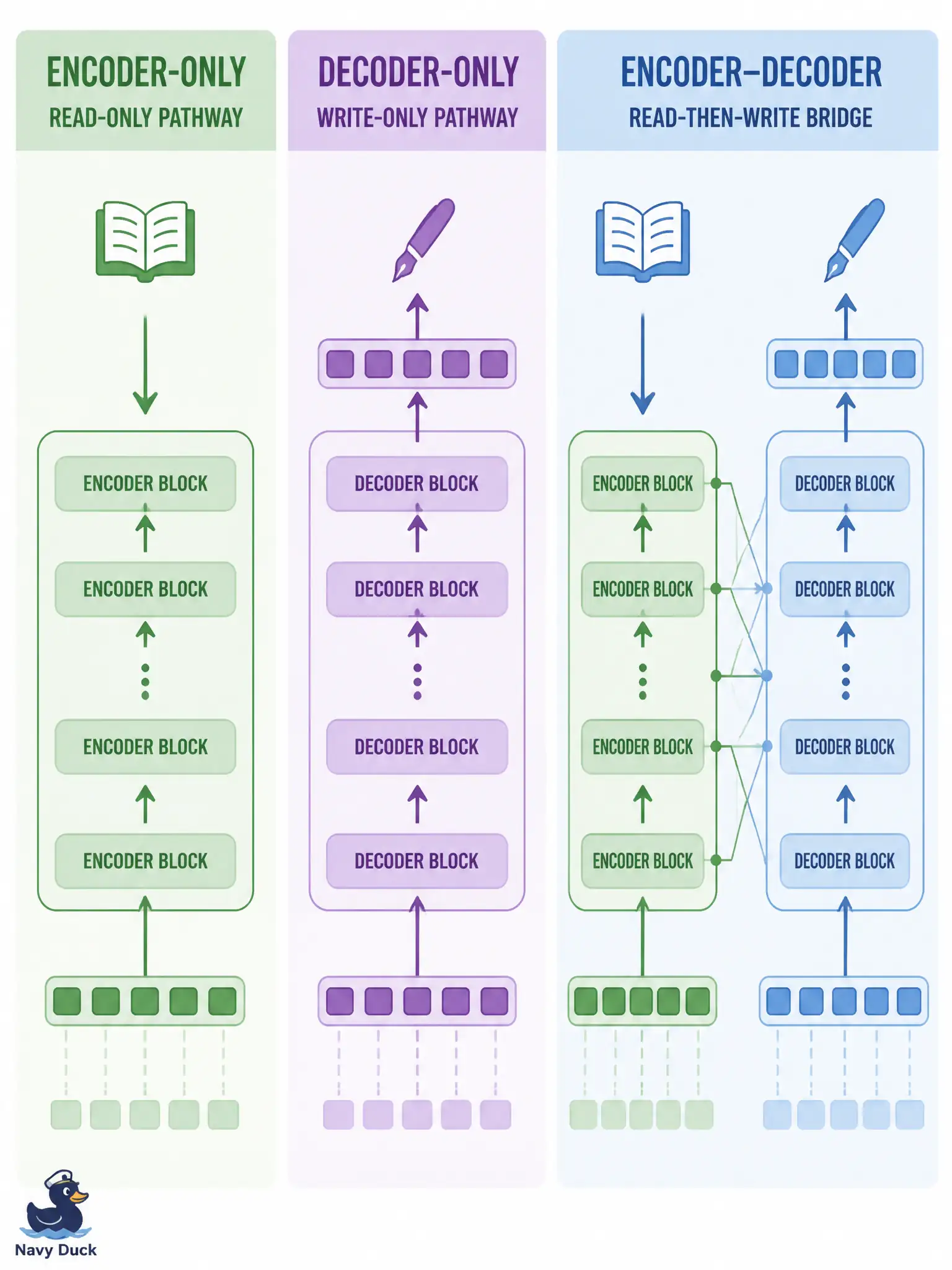
Short Explanation
Picture three desks at city hall. One only reads memos (encoder-only), one only drafts them (decoder-only), and one reads a memo then writes a reply (encoder–decoder). Match the job to the layout.
Full Explanation
For three text jobs at a city flax-retting pond office, transformer layouts map cleanly: encoder-only stacks suit reading/understanding a note; decoder-only stacks suit writing/generating a new note; encoder–decoder stacks suit read-then-write tasks that condition generation on an input note. Swapping decoder-only for reading and encoder-only for writing reverses those strengths. Claiming encoder–decoder is for reading only (and mixing the other roles) mislabels the conditional generation pattern. A single decoder-only stack does not automatically cover every read, write, and read-then-write design choice without considering layout. Exam caveat: associate items test layout-to-role matching, not proprietary SKUs. Operational check: for each civic text job, write whether the model must encode an input, generate freely, or generate conditioned on an encoded input—then pick encoder-only, decoder-only, or encoder–decoder accordingly. Map each flax-office ticket type to encoder-only, decoder-only, or encoder–decoder in a routing table. Encoder-only reads, decoder-only writes, encoder–decoder reads-then-writes—map flax-office jobs to those layouts explicitly. A single decoder-only stack is not an automatic answer for every ticket type.