
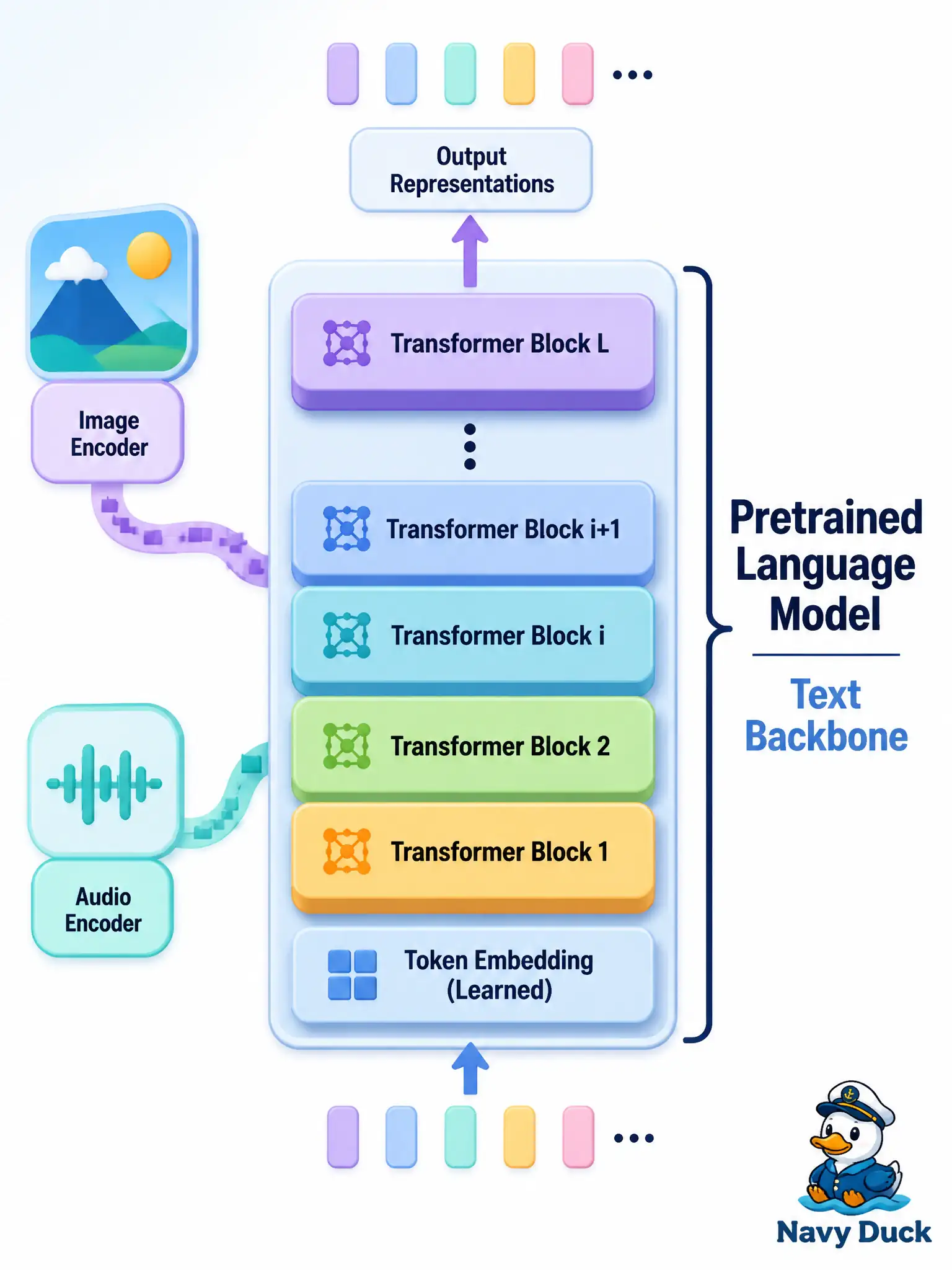
A wool-carding mill is offered “a modern pretrained language model” to sit beside fleece stills in a multimodal pilot. How should the team describe what that model is?
Select an answer to reveal the explanation.
Short Explanation
Call the pretrained LLM a ready-made tower of transformer blocks trained on text. It is the language backbone you park next to stills or speech—not a rule sheet, a vision camera, or a speech deploy chart.
Full Explanation
A “modern pretrained language model” offered beside fleece stills in a wool-carding mill multimodal pilot should be described as a stack of transformer blocks already trained on text, usable as the text building block of a multimodal system. It is not a single rule table mapping words to stills without a neural stack. It is not a Domain 4 container chart that deploys Riva ASR before any text model exists. It is not a vision-only encoder that already understands fleece photos without text training. Exam caveat: pretrained LLM means text transformer backbone; multimodal pairing still needs vision or speech encoders as appropriate. Operational check: document that the text tower is a pretrained transformer LLM, then specify how stills are encoded and fused—do not relabel a Helm chart or pure vision encoder as the language model. In the mill pilot charter, title the text component “pretrained transformer LLM” and list vision encoders separately. A pretrained language model is a text transformer stack usable beside fleece stills—not a rule table, Helm chart, or vision-only encoder. List vision encoders separately in the mill multimodal charter. Close q103 with a municipal evidence note that records why the correct mechanism fits this civic multimodal scenario, why each of the three distractors fails by a distinct concept, and which operational check was observed in logs or dataset cards before promotion. File that note with the run packet so later maintenance cannot silently revive a rejected framing.