
A map-archive wants the same transformer family that reads catalog sentences to also read a sheet by cutting it into patches. What architecture idea is that?
Select an answer to reveal the explanation.
Short Explanation
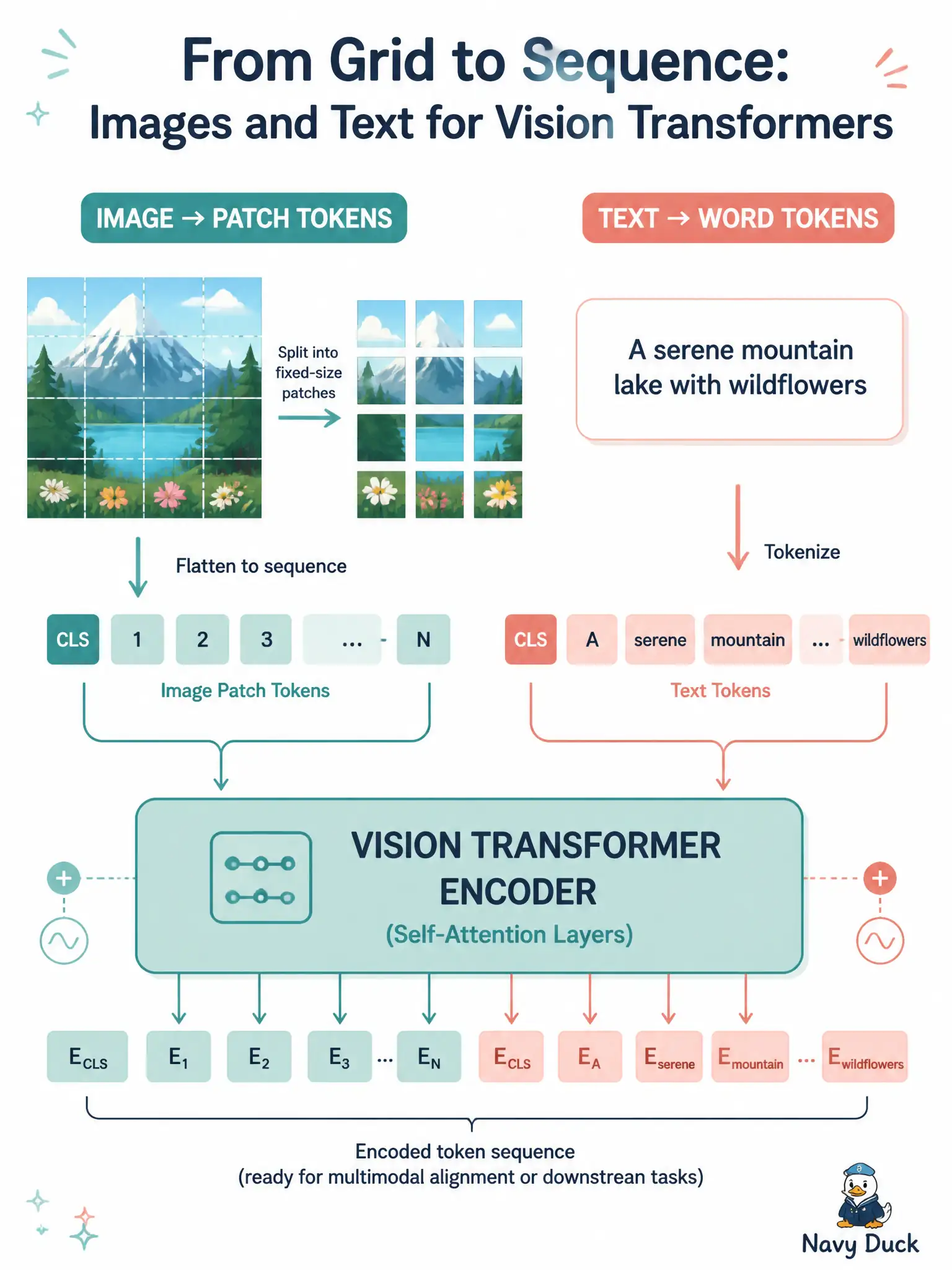
Slice the map into postage-stamp tiles and hand the stack to the same kind of reader that already handles word tokens. Image-as-tokens lets a transformer serve as a vision encoder. It is not a third-party model catalog quiz.
Full Explanation
Treating a map-archive sheet as a sequence of patch tokens lets the same transformer family that reads catalog sentences act as a vision encoder: the still is cut into patches, embedded, and attended over like tokens. Transformers are not limited to text tokens; vision transformers consume image patches. Converting images to WAV files is unnecessary and confuses modalities. Patching alone does not replace embeddings or attention; patches become the sequence those blocks process. Exam caveat: associate depth is the image-as-tokens idea, not a third-party model catalog quiz. Operational check: for a civic sheet, choose patch size, embed patches, and run a transformer encoder; verify attention operates over the patch sequence rather than demanding a WAV conversion. Record patch size and stride used on archive sheets so vision-token experiments remain reproducible. Patchify the map sheet, embed patches, attend; that is the vision-transformer path, not a WAV conversion requirement. Log patch size and stride for reproducibility on archive sheets. Close q094 with a municipal evidence note that records why the correct mechanism fits this civic multimodal scenario, why each of the three distractors fails by a distinct concept, and which operational check was observed in logs or dataset cards before promotion. File that note with the run packet so later maintenance cannot silently revive a rejected framing.