
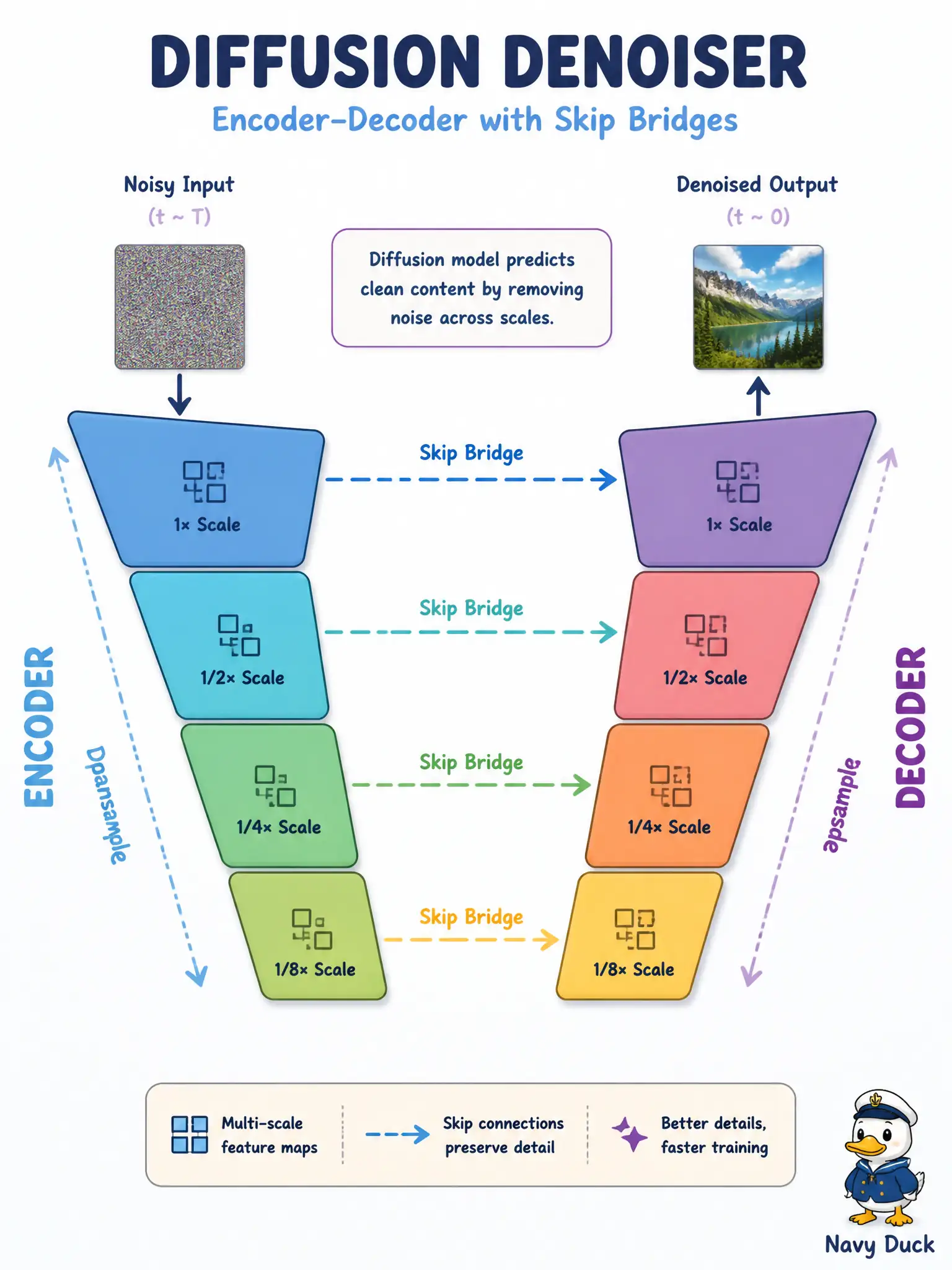
A hop-kiln diagram of a diffusion model shows a shrinking path, a growing path, and bridges between matching sizes. What common denoiser backbone is that?
Select an answer to reveal the explanation.
Short Explanation
Shrink, expand, and bridge the matching floors—that shape is the usual denoiser backbone. Encoder–decoder with skips is the common reading of that diagram. It is not a newly invented product label.
Full Explanation
A hop-kiln diagram of a diffusion denoiser that shows a shrinking path, a growing path, and bridges between matching sizes is the common encoder–decoder backbone with skip paths linking matching scales (a U-Net-style reading). The contracting path builds multi-scale features; the expanding path reconstructs; skips reconnect same-resolution stages so fine detail is not lost. A single fully connected cell with no multi-scale paths does not match that diagram. Inventing a new NVIDIA product name for branding is not architecture reading. A speech-only Riva stage that never processes image features is the wrong modality stack for an image denoiser backbone. Exam caveat: name the encoder–decoder-with-skips pattern; do not invent product labels. Operational check: on the kiln diagram, point to downsample, upsample, and skip bridges at matching scales before discussing sampling schedules. Annotate the kiln U-Net sketch with matching-scale skip arrows so apprentices do not confuse it with a flat MLP. Read shrinking, expanding, and skip bridges as encoder–decoder scales for the denoiser—not as a new product name or Riva speech stage. Matching-scale skips are the bridge detail associates should point to.