
An organ-pipe loft can wire every layer strictly after the last, or allow a parallel / skip graph so air and scale notes meet later. What contrast is that?
Select an answer to reveal the explanation.
Short Explanation
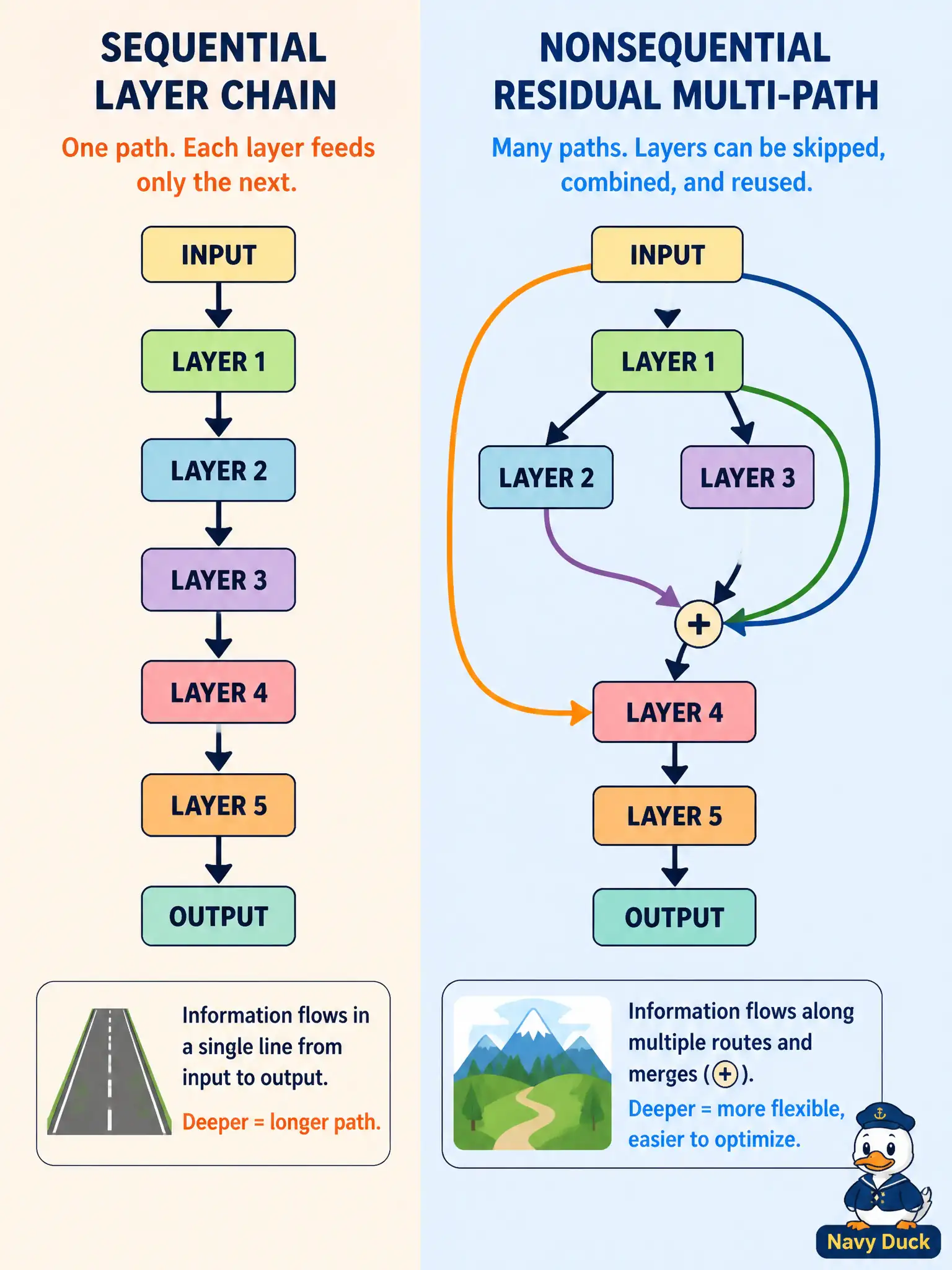
One loft wires pipes in a single marching line; another lets side ducts rejoin downstream. Sequential stacks are that marching line. Residual or multi-path graphs are the rejoining ducts.
Full Explanation
An organ-pipe loft can wire every layer strictly after the last—a purely sequential stack—or allow parallel or skip paths so air and scale notes meet later—a nonsequential residual or multi-path design. Sequential stacks are the marching line; residual or multi-path graphs are the rejoining ducts. Both designs do not forbid every path except a spreadsheet row. It is false that sequential stacks cannot process notes or that only skip graphs can process stills. Nonsequential designs do not delete attention or allow only random weight freezes by definition. Exam caveat: the contrast is sequential versus residual/multi-path connectivity, not modality bans. Operational check: draw the civic loft’s block graph; if side paths rejoin downstream, label it residual/multi-path rather than a pure sequential stack. If side ducts rejoin in the organ-pipe graph, refuse to file the design as a purely sequential stack. Sequential stacks march; residual/multi-path graphs rejoin—label the organ-pipe wiring by connectivity, not by modality myths. Side ducts that merge downstream are nonsequential by definition. Close q095 with a municipal evidence note that records why the correct mechanism fits this civic multimodal scenario, why each of the three distractors fails by a distinct concept, and which operational check was observed in logs or dataset cards before promotion. File that note with the run packet so later maintenance cannot silently revive a rejected framing.